A white coronet stands on a red field, its rim broken into a ring of even spikes, each tipped with a perfect bead of milk about to detach. Below it a thin disc of liquid sits in a shallow saucer of its own making; above, a single round droplet hovers, the next event already in the air. The colour is not naturalistic but tuned for legibility: a deep crimson ground that isolates the white form and lets the geometry read at a glance. This is less a still life than a diagram, an instant lifted from a process the eye can never hold.
What the picture really records is an instrument and its limit. A burst of electronic flash, measured in millionths of a second, has frozen a collision too fast for any shutter, converting a fluid accident into a repeatable, almost mechanical symmetry. The image belongs to a tradition in which the camera is bent toward science rather than observation, extending sight instead of describing it. Made by an engineer, it sits between laboratory document and aesthetic object, and its enduring force lies in that ambiguity: a measurement that turned out to be beautiful.
Seriality is built into the work; the splash exists only as one frame in countless near-identical trials, the chosen specimen from an industrial logic of repetition. That the picture now hangs as an autonomous photograph, held by the Museum of Modern Art and the MIT Museum among others, marks the moment the technical image entered the canon. A vintage print carries that double history in its surface, the physical trace of a discovery and of the medium quietly examining its own reach.
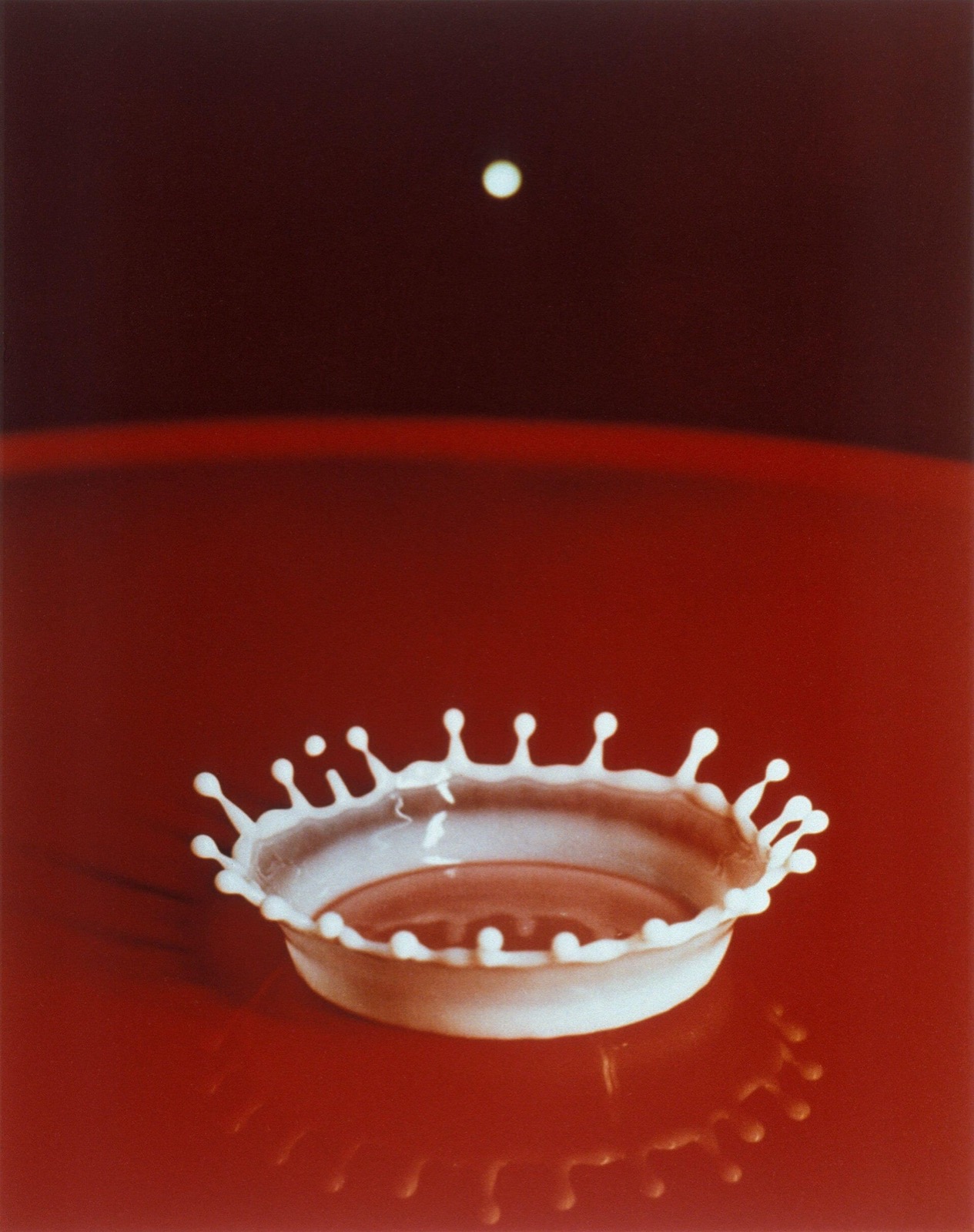

A white coronet stands on a red field, its rim broken into a ring of even spikes, each tipped with a perfect bead of milk about to detach. Below it a thin disc of liquid sits in a shallow saucer of its own making; above, a single round droplet hovers, the next event already in the air. The colour is not naturalistic but tuned for legibility: a deep crimson ground that isolates the white form and lets the geometry read at a glance. This is less a still life than a diagram, an instant lifted from a process the eye can never hold.
What the picture really records is an instrument and its limit. A burst of electronic flash, measured in millionths of a second, has frozen a collision too fast for any shutter, converting a fluid accident into a repeatable, almost mechanical symmetry. The image belongs to a tradition in which the camera is bent toward science rather than observation, extending sight instead of describing it. Made by an engineer, it sits between laboratory document and aesthetic object, and its enduring force lies in that ambiguity: a measurement that turned out to be beautiful.
Seriality is built into the work; the splash exists only as one frame in countless near-identical trials, the chosen specimen from an industrial logic of repetition. That the picture now hangs as an autonomous photograph, held by the Museum of Modern Art and the MIT Museum among others, marks the moment the technical image entered the canon. A vintage print carries that double history in its surface, the physical trace of a discovery and of the medium quietly examining its own reach.