One vaulter becomes a sequence. A single sheet of film holds perhaps a dozen David Torks, each a discrete pulse of the strobe, climbing a diagonal staircase from the lower left of the frame to the upper right, where the last body clears the crossbar feet-first against the black ceiling of the arena. The picture is not a moment but an interval rendered visible, time sliced into even units and laid down side by side. What the eye cannot hold, the apparatus measures. The red and white banding of the crossbar and the orange row of overhead lamps are the only insistent colour in an otherwise tarry darkness; everything legible has been earned by the flash.
This is photography behaving as instrument rather than as witness. The exposures are equidistant, which converts the athlete's effort into something closer to a graph than a portrait — the bent pole, the tucked knees, the inversion over the bar all readable as stages in a single argument about force and ascent. Below, a referee in a checked shirt and a clutch of spectators occupy ordinary continuous time, anchoring the supernatural overhead. The frame quietly stages the meeting of two clocks: the human one of the crowd and the millisecond one of the engineer's lamp.
Made by the MIT physicist who taught the camera to outpace the eye, the image belongs as much to laboratory history as to sport. A vintage chromogenic print such as this — the medium examining its capacity to dissect motion — carries the authority of work now held by MoMA, the Met and the MIT Museum: a document of looking made over into knowledge.
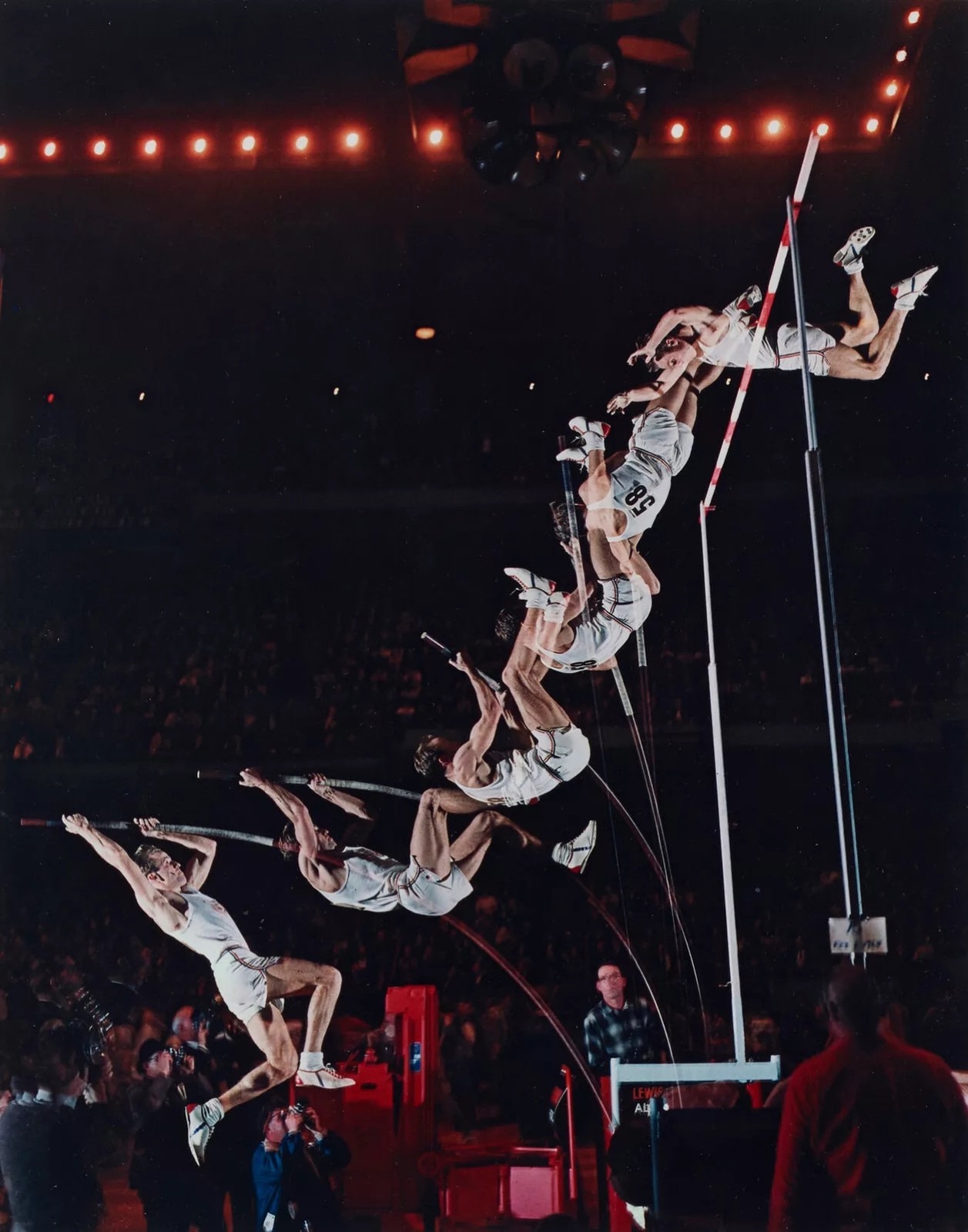
One vaulter becomes a sequence. A single sheet of film holds perhaps a dozen David Torks, each a discrete pulse of the strobe, climbing a diagonal staircase from the lower left of the frame to the upper right, where the last body clears the crossbar feet-first against the black ceiling of the arena. The picture is not a moment but an interval rendered visible, time sliced into even units and laid down side by side. What the eye cannot hold, the apparatus measures. The red and white banding of the crossbar and the orange row of overhead lamps are the only insistent colour in an otherwise tarry darkness; everything legible has been earned by the flash.
This is photography behaving as instrument rather than as witness. The exposures are equidistant, which converts the athlete's effort into something closer to a graph than a portrait — the bent pole, the tucked knees, the inversion over the bar all readable as stages in a single argument about force and ascent. Below, a referee in a checked shirt and a clutch of spectators occupy ordinary continuous time, anchoring the supernatural overhead. The frame quietly stages the meeting of two clocks: the human one of the crowd and the millisecond one of the engineer's lamp.
Made by the MIT physicist who taught the camera to outpace the eye, the image belongs as much to laboratory history as to sport. A vintage chromogenic print such as this — the medium examining its capacity to dissect motion — carries the authority of work now held by MoMA, the Met and the MIT Museum: a document of looking made over into knowledge.