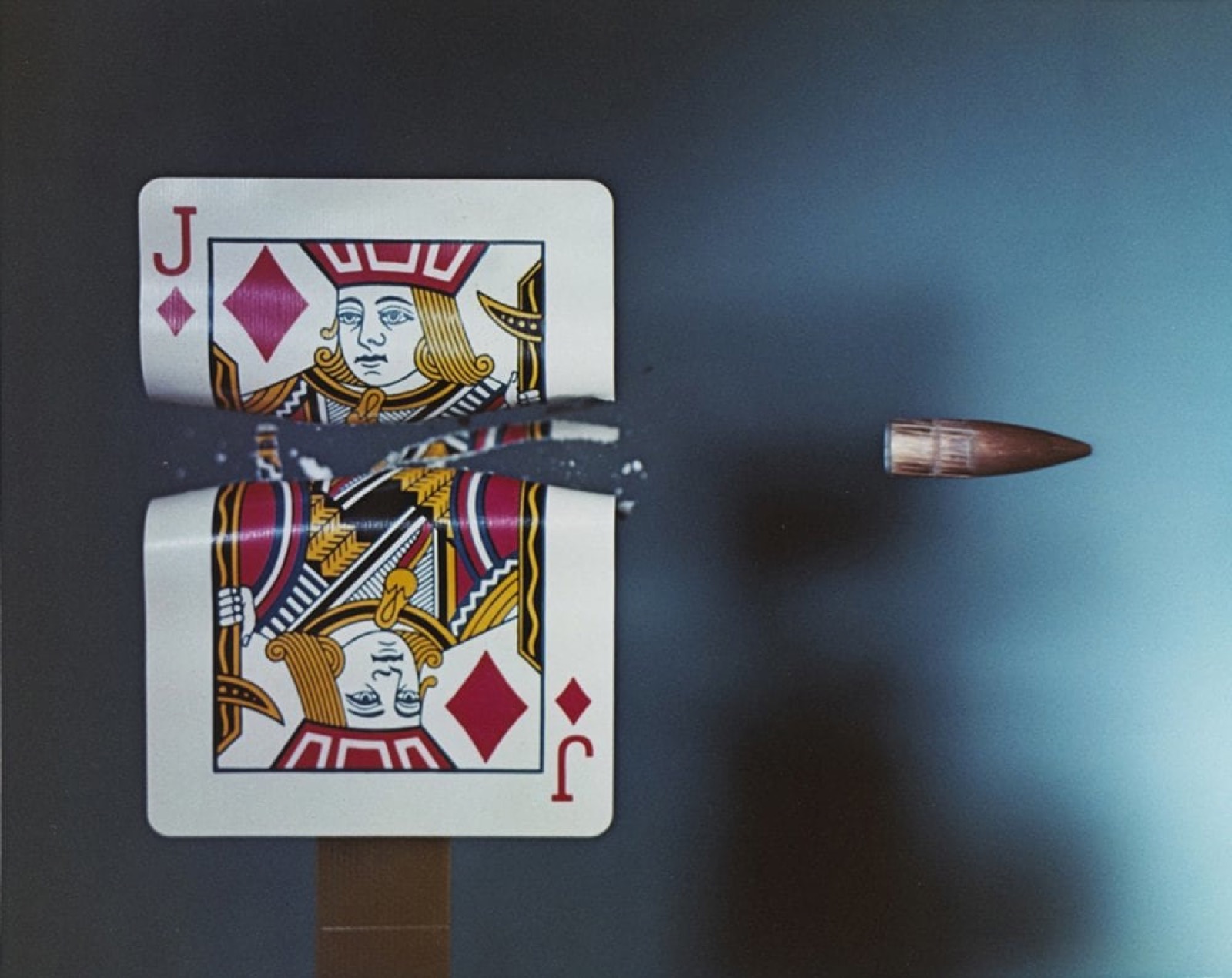
The picture divides cleanly into two unequal events. On the left, filling its half of the frame, stands the Jack of Diamonds, doubled head to head in red and gold, the white card tilted slightly toward us and held upright on a slim wooden stake. On the right, against a field that dissolves from slate gray to a cool window-light blue, the copper bullet hangs alone, nose forward, a small bright spindle caught in mid-air. Between them runs the only line that matters: a ragged horizontal tear opening across the card's waist, fanned with splinters and a faint mist of debris.
What the eye accepts as a still arrangement is in fact an interval of time too brief to see, made visible by a flash measured in millionths of a second. The card has already been cut; the bullet has already passed and is leaving. The shadow on the wall, soft and enormous, doubles the card without explaining it, so that the object and its blur of consequence share one plane. Everything is described with the clarity of a diagram, yet nothing is diagrammatic—the torn paper curls with the particular violence of this single shot.
That an engineer's instrument should yield a composition this elegant is the lasting surprise of this body of work, long since gathered into the permanent collections of the Modern and the Met. The strobe was built to measure, not to please, and here it does both. A vintage print holds the saturated reds and the cold blue exactly as the laboratory fixed them, an original record of a moment the human eye was never meant to witness, and now keeps.
The picture divides cleanly into two unequal events. On the left, filling its half of the frame, stands the Jack of Diamonds, doubled head to head in red and gold, the white card tilted slightly toward us and held upright on a slim wooden stake. On the right, against a field that dissolves from slate gray to a cool window-light blue, the copper bullet hangs alone, nose forward, a small bright spindle caught in mid-air. Between them runs the only line that matters: a ragged horizontal tear opening across the card's waist, fanned with splinters and a faint mist of debris.
What the eye accepts as a still arrangement is in fact an interval of time too brief to see, made visible by a flash measured in millionths of a second. The card has already been cut; the bullet has already passed and is leaving. The shadow on the wall, soft and enormous, doubles the card without explaining it, so that the object and its blur of consequence share one plane. Everything is described with the clarity of a diagram, yet nothing is diagrammatic—the torn paper curls with the particular violence of this single shot.
That an engineer's instrument should yield a composition this elegant is the lasting surprise of this body of work, long since gathered into the permanent collections of the Modern and the Met. The strobe was built to measure, not to please, and here it does both. A vintage print holds the saturated reds and the cold blue exactly as the laboratory fixed them, an original record of a moment the human eye was never meant to witness, and now keeps.