A red-and-gold apple sits skewered on a spent brass cartridge, which in turn rises from a plain block of varnished wood, the whole modest apparatus set against a flat blue ground. This is a laboratory, not a still life, though the fruit's waxy blush and the painterly gradient behind it borrow shamelessly from the genre. The picture exists only because a flash fired for a millionth of a second, far faster than any shutter, arresting what no human eye could ever hold: a bullet, blunt and tumbling, has already torn clean through, and we see it suspended mid-air to the left, trailing its own soft grey shadow on the wall.
What the eye is given is symmetry made of violence. From both flanks of the apple erupt twin plumes of pulped white flesh, feathered like spray or smoke, while the skin splits into curling red petals at entry and exit alike. The fruit is doomed and does not yet know it; for this frozen instant it still looks whole at the core, its stippled stem-well intact. The image is at once a measurement and a small astonishment, an engineer's diagram that happens to be beautiful, proof of the camera's old promise to make the invisible appear.
The maker was an electrical engineer who turned the strobe into an instrument of wonder, and his ballistic studies entered the museum precisely because they collapse the distance between science and the sublime. A vintage dye print of this picture carries that double life in its very surface, the chromogenic blues and reds now part of its history. Held by MoMA and the Met, such prints remain among the most quietly radical pictures the medium has produced.
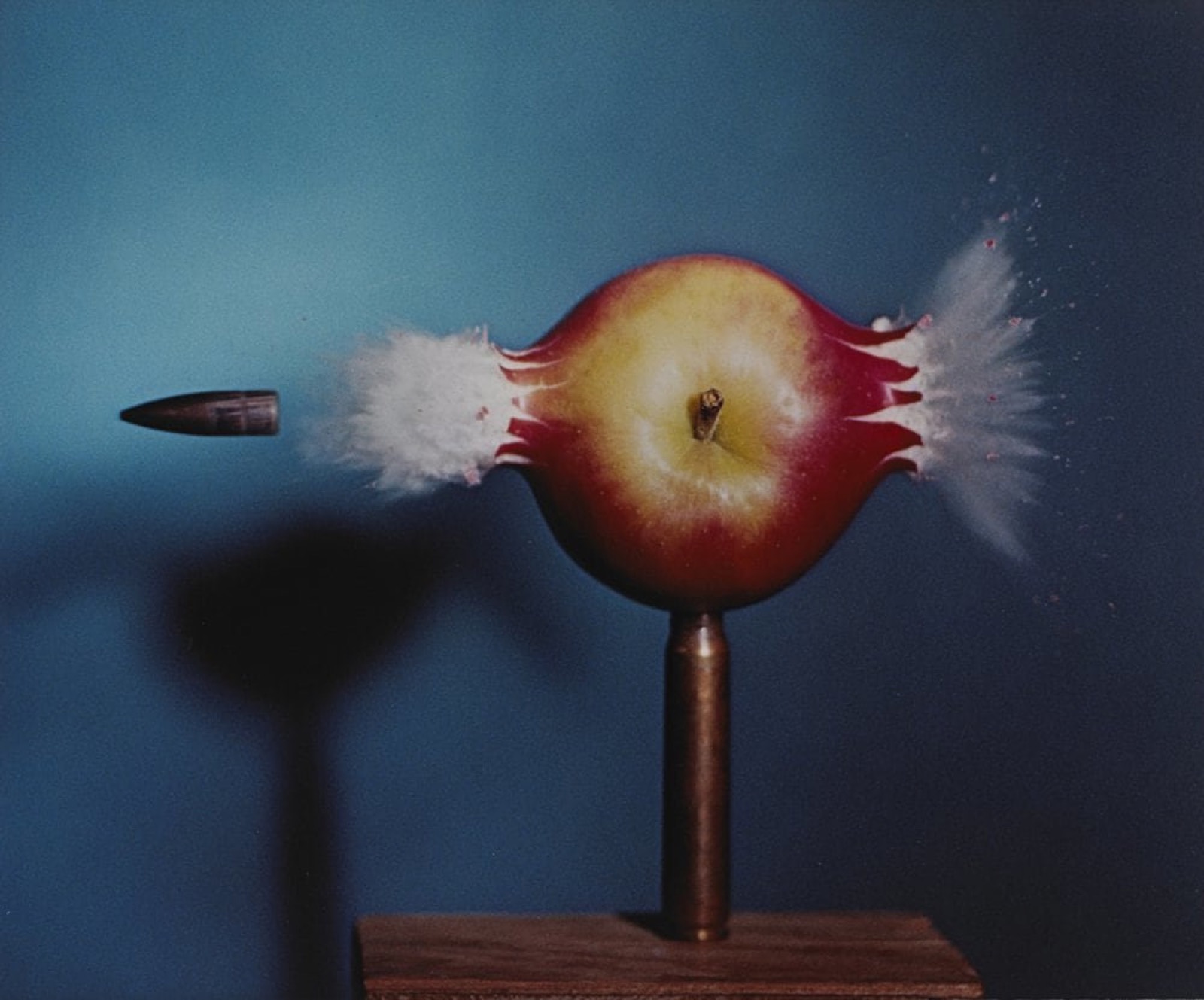
A red-and-gold apple sits skewered on a spent brass cartridge, which in turn rises from a plain block of varnished wood, the whole modest apparatus set against a flat blue ground. This is a laboratory, not a still life, though the fruit's waxy blush and the painterly gradient behind it borrow shamelessly from the genre. The picture exists only because a flash fired for a millionth of a second, far faster than any shutter, arresting what no human eye could ever hold: a bullet, blunt and tumbling, has already torn clean through, and we see it suspended mid-air to the left, trailing its own soft grey shadow on the wall.
What the eye is given is symmetry made of violence. From both flanks of the apple erupt twin plumes of pulped white flesh, feathered like spray or smoke, while the skin splits into curling red petals at entry and exit alike. The fruit is doomed and does not yet know it; for this frozen instant it still looks whole at the core, its stippled stem-well intact. The image is at once a measurement and a small astonishment, an engineer's diagram that happens to be beautiful, proof of the camera's old promise to make the invisible appear.
The maker was an electrical engineer who turned the strobe into an instrument of wonder, and his ballistic studies entered the museum precisely because they collapse the distance between science and the sublime. A vintage dye print of this picture carries that double life in its very surface, the chromogenic blues and reds now part of its history. Held by MoMA and the Met, such prints remain among the most quietly radical pictures the medium has produced.