A dark ovoid enters from the left, its blunt nose already past contact, and meets a slender vertical rod that bisects the frame top to bottom. From that collision a cloud of black particles erupts and fans rightward, dense where the rod is shattered, thinning to a fine spray that drifts off the edge. Faint diagonal lines, the shock waves the title names, rule across the pale field, while a single wavy trail of disturbed air curls upward through the lower half. Against the featureless white ground, every fragment reads as a discrete event.
What this picture records cannot be witnessed by the eye; it exists only because a flash of a millionth of a second was made to do the seeing. The frame belongs to a body of work in which an MIT engineer turned a laboratory instrument into one of revelation, extending a lineage that runs through Muybridge and Marey to photography's founding promise of fixing what moves. Yet this is no diagram. The composition is balanced with a draftsman's care: the heavy bullet anchoring the left, the splatter weighted right, the vertical rod holding the center like a plumb line.
By 1965 the stroboscopic method was decades mature, and the artist composed with the assurance of a master who had long since proved it. Held now by the Museum of Modern Art, the Metropolitan, and the MIT Museum, these images occupy a singular place in the American canon, where engineering and art prove indivisible. A vintage print preserves the silver tonality and velvet blacks in which that flash first registered, the object as close as one can stand to the instant itself.
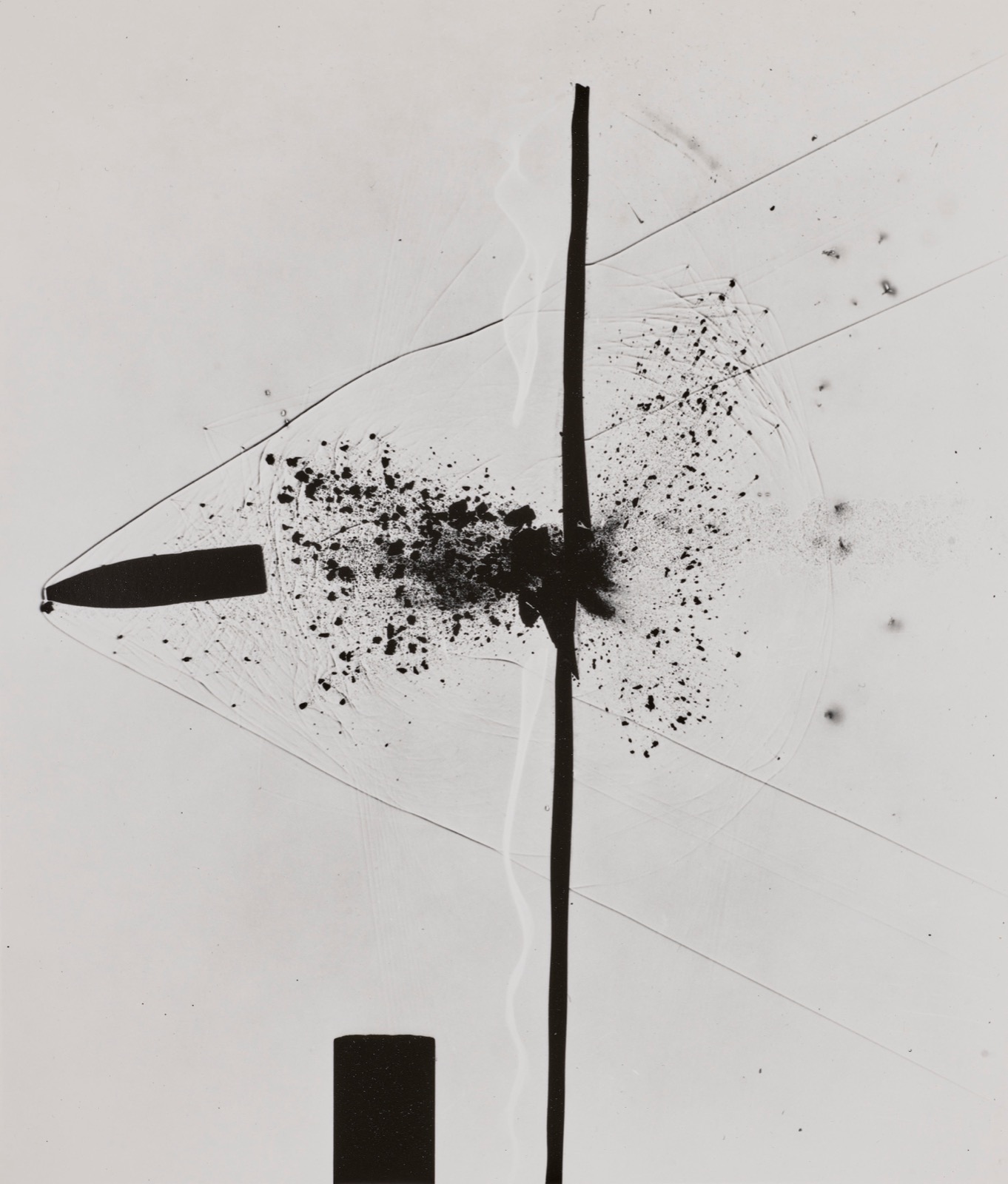

A dark ovoid enters from the left, its blunt nose already past contact, and meets a slender vertical rod that bisects the frame top to bottom. From that collision a cloud of black particles erupts and fans rightward, dense where the rod is shattered, thinning to a fine spray that drifts off the edge. Faint diagonal lines, the shock waves the title names, rule across the pale field, while a single wavy trail of disturbed air curls upward through the lower half. Against the featureless white ground, every fragment reads as a discrete event.
What this picture records cannot be witnessed by the eye; it exists only because a flash of a millionth of a second was made to do the seeing. The frame belongs to a body of work in which an MIT engineer turned a laboratory instrument into one of revelation, extending a lineage that runs through Muybridge and Marey to photography's founding promise of fixing what moves. Yet this is no diagram. The composition is balanced with a draftsman's care: the heavy bullet anchoring the left, the splatter weighted right, the vertical rod holding the center like a plumb line.
By 1965 the stroboscopic method was decades mature, and the artist composed with the assurance of a master who had long since proved it. Held now by the Museum of Modern Art, the Metropolitan, and the MIT Museum, these images occupy a singular place in the American canon, where engineering and art prove indivisible. A vintage print preserves the silver tonality and velvet blacks in which that flash first registered, the object as close as one can stand to the instant itself.