Against pure black the camera has counted what no eye could keep pace with: a single tennis serve splayed into a fan of perhaps twenty rackets, each oval head a distinct rung climbing into the follow-through. This is not one photograph but a ledger of instants, the strobe firing again and again onto one frame so that time becomes a fixed, legible diagram. The body, by contrast, dissolves into a luminous smear—a white blur of torso and skirt where the racket arm stays crisp—because the flesh moved slower and the lamp could not hold it. Geometry survives; the human surrenders to it.
What the picture proposes is photography as an instrument rather than an art, the camera enlisted to make visible a fact of physics. Yet the diagram is also beautiful, almost ceremonial: the rackets arc like a peacock's tail or a drawn bow, two small balls drift at the upper right, and the wooden floor grounds the apparition in an ordinary gymnasium. Here the laboratory and the lyrical refuse to separate. The medium does what only it can—it traces motion as a continuous mark, the way a seismograph inscribes what is otherwise pure event.
Made by an MIT engineer who turned the stroboscopic flash into a new way of seeing, this is one of the defining images of mid-century science photography, a lineage running from Marey's chronophotography into the modern picture held by MoMA, the Met, and the MIT Museum. A vintage print carries that authority in its surface: the deep blacks, the silver of those overlapping wires. To hold one is to hold the moment when measurement and wonder were the same gesture.
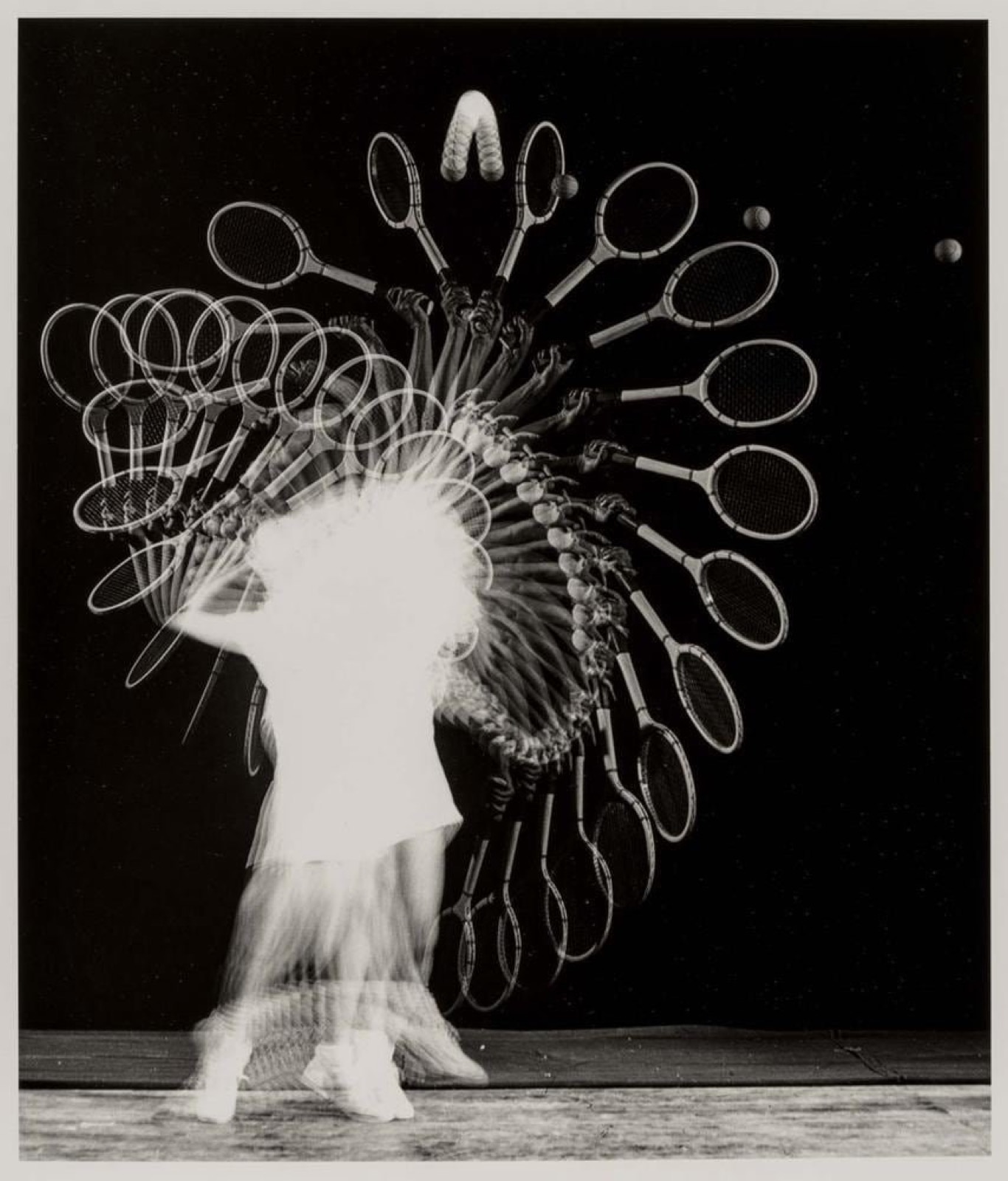

Against pure black the camera has counted what no eye could keep pace with: a single tennis serve splayed into a fan of perhaps twenty rackets, each oval head a distinct rung climbing into the follow-through. This is not one photograph but a ledger of instants, the strobe firing again and again onto one frame so that time becomes a fixed, legible diagram. The body, by contrast, dissolves into a luminous smear—a white blur of torso and skirt where the racket arm stays crisp—because the flesh moved slower and the lamp could not hold it. Geometry survives; the human surrenders to it.
What the picture proposes is photography as an instrument rather than an art, the camera enlisted to make visible a fact of physics. Yet the diagram is also beautiful, almost ceremonial: the rackets arc like a peacock's tail or a drawn bow, two small balls drift at the upper right, and the wooden floor grounds the apparition in an ordinary gymnasium. Here the laboratory and the lyrical refuse to separate. The medium does what only it can—it traces motion as a continuous mark, the way a seismograph inscribes what is otherwise pure event.
Made by an MIT engineer who turned the stroboscopic flash into a new way of seeing, this is one of the defining images of mid-century science photography, a lineage running from Marey's chronophotography into the modern picture held by MoMA, the Met, and the MIT Museum. A vintage print carries that authority in its surface: the deep blacks, the silver of those overlapping wires. To hold one is to hold the moment when measurement and wonder were the same gesture.