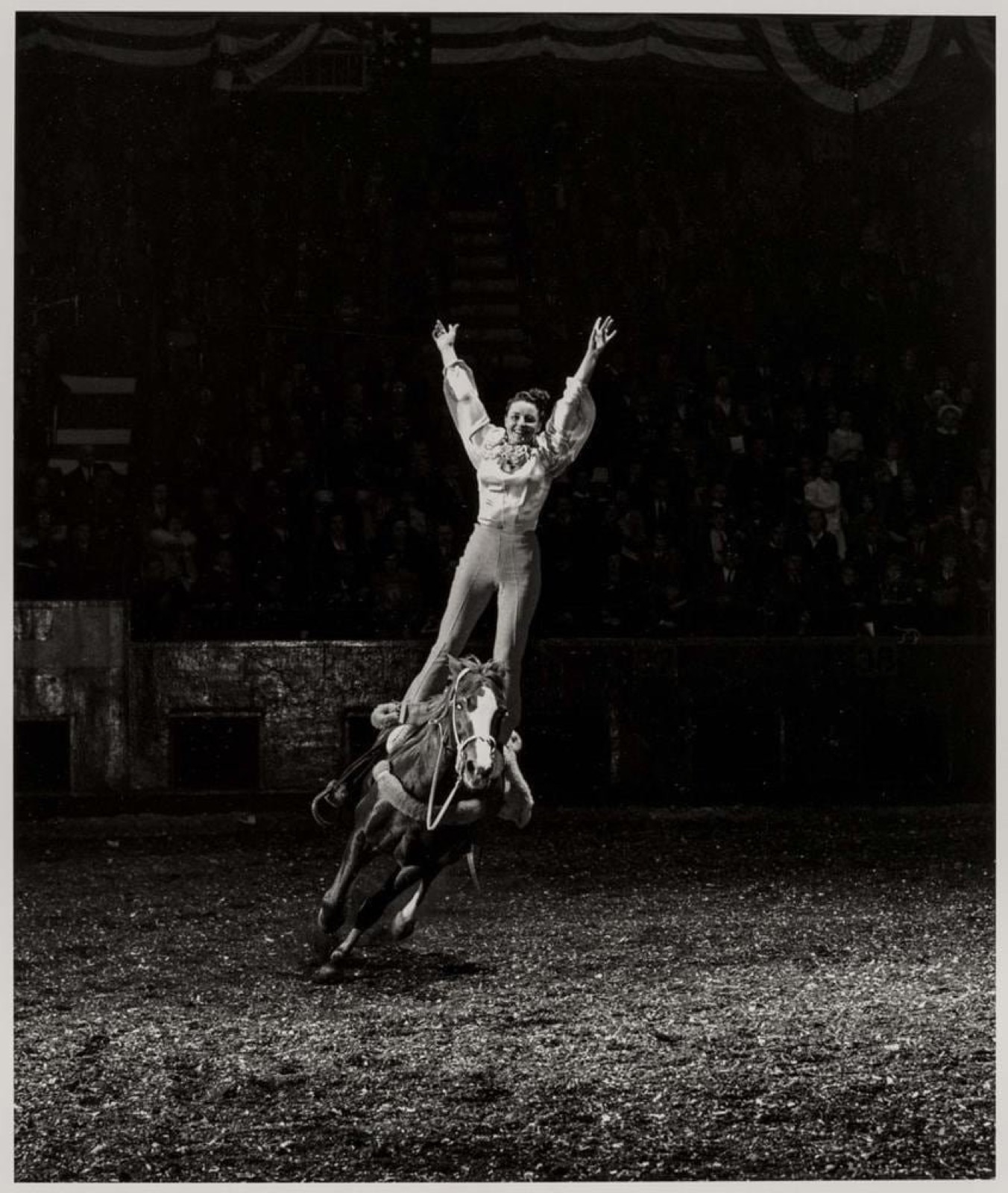
A young woman stands erect on the back of a galloping horse, arms flung into a wide V above her head, palms open to a darkness that swallows everything but her. She wears a pale blouse and light jodhpurs; the paint horse drives forward with its head lowered, reins swinging loose, hooves throwing up the churned earth of an arena. Above hangs the scalloped bunting of stars and stripes; behind, a crowd dissolved into a granular dusk of faces. The picture is a wager on the instant—proof that body and animal held this position for a fraction of a second no eye could have caught.
What we look at is not a performance so much as a piece of evidence. The stroboscopic flash that fixes her gesture and the unblurred legs of the running horse was an engineer's instrument before it was an aesthetic one, designed to seize what the body could feel but never see. There is a peculiar ethics in that ambition: the camera does not interpret here, it certifies. To photograph is to confer a strange immortality, and the appetite for the unrepeatable finds its purest object—a poise that exists only because the machine swears it did.
The image belongs to a moment when photography was learning to be a form of knowledge as much as memory. That tension—spectacle made specimen, applause arrested into silence—gives a vintage print its weight. Held now from MoMA to the Met, it survives as both document and wonder. To own the original is to possess the actual silver trace of a vanished half-second, and the conviction, rare and complete, that it happened.
A young woman stands erect on the back of a galloping horse, arms flung into a wide V above her head, palms open to a darkness that swallows everything but her. She wears a pale blouse and light jodhpurs; the paint horse drives forward with its head lowered, reins swinging loose, hooves throwing up the churned earth of an arena. Above hangs the scalloped bunting of stars and stripes; behind, a crowd dissolved into a granular dusk of faces. The picture is a wager on the instant—proof that body and animal held this position for a fraction of a second no eye could have caught.
What we look at is not a performance so much as a piece of evidence. The stroboscopic flash that fixes her gesture and the unblurred legs of the running horse was an engineer's instrument before it was an aesthetic one, designed to seize what the body could feel but never see. There is a peculiar ethics in that ambition: the camera does not interpret here, it certifies. To photograph is to confer a strange immortality, and the appetite for the unrepeatable finds its purest object—a poise that exists only because the machine swears it did.
The image belongs to a moment when photography was learning to be a form of knowledge as much as memory. That tension—spectacle made specimen, applause arrested into silence—gives a vintage print its weight. Held now from MoMA to the Met, it survives as both document and wonder. To own the original is to possess the actual silver trace of a vanished half-second, and the conviction, rare and complete, that it happened.