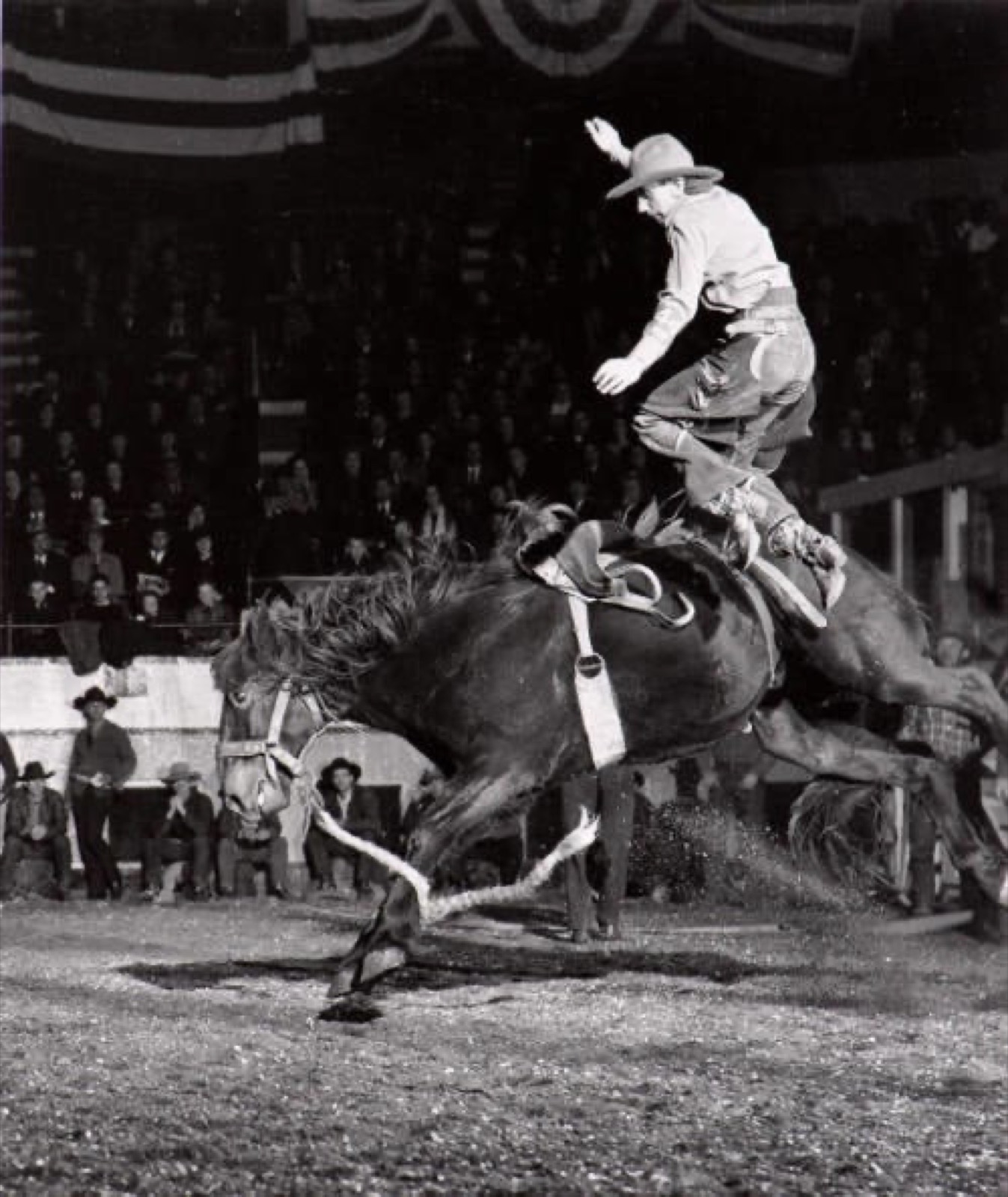
A bronc twists at the height of its buck, all four legs wrenched off the dirt, mane flying, while the rider rises clear of the saddle with one arm flung overhead and the other braced low. Behind them the arena is strung with bunting and a darkened grandstand of spectators in wide-brimmed hats; a row of cowboys watches from the rail at left, and clods of churned ground hang suspended in the air. What would be, to the eye, an indecipherable blur is here held perfectly still—each hair of the tail, each crease of the chaps legible in the hard, even light.
That clarity is the whole point. By 1940 this maker, an electrical engineer rather than a photojournalist, had spent more than a decade perfecting the stroboscopic flash, a burst brief enough to arrest motion the human eye can never see. The rodeo, with its violent, split-second drama, was an ideal proving ground, and the picture belongs to a body of work that moved the frozen instant out of the laboratory and into the world of sport, spectacle, and wonder. It sits at a hinge in the medium's history, where scientific instrument and expressive image became one.
Within his arc this frame marks the moment his technical research turned unmistakably into art, a lineage running back to Muybridge and forward into modern photography. His prints are held by The Museum of Modern Art, The Metropolitan Museum of Art, and the MIT Museum, and a vintage print from this period carries the authority of that standing—a record, made at the source, of the eye learning to see what it had always missed.
A bronc twists at the height of its buck, all four legs wrenched off the dirt, mane flying, while the rider rises clear of the saddle with one arm flung overhead and the other braced low. Behind them the arena is strung with bunting and a darkened grandstand of spectators in wide-brimmed hats; a row of cowboys watches from the rail at left, and clods of churned ground hang suspended in the air. What would be, to the eye, an indecipherable blur is here held perfectly still—each hair of the tail, each crease of the chaps legible in the hard, even light.
That clarity is the whole point. By 1940 this maker, an electrical engineer rather than a photojournalist, had spent more than a decade perfecting the stroboscopic flash, a burst brief enough to arrest motion the human eye can never see. The rodeo, with its violent, split-second drama, was an ideal proving ground, and the picture belongs to a body of work that moved the frozen instant out of the laboratory and into the world of sport, spectacle, and wonder. It sits at a hinge in the medium's history, where scientific instrument and expressive image became one.
Within his arc this frame marks the moment his technical research turned unmistakably into art, a lineage running back to Muybridge and forward into modern photography. His prints are held by The Museum of Modern Art, The Metropolitan Museum of Art, and the MIT Museum, and a vintage print from this period carries the authority of that standing—a record, made at the source, of the eye learning to see what it had always missed.