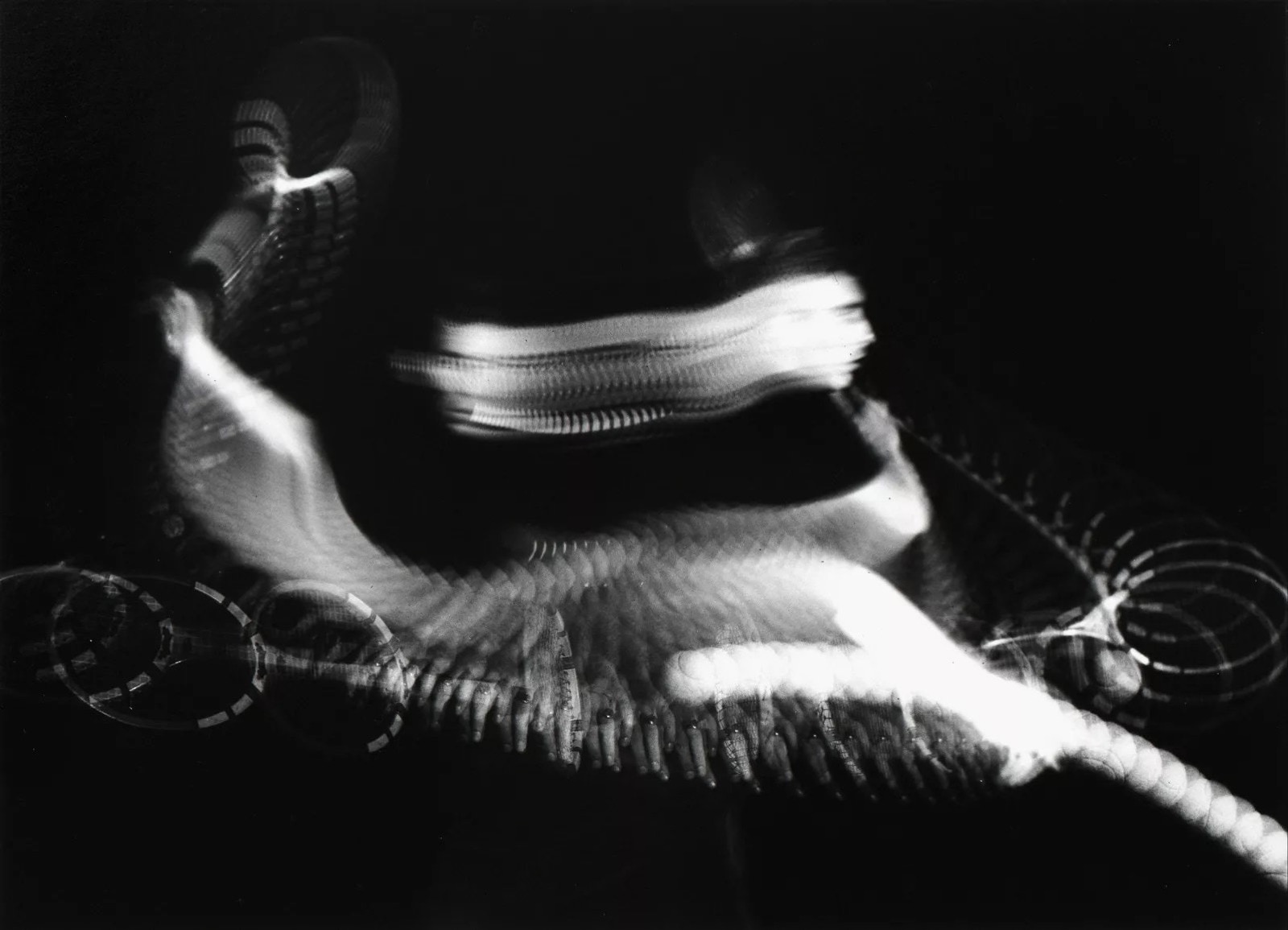
The frame is almost entirely black, and that blackness is not absence but method. To register motion the camera shutter stays open while a lamp pulses, so each thing we see has been struck by light several times over. The result is less a picture of a tennis stroke than a graph of one. Across the centre a thick, corrugated ribbon hovers where the racket should be: not a racket but its swing, fanned into dozens of stacked repetitions, every flash a rung in the same ladder. The body has paid the price for this clarity, dissolving into pale streaks; only the legs, flung upward in canvas high-tops with their laces and ribbed soles, stay solid enough to read as a person.
What makes the image strange is the way it reasons. Along the lower edge and the corners, bright loops and overlapping rings draw themselves out, the trace of small markers turning through space as the player pivots. These are not effects added to a photograph; they are the photograph, the medium describing its own grasp of time. A continuous gesture, too fast for the eye, is parsed into a countable series — vision converted into measurement, the human act rendered as data and still, somehow, kept beautiful.
Made in 1939 by an engineer who turned the stroboscope into a camera, this is photography thinking aloud about what it can hold. Such work hangs now in MoMA and the Met, where the scientific print is read as art. A vintage gelatin silver sheet carries the actual deposit of those pulses of light — the experiment itself, fixed once, on paper that remembers each flash.
The frame is almost entirely black, and that blackness is not absence but method. To register motion the camera shutter stays open while a lamp pulses, so each thing we see has been struck by light several times over. The result is less a picture of a tennis stroke than a graph of one. Across the centre a thick, corrugated ribbon hovers where the racket should be: not a racket but its swing, fanned into dozens of stacked repetitions, every flash a rung in the same ladder. The body has paid the price for this clarity, dissolving into pale streaks; only the legs, flung upward in canvas high-tops with their laces and ribbed soles, stay solid enough to read as a person.
What makes the image strange is the way it reasons. Along the lower edge and the corners, bright loops and overlapping rings draw themselves out, the trace of small markers turning through space as the player pivots. These are not effects added to a photograph; they are the photograph, the medium describing its own grasp of time. A continuous gesture, too fast for the eye, is parsed into a countable series — vision converted into measurement, the human act rendered as data and still, somehow, kept beautiful.
Made in 1939 by an engineer who turned the stroboscope into a camera, this is photography thinking aloud about what it can hold. Such work hangs now in MoMA and the Met, where the scientific print is read as art. A vintage gelatin silver sheet carries the actual deposit of those pulses of light — the experiment itself, fixed once, on paper that remembers each flash.