Stand a single body in front of a strobe firing faster than thought and this is what you get back: a man turned into a chord. The swing arrives all at once, every position struck and held, the club head printed thirty-odd times around him in a fan of pale paddle shapes that nearly closes into a halo. You hear it, almost — the downswing rendered as a glissando of shafts sweeping from upper left and bouncing back. The eye can't follow a golf swing; that's the pathos of the game. Here it finally holds still long enough to be admired, closer to music than to sport.
Look how little of the man survives the procedure. His torso has gone soft and luminous, a smear of white sweater burning at the center, while his head multiplies into a dark ribbed fan, as if he had a dozen faces all turning at once. Only the two shoes stay sharp, planted and crisp on the black floor, the one fixed point the body refuses to surrender. A lone ball waits at lower right, almost comic in its patience. Everything is decided above it, in that whirling architecture of repeated steel.
This is engineering passing itself off as wonder, which is its own kind of beauty. The strobe was built at MIT to measure machinery, not to make pictures; that it makes pictures this strange is the happy accident the medium keeps offering. A vintage print carries the actual silver of that moment, the thing museums from the Modern to the Met have long since claimed. What we keep is motion caught in the act of becoming time.
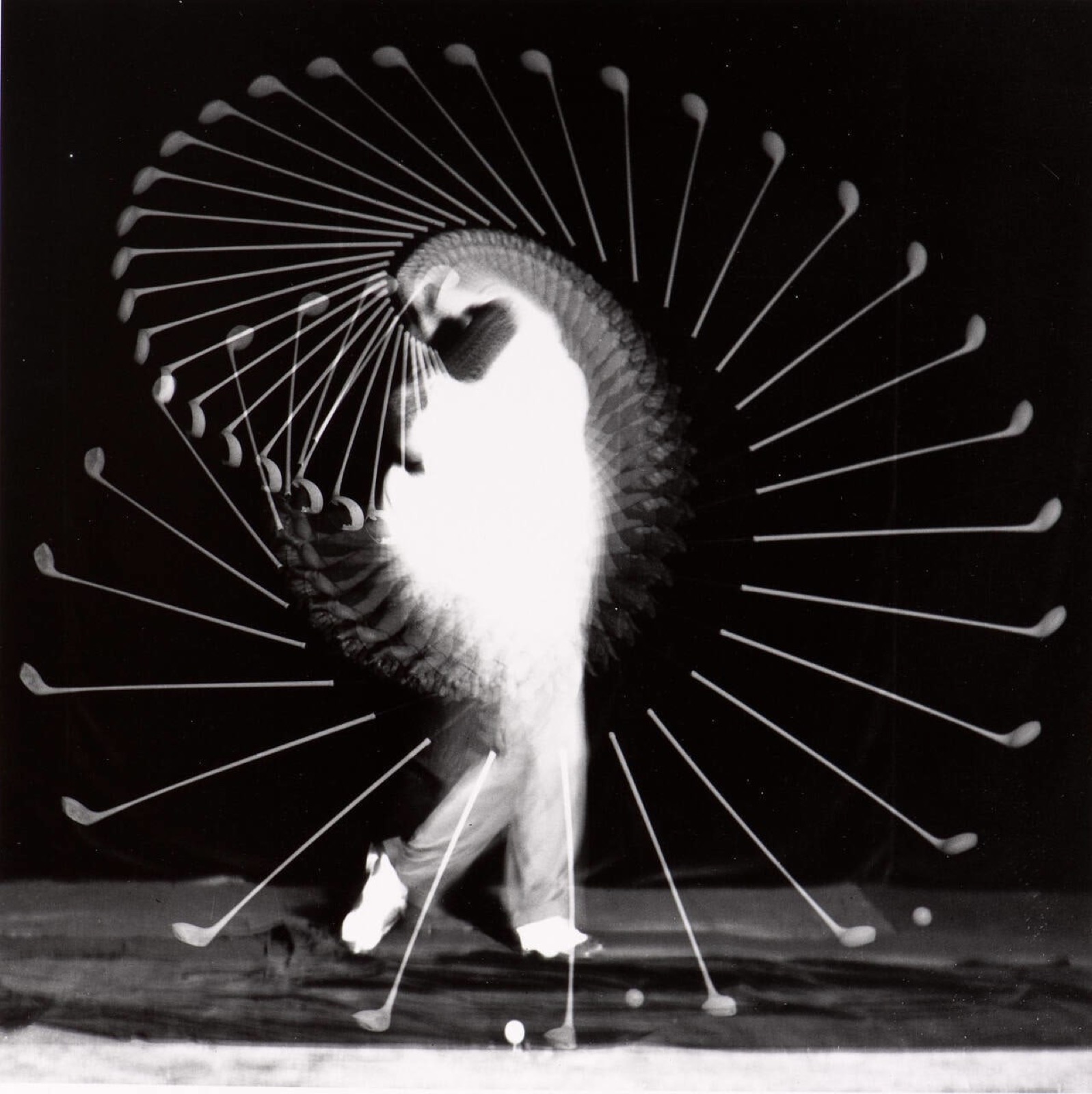

Stand a single body in front of a strobe firing faster than thought and this is what you get back: a man turned into a chord. The swing arrives all at once, every position struck and held, the club head printed thirty-odd times around him in a fan of pale paddle shapes that nearly closes into a halo. You hear it, almost — the downswing rendered as a glissando of shafts sweeping from upper left and bouncing back. The eye can't follow a golf swing; that's the pathos of the game. Here it finally holds still long enough to be admired, closer to music than to sport.
Look how little of the man survives the procedure. His torso has gone soft and luminous, a smear of white sweater burning at the center, while his head multiplies into a dark ribbed fan, as if he had a dozen faces all turning at once. Only the two shoes stay sharp, planted and crisp on the black floor, the one fixed point the body refuses to surrender. A lone ball waits at lower right, almost comic in its patience. Everything is decided above it, in that whirling architecture of repeated steel.
This is engineering passing itself off as wonder, which is its own kind of beauty. The strobe was built at MIT to measure machinery, not to make pictures; that it makes pictures this strange is the happy accident the medium keeps offering. A vintage print carries the actual silver of that moment, the thing museums from the Modern to the Met have long since claimed. What we keep is motion caught in the act of becoming time.