The picture is built from the ground up, and almost nothing in it stands above the knee. A cleated leather boot, scuffed and creased at the instep, has just met the ball; a second boot, blurred and lower, belongs to the holder crouched out of sight. Between them sits the fat oval of the football, tilted on its point in the dirt, its seam catching one hard ridge of light. Everything above is black—a flat, depthless dark the photographer uses as a wall, so the eye can do nothing but read the small drama of contact at the bottom edge.
What the exposure records is a fact the eye could never hold: the instant of the kick, the ball already deforming against the leather of the shoe. The ribbed wool sock, the laces, the rivets of the cleats, the clods of churned earth are rendered with the same merciless precision, as if motion had been switched off. A faint plume of dust streaks to the right, the one soft passage in an image made entirely of edges. The frame is not composed so much as sprung shut at the decisive thousandth of a second.
This is photography enlisted as an instrument, the laboratory flash turned on the playing field by an engineer who wanted to see what no one had seen. Prints of these stroboscopic studies now sit in the Museum of Modern Art and the Met, admitted not as illustrations but as pictures, and a vintage print carries the authority of that early moment when science and seeing briefly became one act. The wonder survives the explanation: an ordinary kick, made permanent.
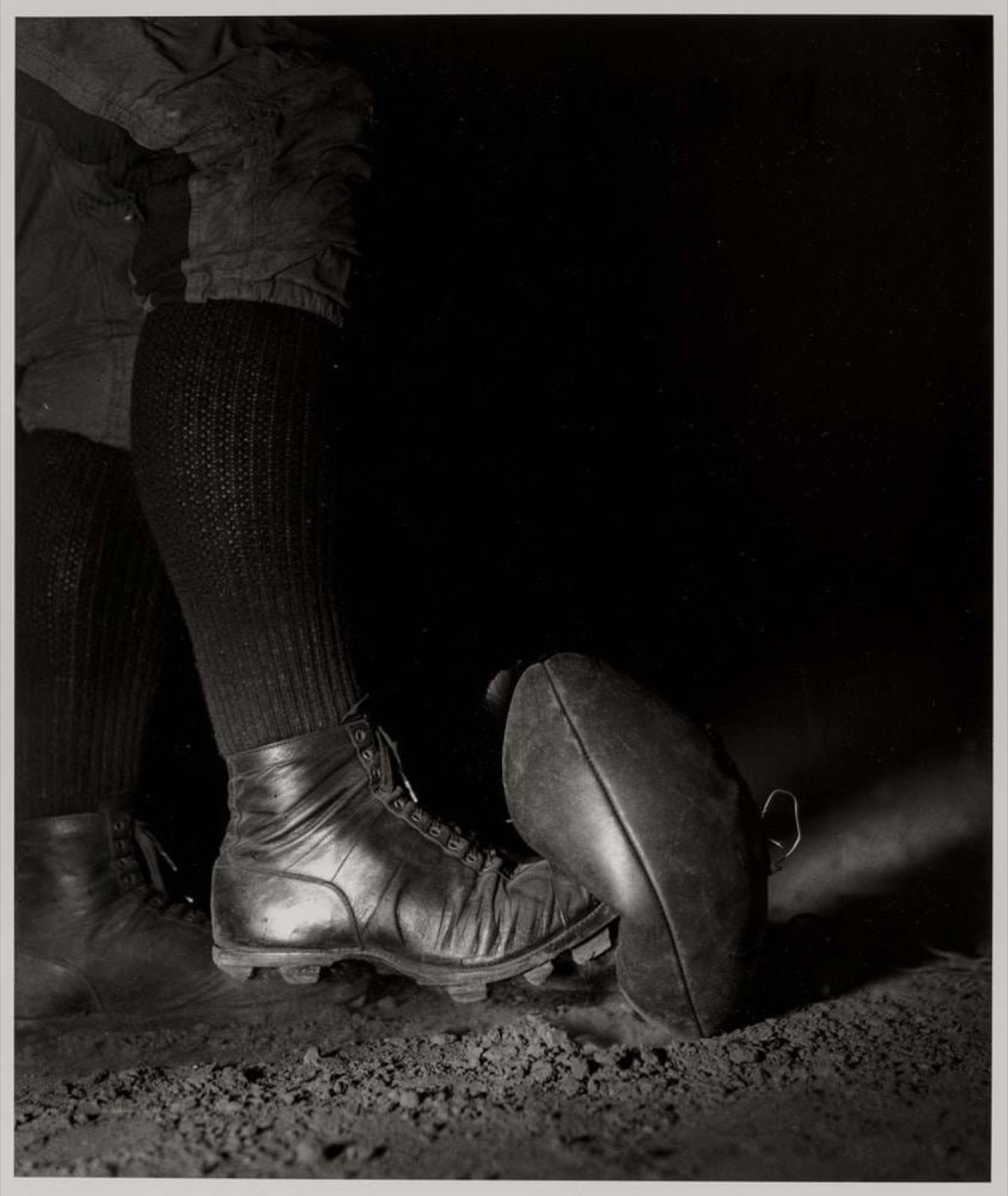

The picture is built from the ground up, and almost nothing in it stands above the knee. A cleated leather boot, scuffed and creased at the instep, has just met the ball; a second boot, blurred and lower, belongs to the holder crouched out of sight. Between them sits the fat oval of the football, tilted on its point in the dirt, its seam catching one hard ridge of light. Everything above is black—a flat, depthless dark the photographer uses as a wall, so the eye can do nothing but read the small drama of contact at the bottom edge.
What the exposure records is a fact the eye could never hold: the instant of the kick, the ball already deforming against the leather of the shoe. The ribbed wool sock, the laces, the rivets of the cleats, the clods of churned earth are rendered with the same merciless precision, as if motion had been switched off. A faint plume of dust streaks to the right, the one soft passage in an image made entirely of edges. The frame is not composed so much as sprung shut at the decisive thousandth of a second.
This is photography enlisted as an instrument, the laboratory flash turned on the playing field by an engineer who wanted to see what no one had seen. Prints of these stroboscopic studies now sit in the Museum of Modern Art and the Met, admitted not as illustrations but as pictures, and a vintage print carries the authority of that early moment when science and seeing briefly became one act. The wonder survives the explanation: an ordinary kick, made permanent.