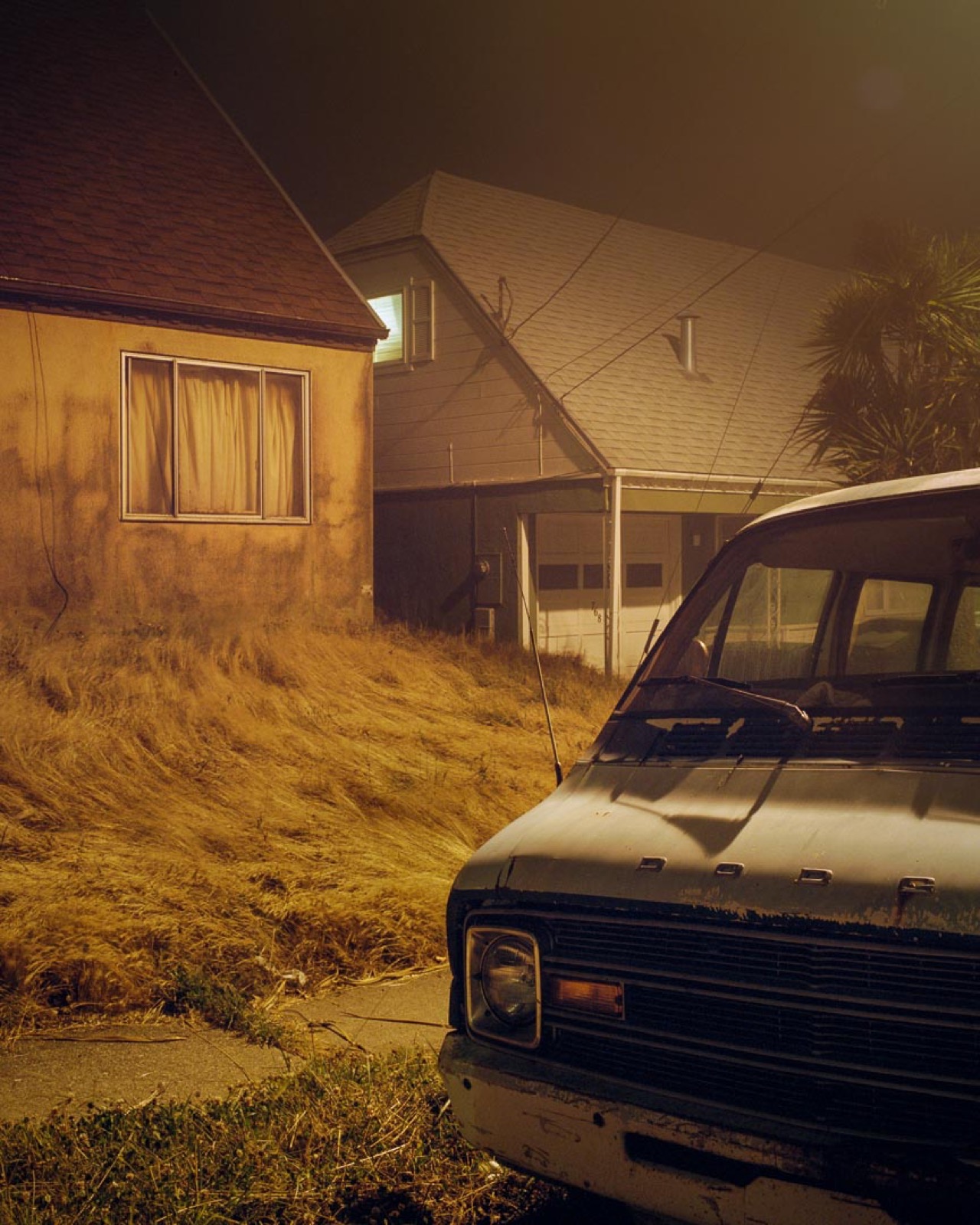
The real weather in this picture is not the fog banked against the rooflines but the light itself, a low sodium orange that behaves like weather, drifting into every surface and settling there. It coats the stucco, soaks the dry grass until the whole slope looks combed by wind, and pools on the flank of an old van whose hood still spells DODGE in raised chrome. Night photography of this kind is really an argument about what a long exposure can gather that an eye, glancing, would miss.
Hido works close to the street and lets the camera do the staring we are too polite to do ourselves. Here the composition splits: houses and a lit upstairs window on the left, the blunt front of the parked van shouldering in from the right, its single round headlight blind, its grille pitted, a thread of chrome catching the streetlamp. Between them the grass runs downhill in the fog. The picture is patient in a way we rarely are, holding the scene long enough for its ordinary menace to develop.
What this work grasped early is that it converts the documentary reflex into mood without abandoning fact: these are real addresses, really this color at this hour. The medium matters to the effect. Printed as an archival pigment print, the sodium orange stays saturated and grainless, so the fog reads as atmosphere rather than noise. Hido’s night houses now sit in SFMOMA, the Getty and the Whitney, and their pull is this doubleness, a street you could name and a dread you cannot, held in the same amber frame.
The real weather in this picture is not the fog banked against the rooflines but the light itself, a low sodium orange that behaves like weather, drifting into every surface and settling there. It coats the stucco, soaks the dry grass until the whole slope looks combed by wind, and pools on the flank of an old van whose hood still spells DODGE in raised chrome. Night photography of this kind is really an argument about what a long exposure can gather that an eye, glancing, would miss.
Hido works close to the street and lets the camera do the staring we are too polite to do ourselves. Here the composition splits: houses and a lit upstairs window on the left, the blunt front of the parked van shouldering in from the right, its single round headlight blind, its grille pitted, a thread of chrome catching the streetlamp. Between them the grass runs downhill in the fog. The picture is patient in a way we rarely are, holding the scene long enough for its ordinary menace to develop.
What this work grasped early is that it converts the documentary reflex into mood without abandoning fact: these are real addresses, really this color at this hour. The medium matters to the effect. Printed as an archival pigment print, the sodium orange stays saturated and grainless, so the fog reads as atmosphere rather than noise. Hido’s night houses now sit in SFMOMA, the Getty and the Whitney, and their pull is this doubleness, a street you could name and a dread you cannot, held in the same amber frame.