Everything here has been steeped in sodium: the stucco, the dry grass, the very air arrive in the same amber wash, as if the night had been dipped in weak tea. This is not the color of a place so much as the color of a decision, the palette a streetlight imposes on whatever it can reach. Two houses hold the frame, one flat and curtained, the other steeper and turned slightly away, and between them the hillside of pale, matted grass runs downhill toward us like spilled straw.
Read as a set, the picture behaves like a stage struck an hour after the actors left. A single upstairs window glows behind its shutters, the only warm interior in a sealed scene; the drawn curtains of the larger window keep their secret. An ornamental white grille guards a garage marked 768, its scrollwork oddly formal against the coarse grass and the slack power lines overhead. Nothing performs. The domestic props simply stand there, lit for a drama that has been called off, and the withholding is exactly the subject.
Working outward from suburban night, Hido has made the ordinary American house into a genre of its own, luminous, faintly ominous, titled only by number. He photographs from the street with a stakeout’s patience, then prints the results, here as an archival pigment print, at a scale that lets the amber breathe. His houses hang at SFMOMA, the Getty and the Whitney, and part of their pull is this: the sense that behind one lit pane a whole interior life is proceeding, and we will never be let in.
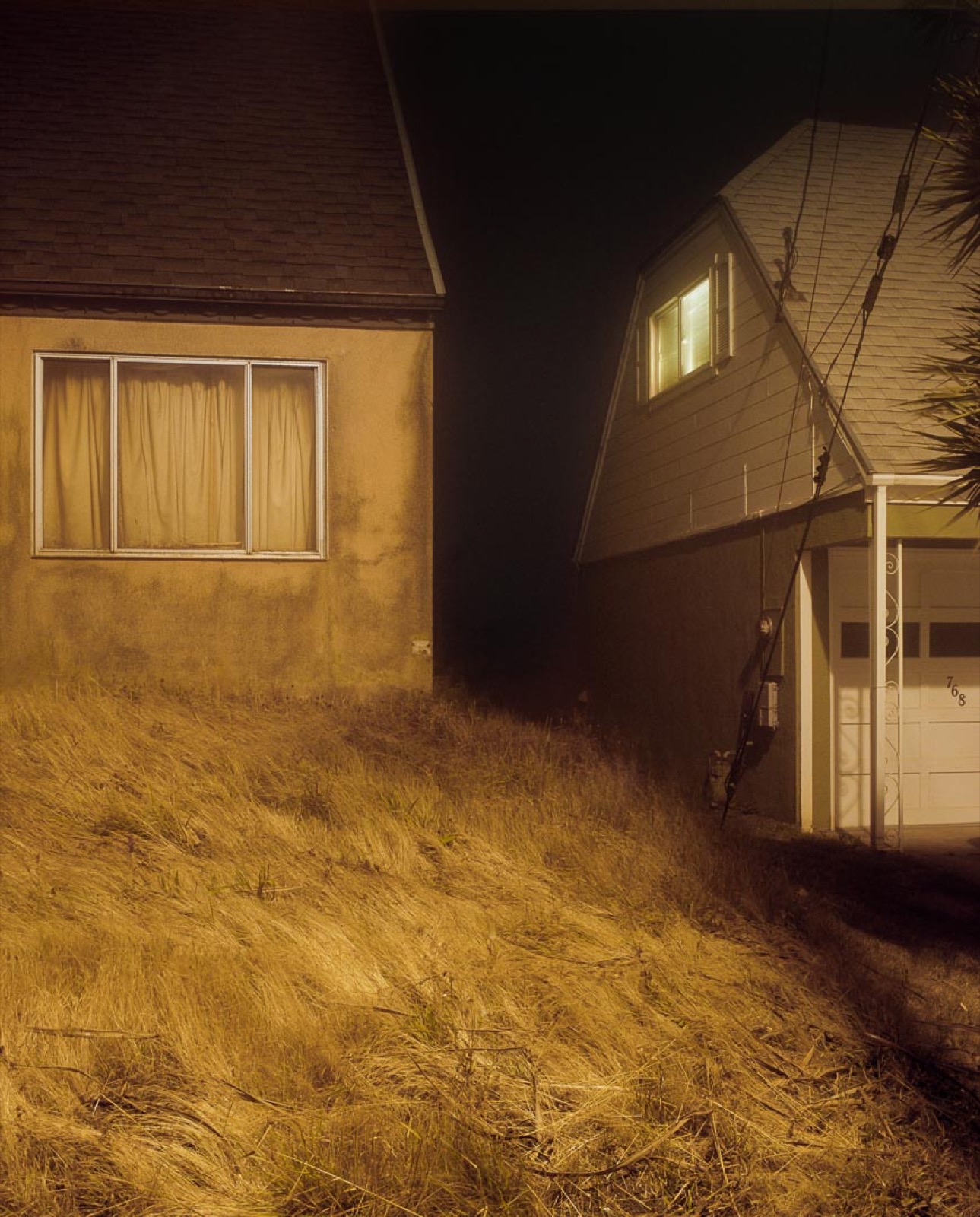

Everything here has been steeped in sodium: the stucco, the dry grass, the very air arrive in the same amber wash, as if the night had been dipped in weak tea. This is not the color of a place so much as the color of a decision, the palette a streetlight imposes on whatever it can reach. Two houses hold the frame, one flat and curtained, the other steeper and turned slightly away, and between them the hillside of pale, matted grass runs downhill toward us like spilled straw.
Read as a set, the picture behaves like a stage struck an hour after the actors left. A single upstairs window glows behind its shutters, the only warm interior in a sealed scene; the drawn curtains of the larger window keep their secret. An ornamental white grille guards a garage marked 768, its scrollwork oddly formal against the coarse grass and the slack power lines overhead. Nothing performs. The domestic props simply stand there, lit for a drama that has been called off, and the withholding is exactly the subject.
Working outward from suburban night, Hido has made the ordinary American house into a genre of its own, luminous, faintly ominous, titled only by number. He photographs from the street with a stakeout’s patience, then prints the results, here as an archival pigment print, at a scale that lets the amber breathe. His houses hang at SFMOMA, the Getty and the Whitney, and part of their pull is this: the sense that behind one lit pane a whole interior life is proceeding, and we will never be let in.