Whistler borrowed a term from music, calling his night paintings nocturnes, and let the Thames dissolve into tone. A century later the American nocturne looks like this: green stucco under an amber sky, two power lines scoring the dark, a single upstairs window burning yellow. The tradition has migrated from river to road, from oil paint to asphalt, and it has kept its essential question intact: what does a place confess at night that it withholds by day?
The picture is scrupulous about thresholds. We stand where anyone may stand, on public asphalt, its surface greened by mixed streetlight, a short yellow dash of lane line waiting for morning traffic. A hem of dry grass, gold and uncut, runs the length of the wall, separating the road from the rooms. Below the lit pane another window is curtained, milk-pale, the cloth parted just enough to remind us that looking is never neutral. Nobody appears, and still the frame is full of habitation. To photograph a stranger’s light is to acknowledge a life without claiming it.
Hido, born in Kent, Ohio, and long based in the San Francisco Bay Area, has made the suburban house at night his signature subject, numbering his pictures rather than naming them, as if keeping an account of American darkness. Prints of his work are held by SFMOMA, the Getty, and the Whitney. This archival pigment print holds the sodium sky and the mineral green of the wall in careful suspension; the color itself is the argument. The house remains anonymous. The light, once seen, does not.
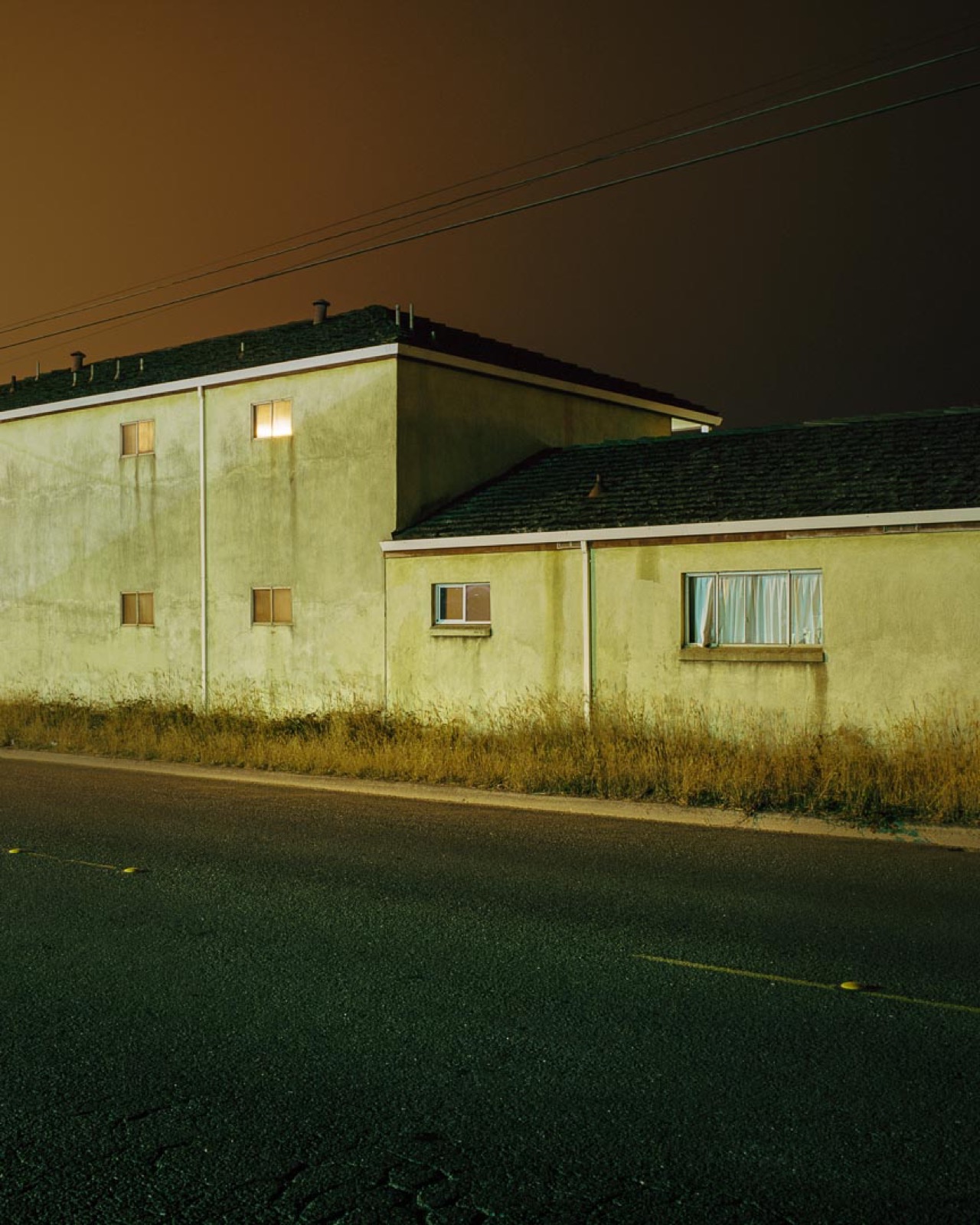

Whistler borrowed a term from music, calling his night paintings nocturnes, and let the Thames dissolve into tone. A century later the American nocturne looks like this: green stucco under an amber sky, two power lines scoring the dark, a single upstairs window burning yellow. The tradition has migrated from river to road, from oil paint to asphalt, and it has kept its essential question intact: what does a place confess at night that it withholds by day?
The picture is scrupulous about thresholds. We stand where anyone may stand, on public asphalt, its surface greened by mixed streetlight, a short yellow dash of lane line waiting for morning traffic. A hem of dry grass, gold and uncut, runs the length of the wall, separating the road from the rooms. Below the lit pane another window is curtained, milk-pale, the cloth parted just enough to remind us that looking is never neutral. Nobody appears, and still the frame is full of habitation. To photograph a stranger’s light is to acknowledge a life without claiming it.
Hido, born in Kent, Ohio, and long based in the San Francisco Bay Area, has made the suburban house at night his signature subject, numbering his pictures rather than naming them, as if keeping an account of American darkness. Prints of his work are held by SFMOMA, the Getty, and the Whitney. This archival pigment print holds the sodium sky and the mineral green of the wall in careful suspension; the color itself is the argument. The house remains anonymous. The light, once seen, does not.