When Robert Adams photographed the summer nights of his Colorado suburbs, he showed how a single streetlight on a lawn could carry the whole weight of American solitude. This picture takes up that inheritance in color. The same municipal glow pools on the grass, the same leafy tree stands between us and the houses, but here the night has a temperature: two windows lit deep amber, leaf shadows thrown across pale clapboard like a second, immaterial foliage, a sky of unbroken indigo overhead.
To look at a lit window from a dark street is an old human situation, and not an innocent one. The photograph acknowledges this. It keeps a respectful distance, out on the cracked asphalt of the road, letting the tree screen most of what we might have seen; through its branches, a further window glows in a neighboring house, a story twice removed. Someone is home. The upstairs window is dark, which is its own kind of information. That is all we are told, and it feels like enough, and also like an ache.
Hido has spent his career on such streets after dark, and museums, SFMOMA, the Getty, the Whitney, have gathered the results into their collections. In this archival pigment print the greens are the quiet revelation: lawn-green, leaf-green, the mineral green the streetlight makes of the siding, colors night is not supposed to have. Adams gave the suburbs their silver elegy. Hido gives them this: warmth seen from outside, which is the oldest definition of longing I know.
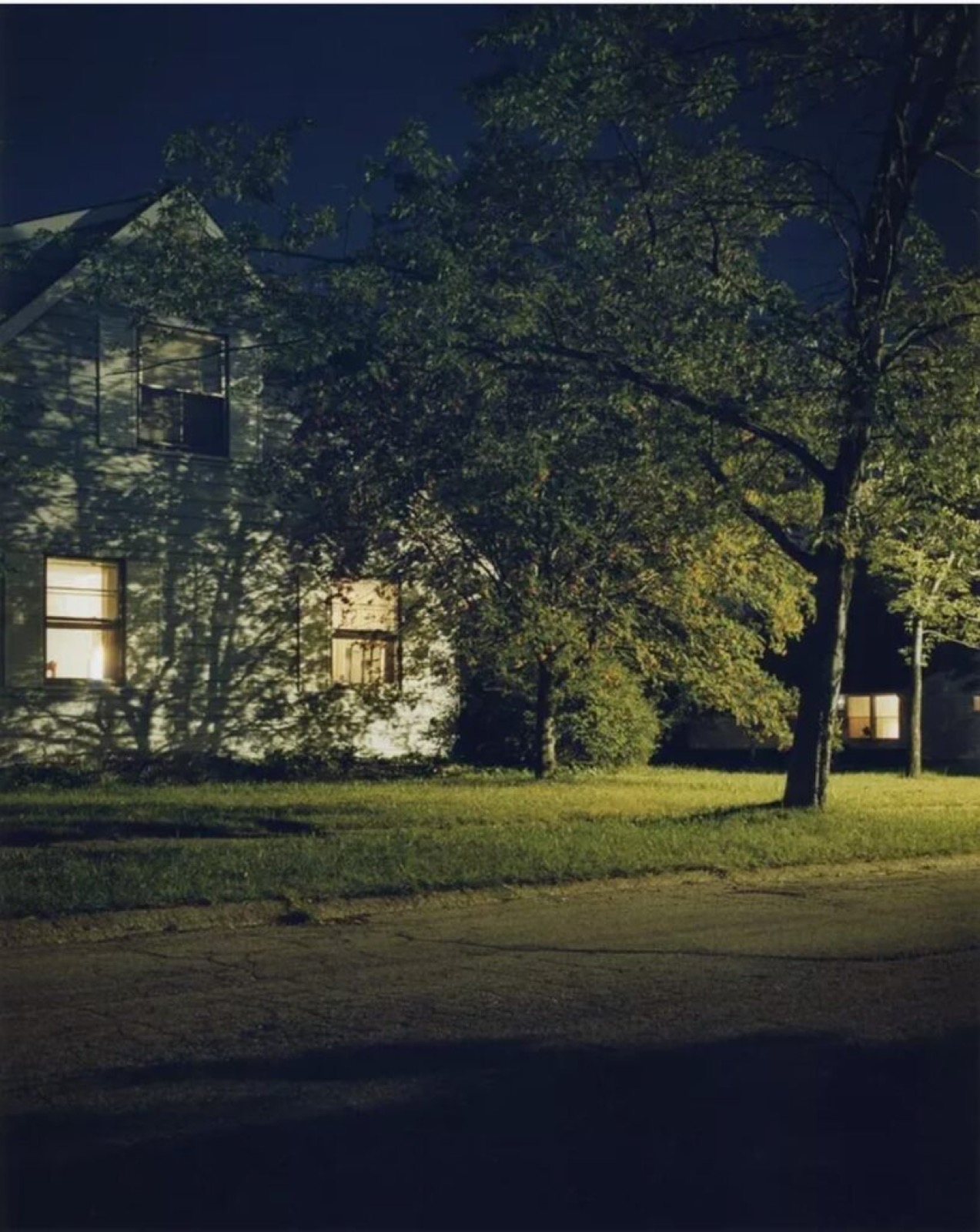

When Robert Adams photographed the summer nights of his Colorado suburbs, he showed how a single streetlight on a lawn could carry the whole weight of American solitude. This picture takes up that inheritance in color. The same municipal glow pools on the grass, the same leafy tree stands between us and the houses, but here the night has a temperature: two windows lit deep amber, leaf shadows thrown across pale clapboard like a second, immaterial foliage, a sky of unbroken indigo overhead.
To look at a lit window from a dark street is an old human situation, and not an innocent one. The photograph acknowledges this. It keeps a respectful distance, out on the cracked asphalt of the road, letting the tree screen most of what we might have seen; through its branches, a further window glows in a neighboring house, a story twice removed. Someone is home. The upstairs window is dark, which is its own kind of information. That is all we are told, and it feels like enough, and also like an ache.
Hido has spent his career on such streets after dark, and museums, SFMOMA, the Getty, the Whitney, have gathered the results into their collections. In this archival pigment print the greens are the quiet revelation: lawn-green, leaf-green, the mineral green the streetlight makes of the siding, colors night is not supposed to have. Adams gave the suburbs their silver elegy. Hido gives them this: warmth seen from outside, which is the oldest definition of longing I know.