The handrail goes first, feeling its way down into the fog like a blind man’s cane. We follow, or we decide not to, which is more or less the whole question the picture poses. A footpath at night, two streetlamps burning at different depths of murk, one confident and one barely managing, ice plant crowding the rail, and beyond the chain-link, nothing you could testify to. Every horror film says do not take this path. Every photograph worth living with says you already have.
Hido is famous for houses, the lit window seen from the street, but here he gives us the connective tissue of suburbia instead: the path between places, municipally railed, gritted, maintained just about enough. The fog does for this walkway what memory does for adolescence, blurring it into significance. I have never been here and yet I know it completely: the damp handrail’s chill, the hum of the lamps, the way the second one hangs in the mist like a moon that has lowered its standards.
It would be wrong to call the picture empty, though nobody is in it. It is full of walking, all the walking done and to come, the after-dinner circuits and the two-in-the-morning returns. Hido, whose photographs hang in the Getty, the Whitney and SFMOMA, prints this one in archival pigment that keeps the fog’s brown-green density and the lamps’ small competing triumphs exactly graded. Some pictures promise arrival. This one, kinder and stranger, promises the way down, railed on one side, lit at intervals.
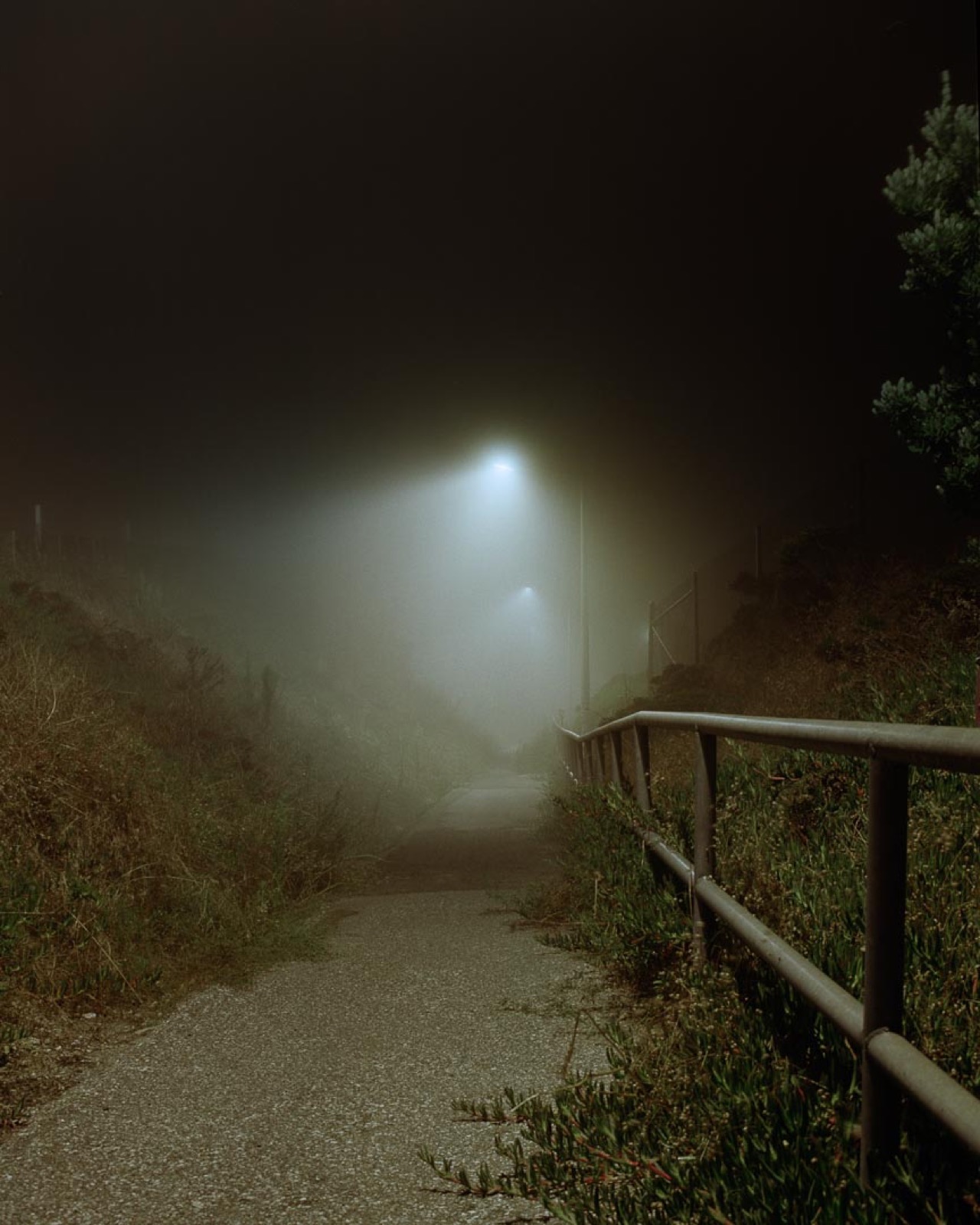

The handrail goes first, feeling its way down into the fog like a blind man’s cane. We follow, or we decide not to, which is more or less the whole question the picture poses. A footpath at night, two streetlamps burning at different depths of murk, one confident and one barely managing, ice plant crowding the rail, and beyond the chain-link, nothing you could testify to. Every horror film says do not take this path. Every photograph worth living with says you already have.
Hido is famous for houses, the lit window seen from the street, but here he gives us the connective tissue of suburbia instead: the path between places, municipally railed, gritted, maintained just about enough. The fog does for this walkway what memory does for adolescence, blurring it into significance. I have never been here and yet I know it completely: the damp handrail’s chill, the hum of the lamps, the way the second one hangs in the mist like a moon that has lowered its standards.
It would be wrong to call the picture empty, though nobody is in it. It is full of walking, all the walking done and to come, the after-dinner circuits and the two-in-the-morning returns. Hido, whose photographs hang in the Getty, the Whitney and SFMOMA, prints this one in archival pigment that keeps the fog’s brown-green density and the lamps’ small competing triumphs exactly graded. Some pictures promise arrival. This one, kinder and stranger, promises the way down, railed on one side, lit at intervals.