A man fills the foreground, balding, his brow furrowed into deep horizontal creases, a cigarette clamped at the corner of a mouth turned downward. His eyes have rolled upward and to the side, away from us, as if pleading with something just beyond the frame. On his lapel a campaign button shows a candidate's smiling face above block letters; another floats behind, reading HEADQUARTERS. This is the floor of a nominating convention, that peculiarly American liturgy where ordinary faces are conscripted into the machinery of hope and slogan.
Behind him, a younger man in heavy spectacles holds himself with the patient stiffness of one who has waited a long time; he too wears the buttons, the same borrowed enthusiasm. At the right edge a third figure leans in, an earpiece cord trailing to his collar, a microphone lifted toward the talkers—radio's intermediary, harvesting the room's noise. The crowd behind dissolves into a grainy tide of strangers. The whole image vibrates with the heat and exhaustion of partisan ritual seen from inside, not from the podium.
The picture belongs to the years of looking that produced one of the twentieth century's defining bodies of work, the road-vision that remade the photographic book. This Swiss-born eye found the United States neither heroic nor damned, only human and a little dazed. Signed in pencil at the lower right and inscribed with its year, this print carries that authorship in the hand. The artist's archive resides at the National Gallery of Art, with prints at MoMA and the Met; a vintage sheet such as this is the closest one comes to the original act of seeing.
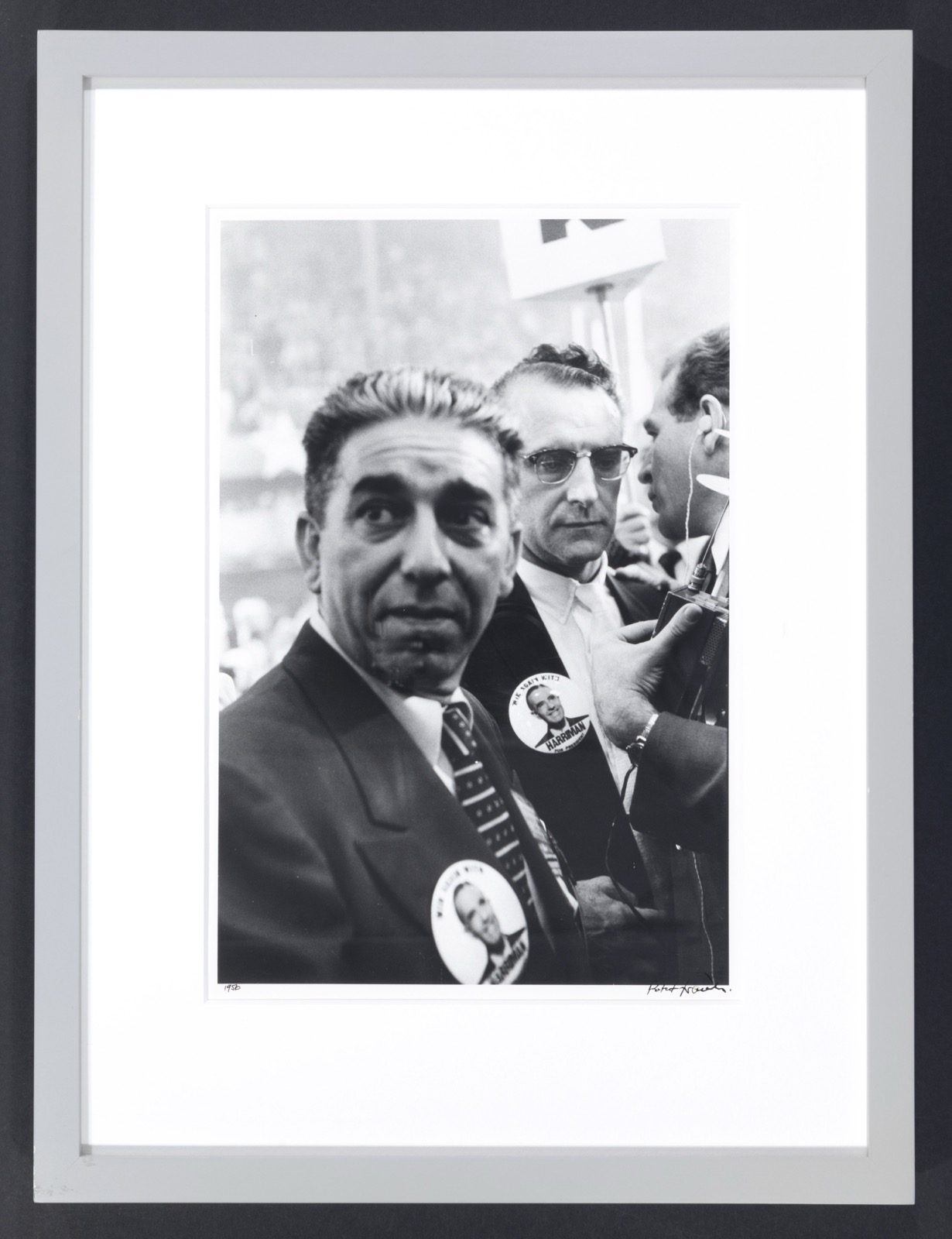

A man fills the foreground, balding, his brow furrowed into deep horizontal creases, a cigarette clamped at the corner of a mouth turned downward. His eyes have rolled upward and to the side, away from us, as if pleading with something just beyond the frame. On his lapel a campaign button shows a candidate's smiling face above block letters; another floats behind, reading HEADQUARTERS. This is the floor of a nominating convention, that peculiarly American liturgy where ordinary faces are conscripted into the machinery of hope and slogan.
Behind him, a younger man in heavy spectacles holds himself with the patient stiffness of one who has waited a long time; he too wears the buttons, the same borrowed enthusiasm. At the right edge a third figure leans in, an earpiece cord trailing to his collar, a microphone lifted toward the talkers—radio's intermediary, harvesting the room's noise. The crowd behind dissolves into a grainy tide of strangers. The whole image vibrates with the heat and exhaustion of partisan ritual seen from inside, not from the podium.
The picture belongs to the years of looking that produced one of the twentieth century's defining bodies of work, the road-vision that remade the photographic book. This Swiss-born eye found the United States neither heroic nor damned, only human and a little dazed. Signed in pencil at the lower right and inscribed with its year, this print carries that authorship in the hand. The artist's archive resides at the National Gallery of Art, with prints at MoMA and the Met; a vintage sheet such as this is the closest one comes to the original act of seeing.