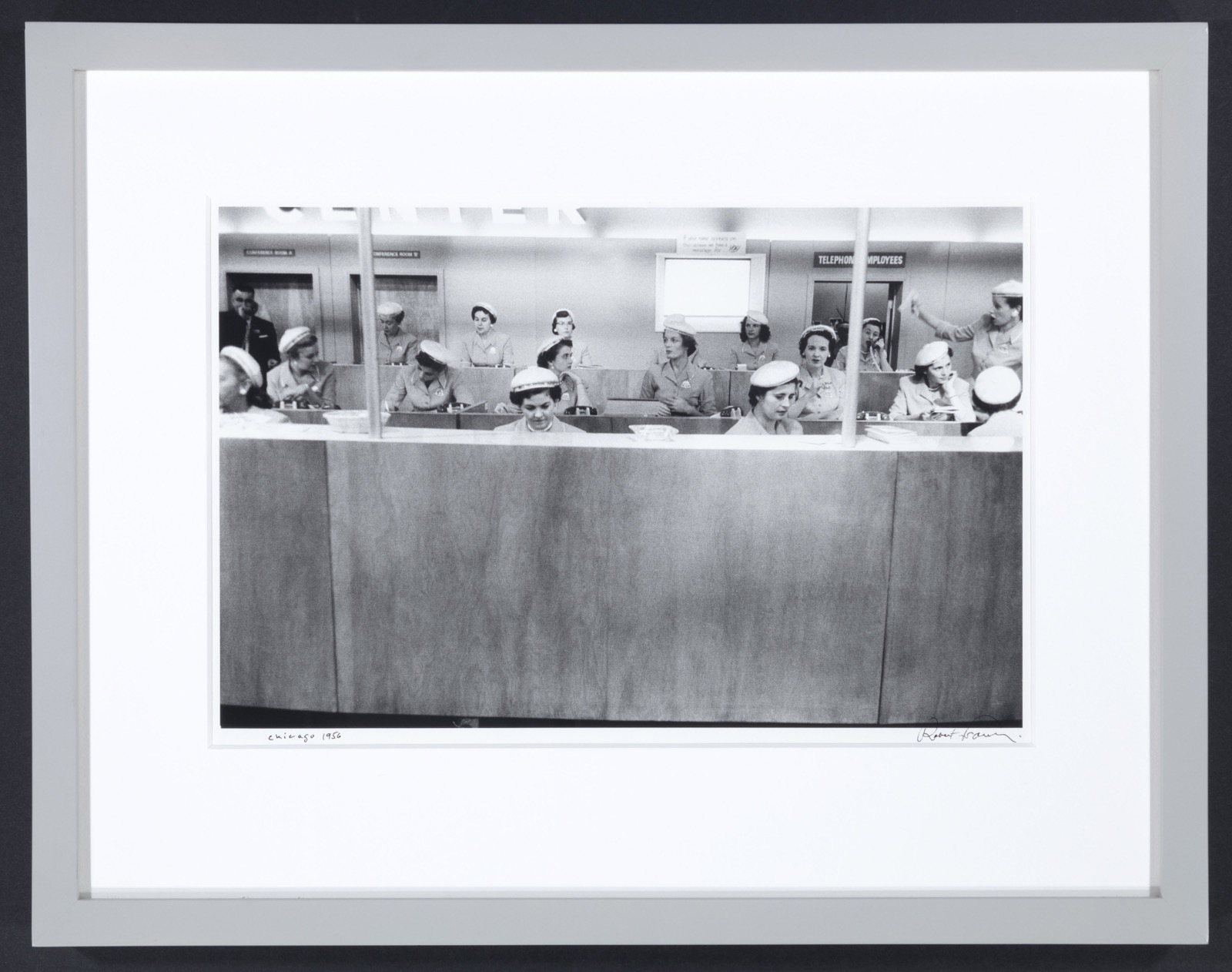
What gets you first is the hats. A whole choir of little white pillbox caps, perched on women bent over a long counter, each one a repeated note in a melody nobody chose to play. The blond-wood front of the desk runs flat across the lower half of the frame like a held bass tone, almost half the picture given over to plain veneer, and above it the heads come in waves. One woman, dead centre, looks up out of the row and straight past the lens, and you feel the whole orderly arrangement wobble for a second on that single off-beat.
Then you start reading the room. CONFERENCE ROOM B. TELEPHONE EMPLOYEES, stencilled over a far door. A man in a dark suit stands sentry at the left edge, the only one upright. A pane of glass cuts a thin vertical seam down the scene, splitting the chorus, putting a faint smear between us and them. This is the working America the photographer was driving through in the mid-fifties, caught not as scandal but as atmosphere — the hum of fluorescent routine, faces sealed into a system, improvisation squeezed almost to nothing.
And yet it swings. The grain breathes, the greys go soft and dirty in the corners, the whole thing tilts toward feeling rather than report. Signed in pencil along the bottom, "Chicago 1956," it predates the book that rewrote what a photograph could confess. A print this early, this physically present, is the take itself — held now by the National Gallery, MoMA, the Met — the moment the man at the edge of the frame learned to make boredom sing.
What gets you first is the hats. A whole choir of little white pillbox caps, perched on women bent over a long counter, each one a repeated note in a melody nobody chose to play. The blond-wood front of the desk runs flat across the lower half of the frame like a held bass tone, almost half the picture given over to plain veneer, and above it the heads come in waves. One woman, dead centre, looks up out of the row and straight past the lens, and you feel the whole orderly arrangement wobble for a second on that single off-beat.
Then you start reading the room. CONFERENCE ROOM B. TELEPHONE EMPLOYEES, stencilled over a far door. A man in a dark suit stands sentry at the left edge, the only one upright. A pane of glass cuts a thin vertical seam down the scene, splitting the chorus, putting a faint smear between us and them. This is the working America the photographer was driving through in the mid-fifties, caught not as scandal but as atmosphere — the hum of fluorescent routine, faces sealed into a system, improvisation squeezed almost to nothing.
And yet it swings. The grain breathes, the greys go soft and dirty in the corners, the whole thing tilts toward feeling rather than report. Signed in pencil along the bottom, "Chicago 1956," it predates the book that rewrote what a photograph could confess. A print this early, this physically present, is the take itself — held now by the National Gallery, MoMA, the Met — the moment the man at the edge of the frame learned to make boredom sing.