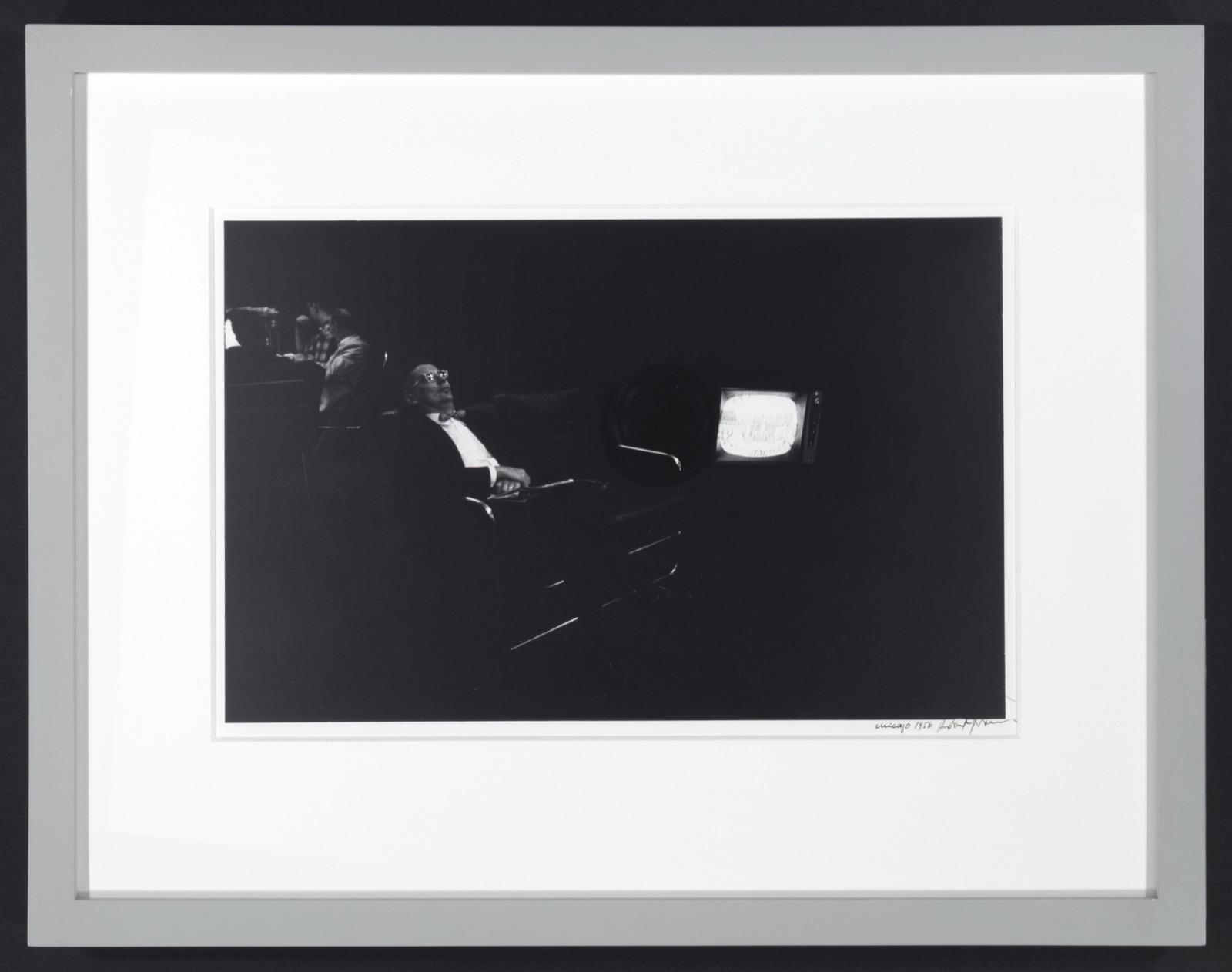
Black holds most of this frame, and the picture's argument lies in how little is permitted to rise out of it. A balding man in spectacles and a dark suit reclines low in a chair, his face and white shirt catching a light that seems to come from below, so that he appears less seated than laid back into the dark. His hand rests, open and idle. To the right, a small television glows with a pale, indecipherable broadcast, and beside it a round black mass—a hat—doubles the screen's circle without returning its light.
The organization is severe and exact. Two sources of illumination, the man and the screen, are set apart across a horizontal band of shadow, and everything between them is withheld. A second figure dissolves at the upper left, barely a collar and a tilt of head. The eye is given two things to do—read the face, read the screen—and the gap between them becomes the subject: a man and a machine each emitting light into the same room, neither looking at the other. Nothing here is arranged for our comfort; the framing crops, the tones close down, the meaning is left to assemble itself.
Made in 1956, this belongs to the restless American looking that would soon remake what a photograph could carry—private, oblique, unwilling to explain. The pencil inscription at lower right, "Chicago 1956," signed by the artist, marks a vintage print from that decisive moment, the kind of object museums have since gathered as the record of how the medium learned to speak in the first person. Its eloquence is entirely in the dark it dares to keep.
Black holds most of this frame, and the picture's argument lies in how little is permitted to rise out of it. A balding man in spectacles and a dark suit reclines low in a chair, his face and white shirt catching a light that seems to come from below, so that he appears less seated than laid back into the dark. His hand rests, open and idle. To the right, a small television glows with a pale, indecipherable broadcast, and beside it a round black mass—a hat—doubles the screen's circle without returning its light.
The organization is severe and exact. Two sources of illumination, the man and the screen, are set apart across a horizontal band of shadow, and everything between them is withheld. A second figure dissolves at the upper left, barely a collar and a tilt of head. The eye is given two things to do—read the face, read the screen—and the gap between them becomes the subject: a man and a machine each emitting light into the same room, neither looking at the other. Nothing here is arranged for our comfort; the framing crops, the tones close down, the meaning is left to assemble itself.
Made in 1956, this belongs to the restless American looking that would soon remake what a photograph could carry—private, oblique, unwilling to explain. The pencil inscription at lower right, "Chicago 1956," signed by the artist, marks a vintage print from that decisive moment, the kind of object museums have since gathered as the record of how the medium learned to speak in the first person. Its eloquence is entirely in the dark it dares to keep.