A photograph of a democracy admiring itself. The frame is choked with placards — HARRIMAN, HARRIMAN CAN WIN!, STEVENSON, the state names INDIANA, CALIFORNIA, UTAH lifted on poles — and behind them the printed faces of the candidates, enlarged into posters that loom larger and steadier than any living person below. The image is almost all surface, all slogan; the convention has already become its own reproduction. To look is to watch politics rehearse what photography does best: turn a person into an image, persuasion into a thing held overhead.
What pierces the noise is the human residue caught between the signs. A man in a feathered headdress sits stoically beneath OKMULGEE OKLAHOMA; a woman in cat-eye glasses throws her head back, laughing; a delegate in a dark suit turns his back to us entirely. These are the un-posed citizens the posters were made to mobilize, and they look exhausted, comic, abstracted — anything but persuaded. The camera does not editorialize so much as accumulate evidence, and the accumulation is the argument: faith and farce in the same square inch.
Made for the project that would become The Americans, this is the outsider's clear-eyed appetite for a country forever advertising itself. The grain is coarse, the tilt deliberate, the white signature scrawled into the lower corner like a verdict. A vintage print from this body of work carries the authority of the moment Frank reinvented the photographic book — held now by the National Gallery of Art, MoMA, the Met. To own one is to keep, in the hand, the negative of an idea: how a nation looks when it forgets the camera is there.
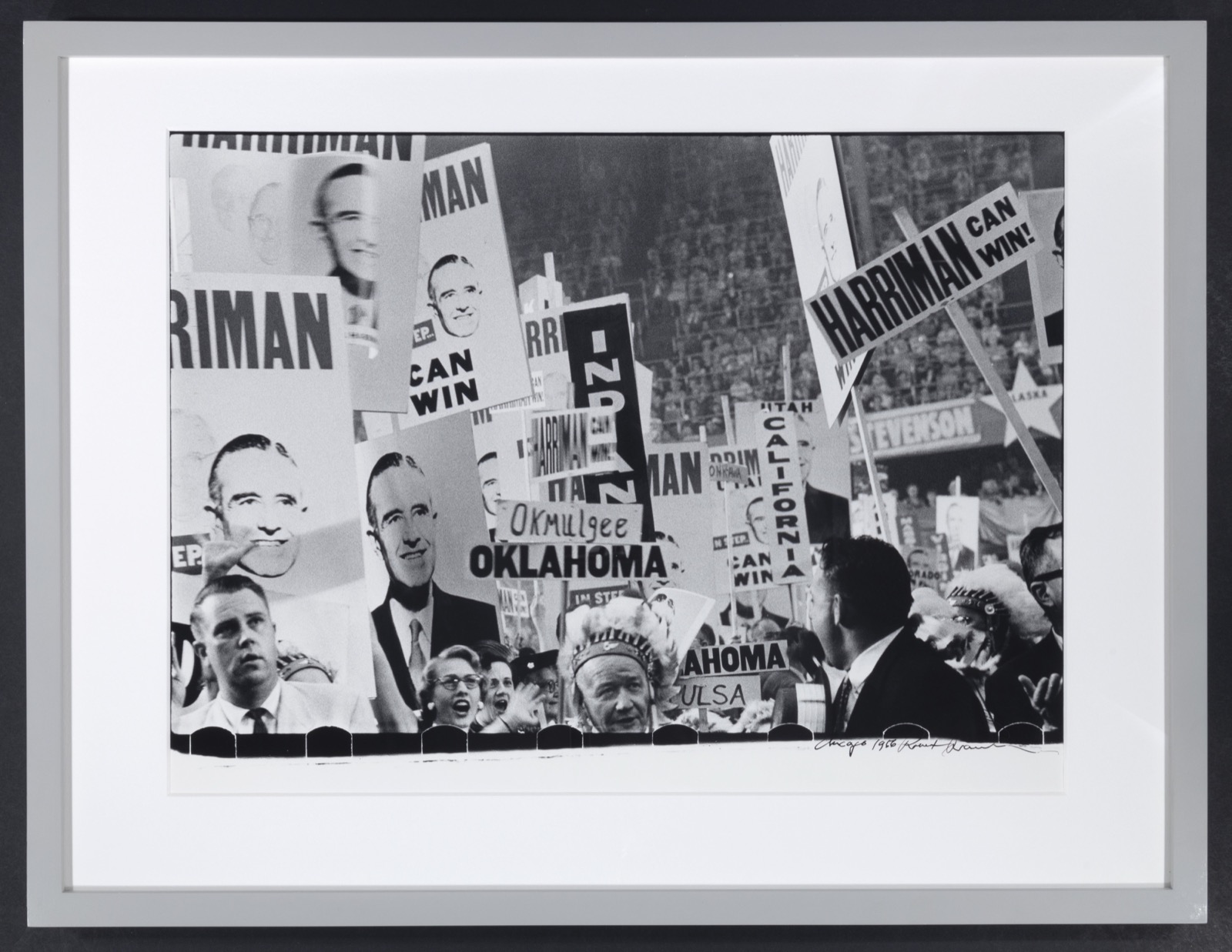

A photograph of a democracy admiring itself. The frame is choked with placards — HARRIMAN, HARRIMAN CAN WIN!, STEVENSON, the state names INDIANA, CALIFORNIA, UTAH lifted on poles — and behind them the printed faces of the candidates, enlarged into posters that loom larger and steadier than any living person below. The image is almost all surface, all slogan; the convention has already become its own reproduction. To look is to watch politics rehearse what photography does best: turn a person into an image, persuasion into a thing held overhead.
What pierces the noise is the human residue caught between the signs. A man in a feathered headdress sits stoically beneath OKMULGEE OKLAHOMA; a woman in cat-eye glasses throws her head back, laughing; a delegate in a dark suit turns his back to us entirely. These are the un-posed citizens the posters were made to mobilize, and they look exhausted, comic, abstracted — anything but persuaded. The camera does not editorialize so much as accumulate evidence, and the accumulation is the argument: faith and farce in the same square inch.
Made for the project that would become The Americans, this is the outsider's clear-eyed appetite for a country forever advertising itself. The grain is coarse, the tilt deliberate, the white signature scrawled into the lower corner like a verdict. A vintage print from this body of work carries the authority of the moment Frank reinvented the photographic book — held now by the National Gallery of Art, MoMA, the Met. To own one is to keep, in the hand, the negative of an idea: how a nation looks when it forgets the camera is there.