Down on the sandy track, two or three small cars have been left nose to tail as though the drivers only meant to pop in for milk. It is the sort of unglamorous detail that, once seen, quietly rearranges everything above it, because the everything above it is a sky the colour of a bruise gone brown, a storm ceiling pressing down over Corn Hill until the whole of Cape Cod seems held under a lid. The cars have no idea. That is their charm.
Meyerowitz’s gift is to let the ridiculous and the sublime keep house together. A red fishing shack, the one saturated note for miles, sits by the tidal creek where boats have gone over on their sides at low water. White cottages line up like teeth. On the right a telephone pole strings its wires clean across the storm, the most banal object in New England conscripted to measure the sky’s bad temper. Nothing dramatic is happening, and yet the air has that pre-thunder charge, the light turned to weak tea and iron.
This is the terrain of Cape Light, the sequence with which he and the eight-by-ten view camera taught American colour photography to be patient, contemplative, adult, alongside Shore and Eggleston. He had begun on the street in Frank’s wake; here he simply waits, letting the weather do the composing. Offered now as an archival pigment print, the sheet keeps the long tonal reach from grass-gold to storm-umber that the big negative made possible. His work lives at the Modern, the Met and the Boston MFA. The cars, presumably, made it home.
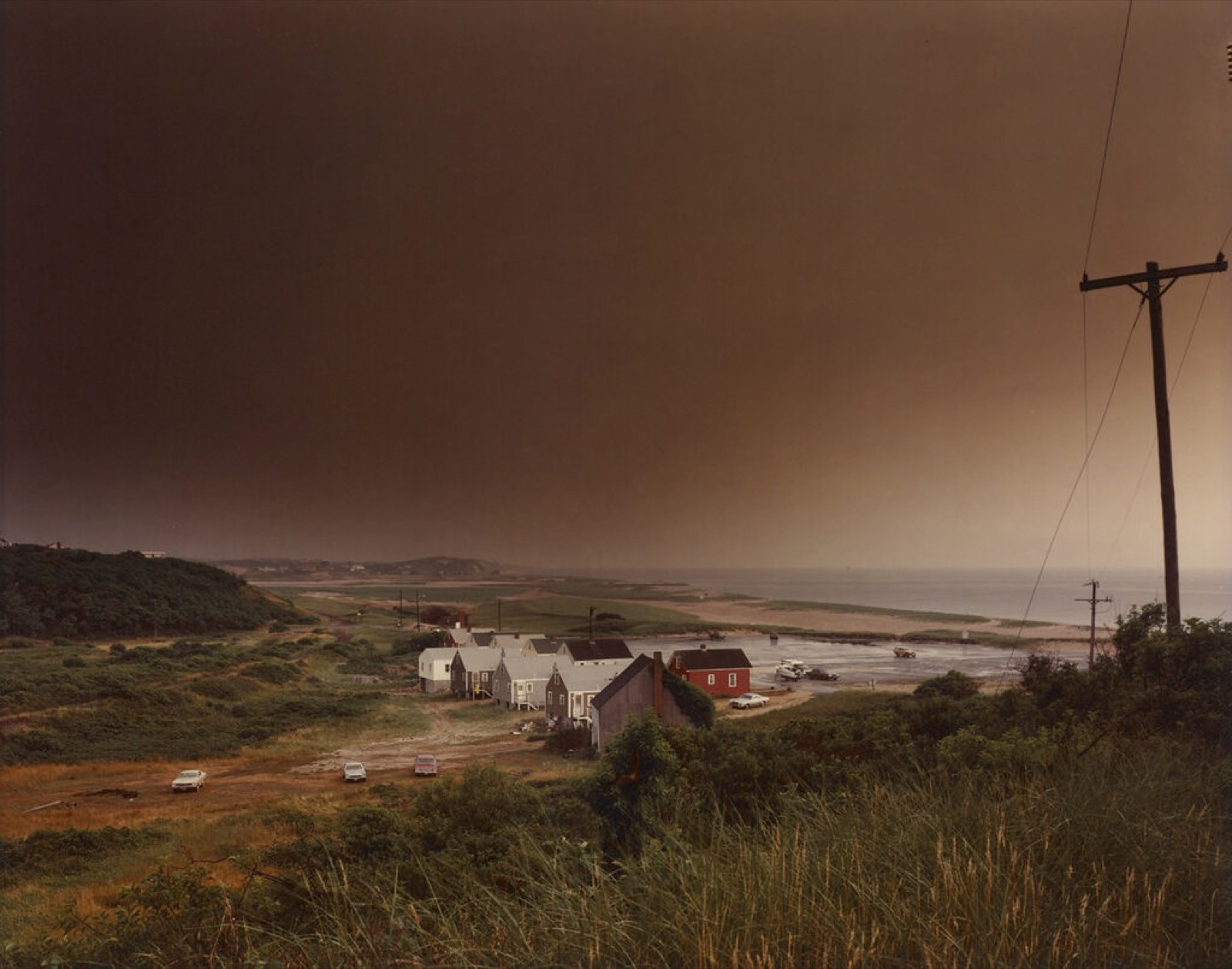

Down on the sandy track, two or three small cars have been left nose to tail as though the drivers only meant to pop in for milk. It is the sort of unglamorous detail that, once seen, quietly rearranges everything above it, because the everything above it is a sky the colour of a bruise gone brown, a storm ceiling pressing down over Corn Hill until the whole of Cape Cod seems held under a lid. The cars have no idea. That is their charm.
Meyerowitz’s gift is to let the ridiculous and the sublime keep house together. A red fishing shack, the one saturated note for miles, sits by the tidal creek where boats have gone over on their sides at low water. White cottages line up like teeth. On the right a telephone pole strings its wires clean across the storm, the most banal object in New England conscripted to measure the sky’s bad temper. Nothing dramatic is happening, and yet the air has that pre-thunder charge, the light turned to weak tea and iron.
This is the terrain of Cape Light, the sequence with which he and the eight-by-ten view camera taught American colour photography to be patient, contemplative, adult, alongside Shore and Eggleston. He had begun on the street in Frank’s wake; here he simply waits, letting the weather do the composing. Offered now as an archival pigment print, the sheet keeps the long tonal reach from grass-gold to storm-umber that the big negative made possible. His work lives at the Modern, the Met and the Boston MFA. The cars, presumably, made it home.