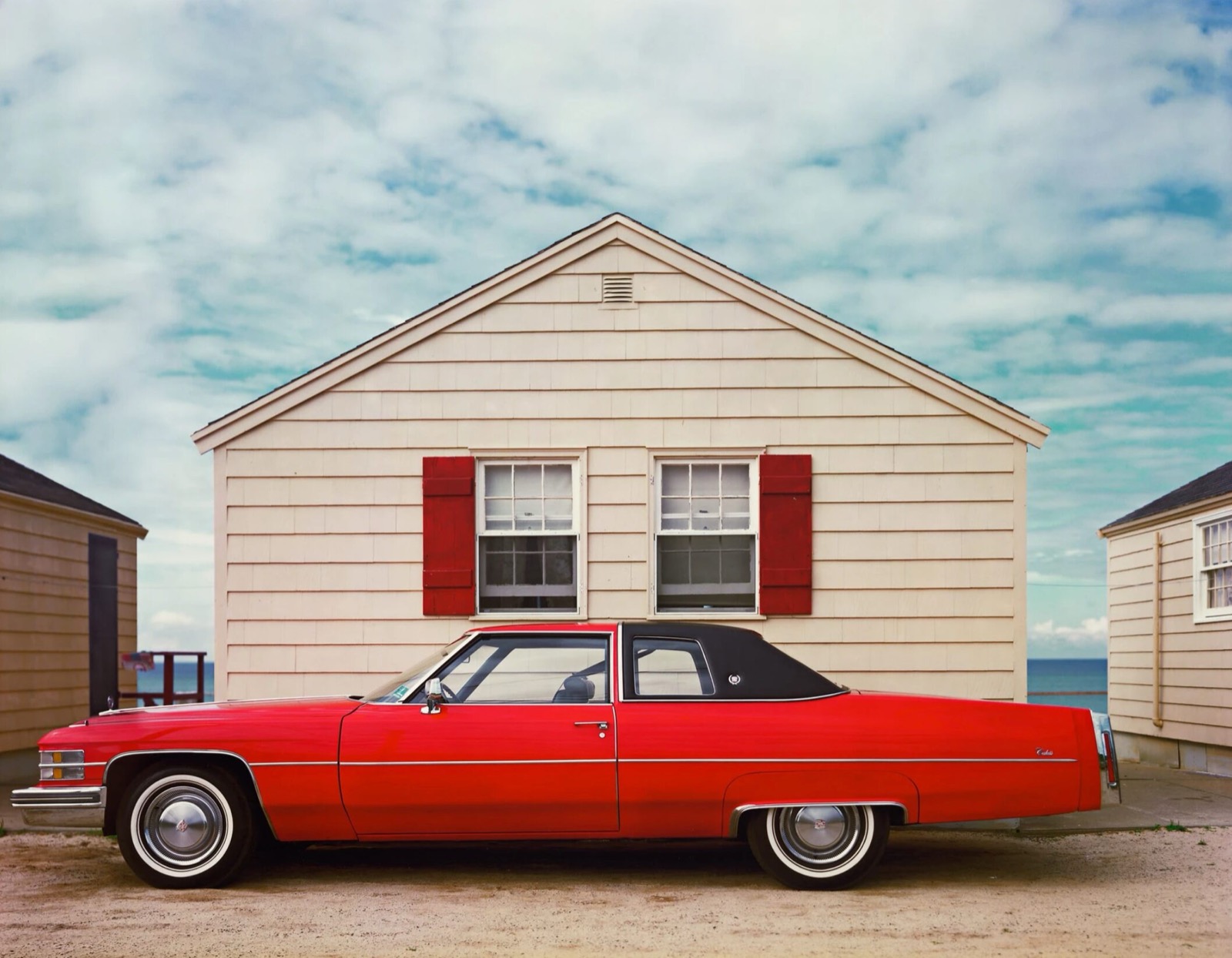
Meyerowitz parks the picture as deliberately as someone has parked the car. The red Cadillac sits broadside to the lens, its long flank laid out parallel to the cottage behind it, so that two flat planes — the lacquered car, the clapboard gable — stack into a frontal, almost heraldic arrangement. Nothing recedes and nothing is caught in passing. This is the deadpan that the new colour photographers of the seventies were learning to trust: a refusal of the decisive moment in favour of the patiently described thing.
A single chord of red organises the frame — the car’s body answered, window for window, by the maroon shutters above it — held against the chalk of the cottage and the cool, overcast blue of a Cape Cod sky. Meyerowitz had moved to the large-format camera precisely to slow down and let colour behave like this, as structure rather than incident. You are given time to register the rhyme, then the whitewall tyres, then the thin seam of sea slipping past on either side, a reminder that the whole tidy colony is pitched on a sandbar at the edge of the Atlantic.
These are the modest, identical rentals that line the Truro shore, and Meyerowitz photographs them with the straight-on respect usually kept for a portrait. The Cadillac, gleaming and faintly absurd in front of so plain a house, becomes the sitter — a piece of American wanting made gorgeous by description rather than judgement. It is a quietly comic, quietly affectionate picture, and its argument is the one he would spend the decade making: that colour, looked at long enough and squarely enough, is subject enough.
Meyerowitz parks the picture as deliberately as someone has parked the car. The red Cadillac sits broadside to the lens, its long flank laid out parallel to the cottage behind it, so that two flat planes — the lacquered car, the clapboard gable — stack into a frontal, almost heraldic arrangement. Nothing recedes and nothing is caught in passing. This is the deadpan that the new colour photographers of the seventies were learning to trust: a refusal of the decisive moment in favour of the patiently described thing.
A single chord of red organises the frame — the car’s body answered, window for window, by the maroon shutters above it — held against the chalk of the cottage and the cool, overcast blue of a Cape Cod sky. Meyerowitz had moved to the large-format camera precisely to slow down and let colour behave like this, as structure rather than incident. You are given time to register the rhyme, then the whitewall tyres, then the thin seam of sea slipping past on either side, a reminder that the whole tidy colony is pitched on a sandbar at the edge of the Atlantic.
These are the modest, identical rentals that line the Truro shore, and Meyerowitz photographs them with the straight-on respect usually kept for a portrait. The Cadillac, gleaming and faintly absurd in front of so plain a house, becomes the sitter — a piece of American wanting made gorgeous by description rather than judgement. It is a quietly comic, quietly affectionate picture, and its argument is the one he would spend the decade making: that colour, looked at long enough and squarely enough, is subject enough.