It is the unlit window that detains me: off to the right, a pale grid of muntins hanging in the fog like graph paper, belonging to a house that has gone to sleep or never woken. Everything else in this amber night performs its role. The streetlamp burns a hole in the mist; the corner window glows its domestic yellow; the wet asphalt returns the light with the obedience of a mirror. But that dark window, ruled into little squares, refuses the drama. It records nothing, expects no one.
I know this hour without ever having lived on this street. The fog is not weather here; it is a kind of amnesia, dissolving the rooflines into one long silhouette, letting the power lines score the sky like the staves of an inaudible music. A dark truck sleeps at the curb. Whoever is awake behind the lit corner panes does not know that they have become the sole event of the night, the small proof that the neighborhood persists. Photography loves such proofs; I distrust them, and am moved all the same.
Todd Hido has photographed the American suburb at night as if it were a sleeping face, and the archival pigment print keeps the mist honest: amber deepening to umber, gradations that never harden. His nocturnes, titled only with numbers, have entered the collections of SFMOMA, the Getty, the Whitney. Yet the print answers to none of that; it answers, finally, to the one dark window, keeping its square and patient silence.
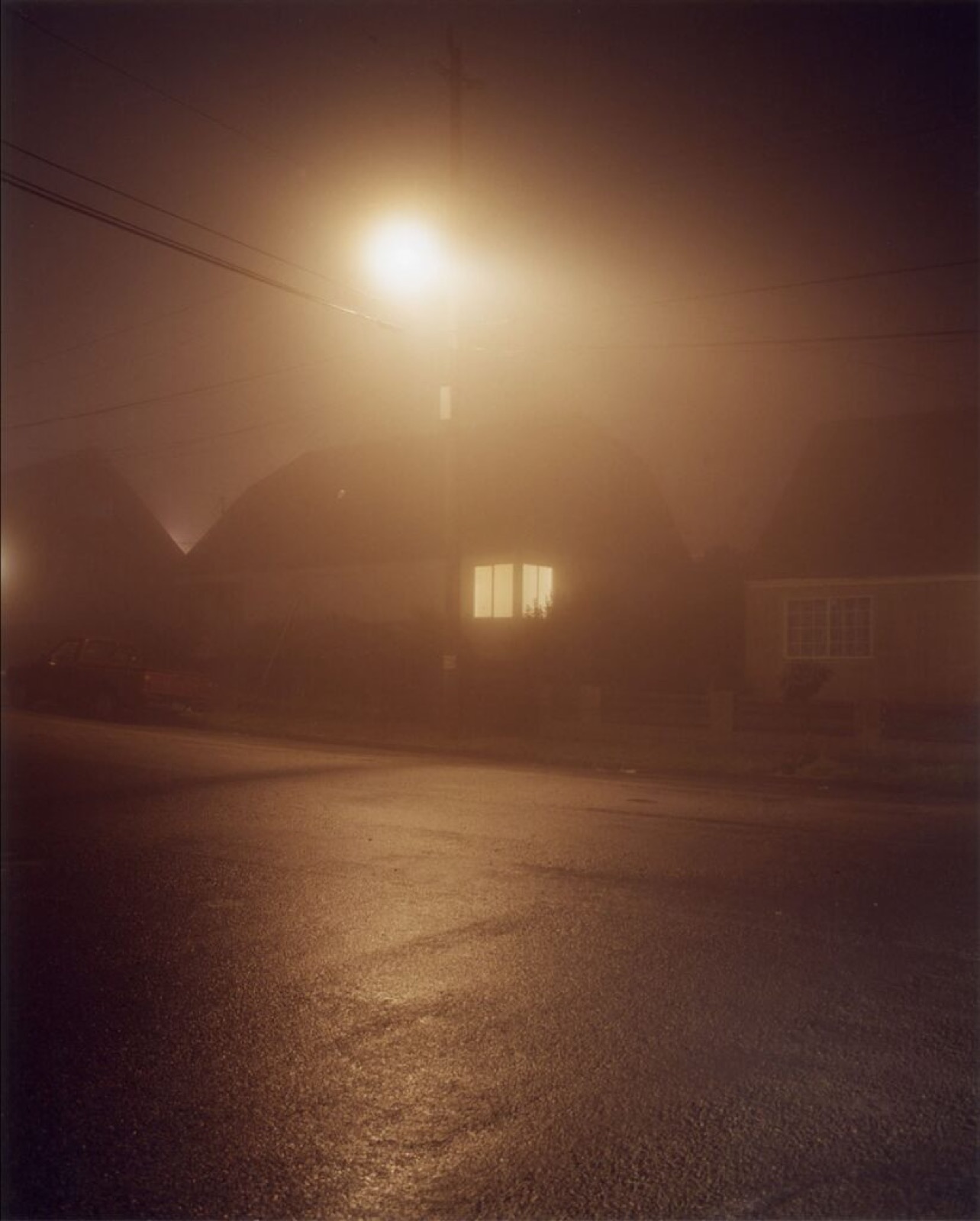

It is the unlit window that detains me: off to the right, a pale grid of muntins hanging in the fog like graph paper, belonging to a house that has gone to sleep or never woken. Everything else in this amber night performs its role. The streetlamp burns a hole in the mist; the corner window glows its domestic yellow; the wet asphalt returns the light with the obedience of a mirror. But that dark window, ruled into little squares, refuses the drama. It records nothing, expects no one.
I know this hour without ever having lived on this street. The fog is not weather here; it is a kind of amnesia, dissolving the rooflines into one long silhouette, letting the power lines score the sky like the staves of an inaudible music. A dark truck sleeps at the curb. Whoever is awake behind the lit corner panes does not know that they have become the sole event of the night, the small proof that the neighborhood persists. Photography loves such proofs; I distrust them, and am moved all the same.
Todd Hido has photographed the American suburb at night as if it were a sleeping face, and the archival pigment print keeps the mist honest: amber deepening to umber, gradations that never harden. His nocturnes, titled only with numbers, have entered the collections of SFMOMA, the Getty, the Whitney. Yet the print answers to none of that; it answers, finally, to the one dark window, keeping its square and patient silence.