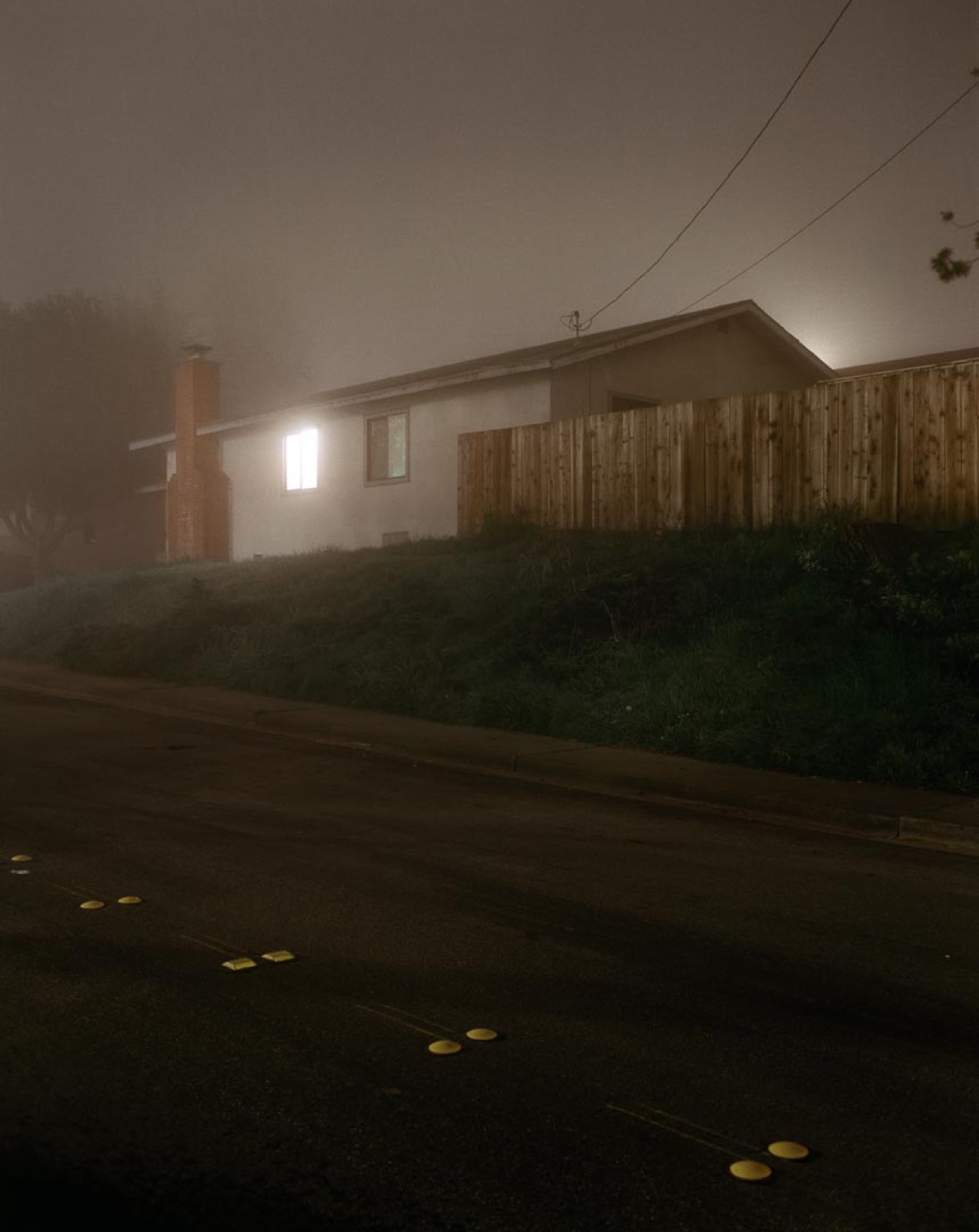
The one lit window gives nothing away: a blank of incandescent white behind glass, no silhouette, no wallpaper, not even the angle of a lamp. That refusal is the engine of the picture. We are shown the full apparatus of narrative, a pale ranch house on its grassy bank, a brick chimney, a new cedar fence still raw enough to glow, and we are denied the plot entirely. Even the second window, dark beside the bright one, reads like a door closed in our face.
Hido works in the directorial mode without directing anything. The suburb supplies its own art department: yellow reflector dots punctuating the asphalt like marks on a stage floor, fog performing as a diffusion filter, a second light flaring behind the fence as if a crew were shooting the reverse angle one garden over. The camera keeps to the street, holding the polite distance of a passing car, and that distance is precisely what makes the looking feel illicit. Cinema taught us these houses; the photograph hands them back unscripted.
Hido, raised in Ohio and long based in the San Francisco Bay Area, has made the fogged suburban night his signature subject; this series carries only numbers for titles, as if names would say too much. Prints from this body of work are held by SFMOMA, the Getty and the Whitney, and the archival pigment print earns that company: the fog resolved into fine tonal breath, the window a clean white aperture in it. What happened inside stays inside. The photograph was never going to tell.

The one lit window gives nothing away: a blank of incandescent white behind glass, no silhouette, no wallpaper, not even the angle of a lamp. That refusal is the engine of the picture. We are shown the full apparatus of narrative, a pale ranch house on its grassy bank, a brick chimney, a new cedar fence still raw enough to glow, and we are denied the plot entirely. Even the second window, dark beside the bright one, reads like a door closed in our face.
Hido works in the directorial mode without directing anything. The suburb supplies its own art department: yellow reflector dots punctuating the asphalt like marks on a stage floor, fog performing as a diffusion filter, a second light flaring behind the fence as if a crew were shooting the reverse angle one garden over. The camera keeps to the street, holding the polite distance of a passing car, and that distance is precisely what makes the looking feel illicit. Cinema taught us these houses; the photograph hands them back unscripted.
Hido, raised in Ohio and long based in the San Francisco Bay Area, has made the fogged suburban night his signature subject; this series carries only numbers for titles, as if names would say too much. Prints from this body of work are held by SFMOMA, the Getty and the Whitney, and the archival pigment print earns that company: the fog resolved into fine tonal breath, the window a clean white aperture in it. What happened inside stays inside. The photograph was never going to tell.