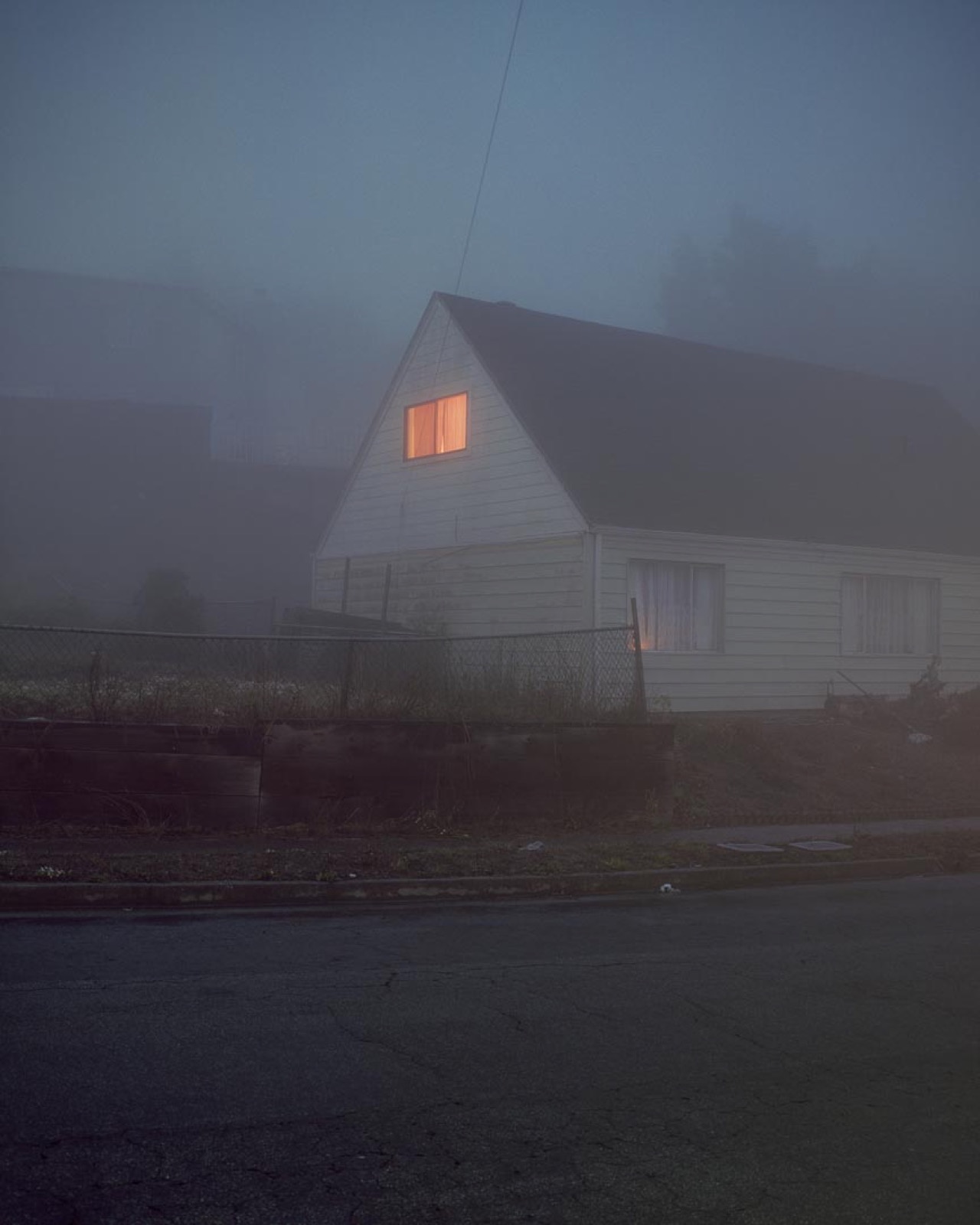
At the end of the American century, the tract house — that postwar promise of safety bought on installment — stood in the fog like this: white clapboard going grey, chain-link sagging, the neighbor’s roofline dissolved to a shadow, one upstairs window burning orange as if the whole idea of home had retreated to a single room. The photograph records less a place than a late chapter; the era that built these streets by the thousand could no longer quite believe in them.
Fog is the great flatterer of photographs. It converts a street into a mood, poverty of detail into plenitude of suggestion; it makes the ordinary illegible and calls the illegibility depth. One is right to be suspicious of such beauty. And yet the seduction works: the cold blue mass of air, the two embers of light, the weeds rising through the planter boxes, a wire descending out of nowhere to touch the roof. The eye consents before the mind can file its objection. A photograph like this does not inform; it administers a feeling.
The photographer made his name on such scenes, cruising the residential dark and numbering what he found; this frame is number 1975-a, and his prints now sit in SFMOMA, the Getty and the Whitney, institutions that certify what the fog already argued. As an archival pigment print, it holds the blue hour without exaggeration and the two orange windows without sentimentality. To look at it long is to feel the century close quietly, one window at a time.
At the end of the American century, the tract house — that postwar promise of safety bought on installment — stood in the fog like this: white clapboard going grey, chain-link sagging, the neighbor’s roofline dissolved to a shadow, one upstairs window burning orange as if the whole idea of home had retreated to a single room. The photograph records less a place than a late chapter; the era that built these streets by the thousand could no longer quite believe in them.
Fog is the great flatterer of photographs. It converts a street into a mood, poverty of detail into plenitude of suggestion; it makes the ordinary illegible and calls the illegibility depth. One is right to be suspicious of such beauty. And yet the seduction works: the cold blue mass of air, the two embers of light, the weeds rising through the planter boxes, a wire descending out of nowhere to touch the roof. The eye consents before the mind can file its objection. A photograph like this does not inform; it administers a feeling.
The photographer made his name on such scenes, cruising the residential dark and numbering what he found; this frame is number 1975-a, and his prints now sit in SFMOMA, the Getty and the Whitney, institutions that certify what the fog already argued. As an archival pigment print, it holds the blue hour without exaggeration and the two orange windows without sentimentality. To look at it long is to feel the century close quietly, one window at a time.