From where we stand — in the middle of an asphalt street, behind a sagging chain-link fence and a strip of dead grass — the house keeps its distance. Fog has thickened the night into something almost solid, and through it a gambrel-roofed home shaped like a barn shows us a single lit window, twin panes of curtained amber burning against pale siding. A television antenna scratches at the murk overhead; power lines slice the sky in long diagonals; at the left edge, a van waits with its lights off. Everything else dissolves.
That window is the picture's engine, and its enigma. Photography, we like to say, brings us closer, but this exposure does the opposite: it measures how far we remain from other lives. The glow tells us somebody is home — a lamp, perhaps a hall light left on — while the curtains refuse every particular. What we are given is not a person but the sign of one, light standing in for presence the way a photograph itself does, an emanation that arrives without its body. The fog behaves like a second emulsion, softening the world into latency, as if the scene were still developing.
This archival pigment print holds the saturated ambers and bruised greys of long exposures made from exactly such curbs in 1997, when this photographer began circling America's subdivisions at night. Those pictures now hang in the collections of SFMOMA, the Getty, and the Whitney, and this one shows why: an ordinary house, patiently attended, made to confess how much of domestic life photography can only ever watch from the street.
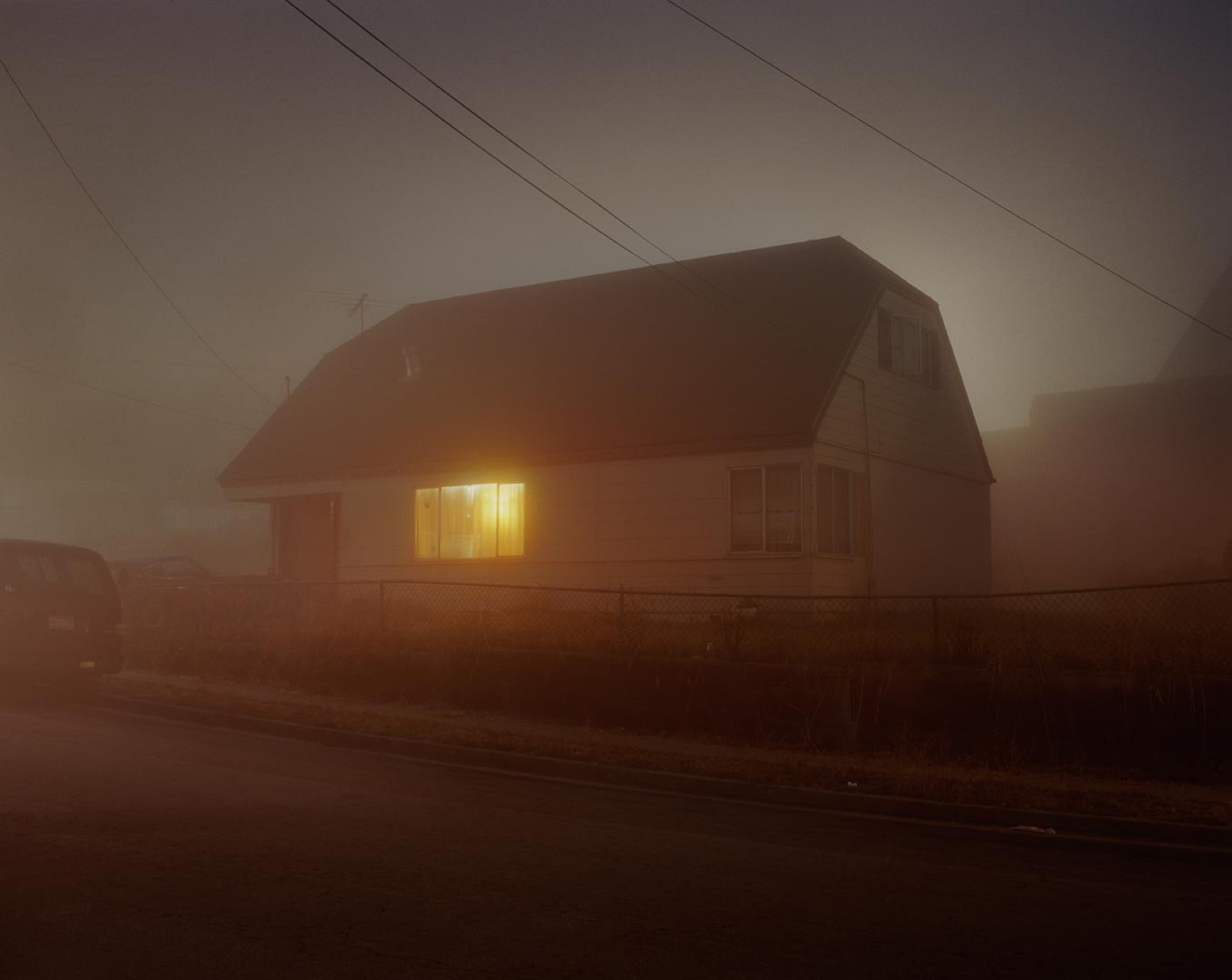

From where we stand — in the middle of an asphalt street, behind a sagging chain-link fence and a strip of dead grass — the house keeps its distance. Fog has thickened the night into something almost solid, and through it a gambrel-roofed home shaped like a barn shows us a single lit window, twin panes of curtained amber burning against pale siding. A television antenna scratches at the murk overhead; power lines slice the sky in long diagonals; at the left edge, a van waits with its lights off. Everything else dissolves.
That window is the picture's engine, and its enigma. Photography, we like to say, brings us closer, but this exposure does the opposite: it measures how far we remain from other lives. The glow tells us somebody is home — a lamp, perhaps a hall light left on — while the curtains refuse every particular. What we are given is not a person but the sign of one, light standing in for presence the way a photograph itself does, an emanation that arrives without its body. The fog behaves like a second emulsion, softening the world into latency, as if the scene were still developing.
This archival pigment print holds the saturated ambers and bruised greys of long exposures made from exactly such curbs in 1997, when this photographer began circling America's subdivisions at night. Those pictures now hang in the collections of SFMOMA, the Getty, and the Whitney, and this one shows why: an ordinary house, patiently attended, made to confess how much of domestic life photography can only ever watch from the street.