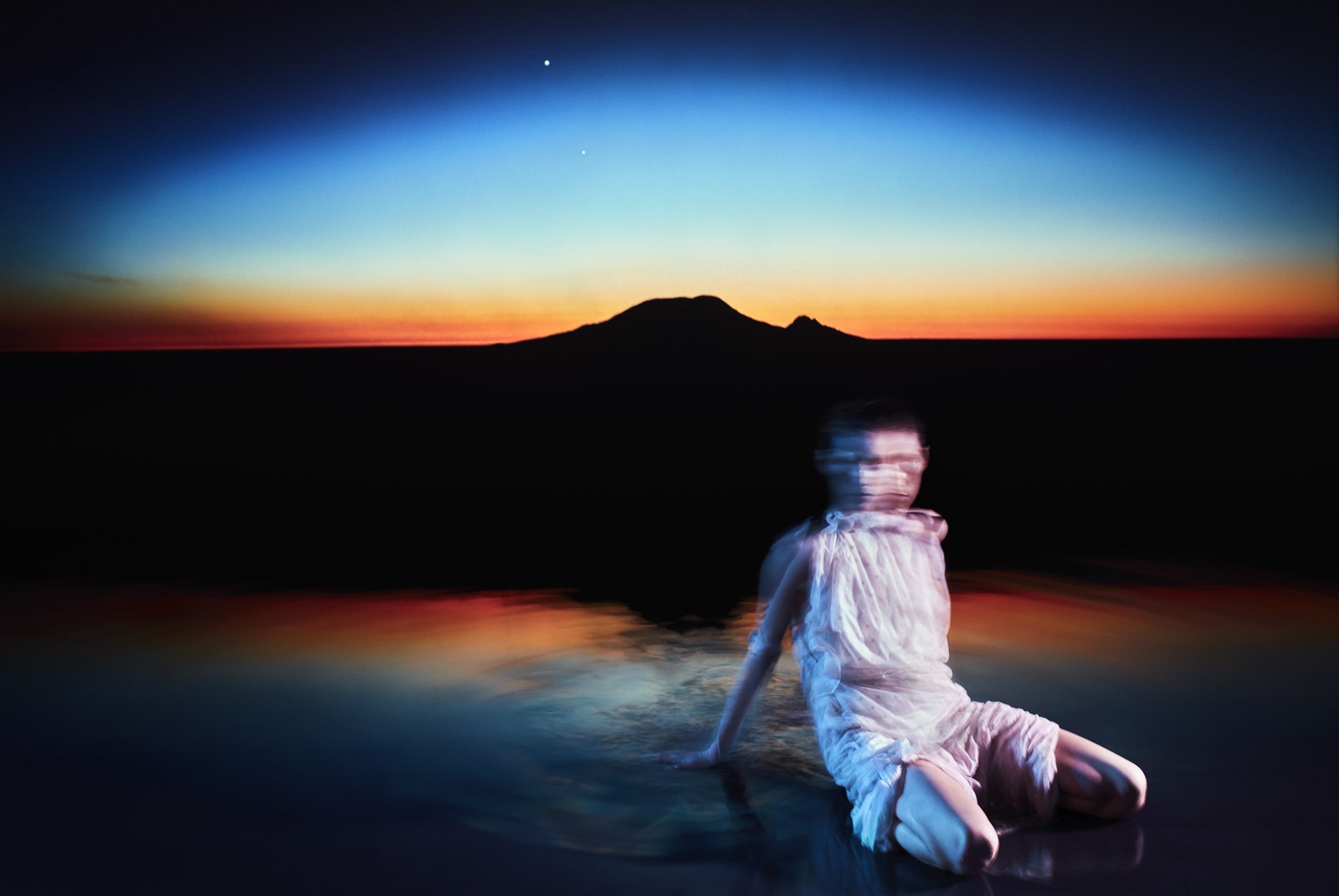
The first photographs could not keep a living body: exposures were so long that the street remained, mineral and exact, while the passerby thinned into mist. This picture consents to that ancient condition instead of correcting it. The mountain holds its silhouette against a sky graded from deep blue to burning orange; two small stars keep their posts; only the woman, kneeling in her white dress where the ground turns to dark mirror, is allowed to blur, as though the exposure had measured her pulse and printed that instead of her face.
What detains me is her hand. Braced flat against the wet ground, it is the steadiest part of her, the one place where she and the landscape agree to touch; everything above it, shoulder, throat, face, has already begun to leave. I find I read the picture twice: once as fashion, the gauze dress, the studied pose; once as something older, a figure taking the temperature of the earth before the sun commits itself. The land is exact; she is duration. Dawn belongs to her kind.
Yeste, born in Barcelona, has carried this elemental register through the great fashion magazines, Numéro, Harper’s Bazaar, Vogue: sand, water, fire, cloth in wind. Here the vehicle is a chromogenic print, and the choice matters: its dyes are made for exactly this passage from night-blue to ember, colors laid into the paper rather than upon it. When I look up from the print, the room seems briefly darker. Two stars, a mountain, a blur in white: morning, before it has decided anything.
The first photographs could not keep a living body: exposures were so long that the street remained, mineral and exact, while the passerby thinned into mist. This picture consents to that ancient condition instead of correcting it. The mountain holds its silhouette against a sky graded from deep blue to burning orange; two small stars keep their posts; only the woman, kneeling in her white dress where the ground turns to dark mirror, is allowed to blur, as though the exposure had measured her pulse and printed that instead of her face.
What detains me is her hand. Braced flat against the wet ground, it is the steadiest part of her, the one place where she and the landscape agree to touch; everything above it, shoulder, throat, face, has already begun to leave. I find I read the picture twice: once as fashion, the gauze dress, the studied pose; once as something older, a figure taking the temperature of the earth before the sun commits itself. The land is exact; she is duration. Dawn belongs to her kind.
Yeste, born in Barcelona, has carried this elemental register through the great fashion magazines, Numéro, Harper’s Bazaar, Vogue: sand, water, fire, cloth in wind. Here the vehicle is a chromogenic print, and the choice matters: its dyes are made for exactly this passage from night-blue to ember, colors laid into the paper rather than upon it. When I look up from the print, the room seems briefly darker. Two stars, a mountain, a blur in white: morning, before it has decided anything.