A telephone in a photograph is always a picture of elsewhere. The camera can hold the receiver against an ear, the coiled cord crossing a leather sleeve, but the voice at the other end stays permanently out of reach. So Yeste photographs the listening instead: a woman stretched across a white mattress in black biker leather and long gloves, hair spilling like ink, a push-button phone resting on the bed beside her. Her face gives nothing away. The title calls it a pause; the picture makes the pause feel like weather.
Then the second frame arrives, stacked beneath the first like a reply: a black dog in profile, jaws wide, teeth bared, a thread of saliva catching the light. Nothing literally connects the two images, which is exactly how they connect. This is the old intelligence of the printed page, where meaning lives in the gutter between pictures. Pair a still woman with a snarling animal and the call acquires a content no caption could supply: threat, appetite, bad news, or the sound of her own interior turned up loud. The cut does the talking.
Yeste, among the leading Spanish fashion photographers of his generation, made his name in Numéro, Harper’s Bazaar and Vogue, where sequencing is craft, not afterthought; this diptych carries that editorial intelligence into a single object. As an archival pigment print it runs on deep contrast: leather, dog, shadowed wall against mattress, the cord and the teeth. Fashion photography usually promises that glamour will answer. Here the line stays open.
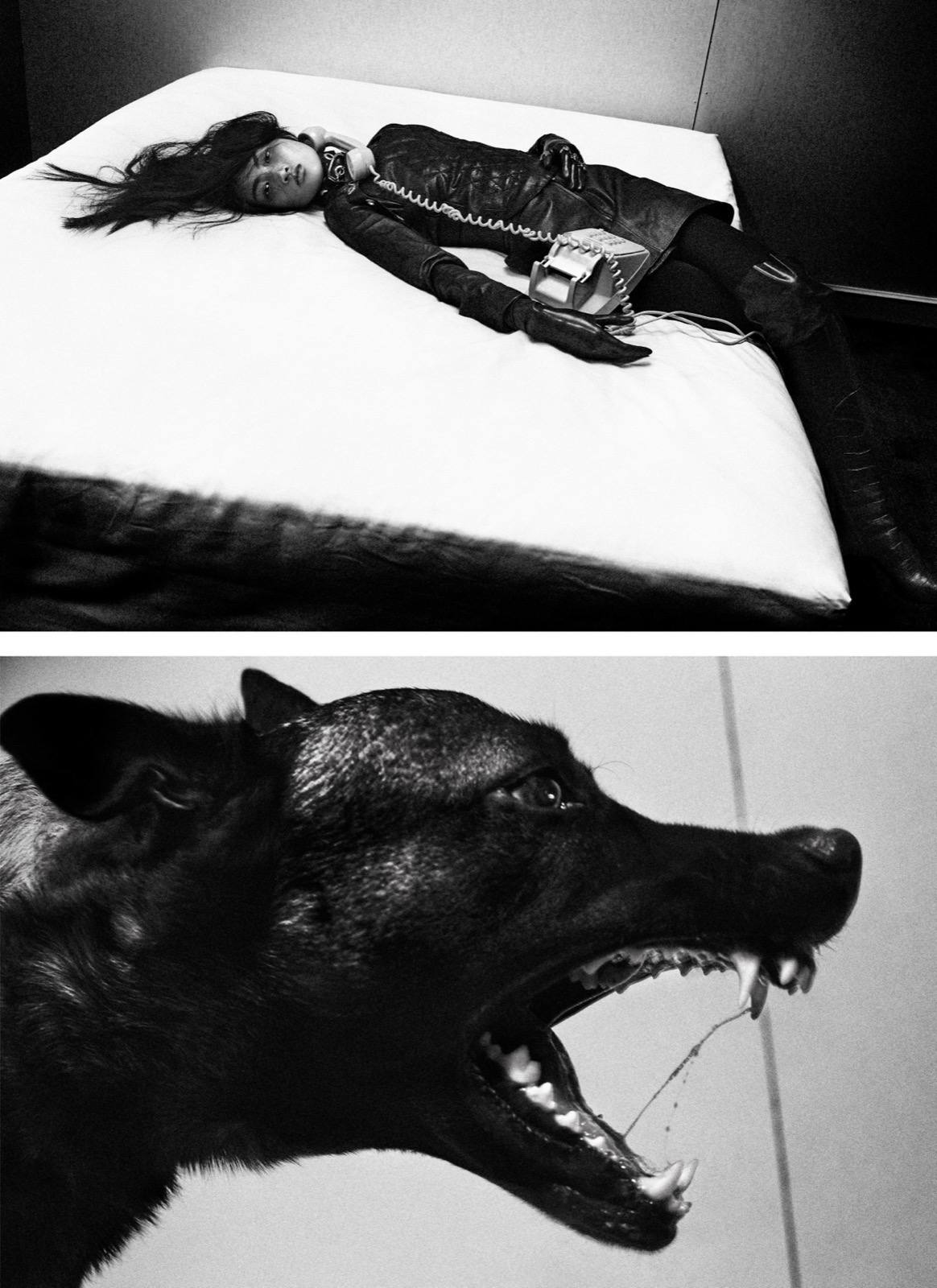

A telephone in a photograph is always a picture of elsewhere. The camera can hold the receiver against an ear, the coiled cord crossing a leather sleeve, but the voice at the other end stays permanently out of reach. So Yeste photographs the listening instead: a woman stretched across a white mattress in black biker leather and long gloves, hair spilling like ink, a push-button phone resting on the bed beside her. Her face gives nothing away. The title calls it a pause; the picture makes the pause feel like weather.
Then the second frame arrives, stacked beneath the first like a reply: a black dog in profile, jaws wide, teeth bared, a thread of saliva catching the light. Nothing literally connects the two images, which is exactly how they connect. This is the old intelligence of the printed page, where meaning lives in the gutter between pictures. Pair a still woman with a snarling animal and the call acquires a content no caption could supply: threat, appetite, bad news, or the sound of her own interior turned up loud. The cut does the talking.
Yeste, among the leading Spanish fashion photographers of his generation, made his name in Numéro, Harper’s Bazaar and Vogue, where sequencing is craft, not afterthought; this diptych carries that editorial intelligence into a single object. As an archival pigment print it runs on deep contrast: leather, dog, shadowed wall against mattress, the cord and the teeth. Fashion photography usually promises that glamour will answer. Here the line stays open.