Under the peak of the roof, one window is awake, and in it hangs a lace curtain. This is the detail I cannot get past. The house presents itself as pure geometry, an enormous dark triangle bearing down on streaked stucco, and the night as pure circuitry, pole, cables, a brace running diagonally to the ground. Then the lace: patterned, grandmotherly, lit from within like a paper lantern. One soft thing, and the only one. It converts the whole severe structure into a shell around a life.
I do not know who chose that curtain, but I know the choosing: the wish to be veiled and luminous at once, to let the street see only that one is home. Below, a window flanked by shutters returns the light coldly, glass without confession. The lawn keeps the long shadow of the utility pole the way skin keeps the print of a watchband. Everything else is a silence of the deepest blue; the sky has the density of velvet, and against it the house insists, absurdly, tenderly, on being someone’s.
Hido’s night houses, numbered rather than named, hang now in SFMOMA, the Whitney, the Getty; institutions collect them, I suspect, for the very reason I linger here: they are portraits from which the sitter has been withheld. The archival pigment print gives the blue its full nocturnal weight and lets the little flame of the window stay warm inside it. Lace, shadow, velvet dark: a house like a body asleep, one eye still lit.
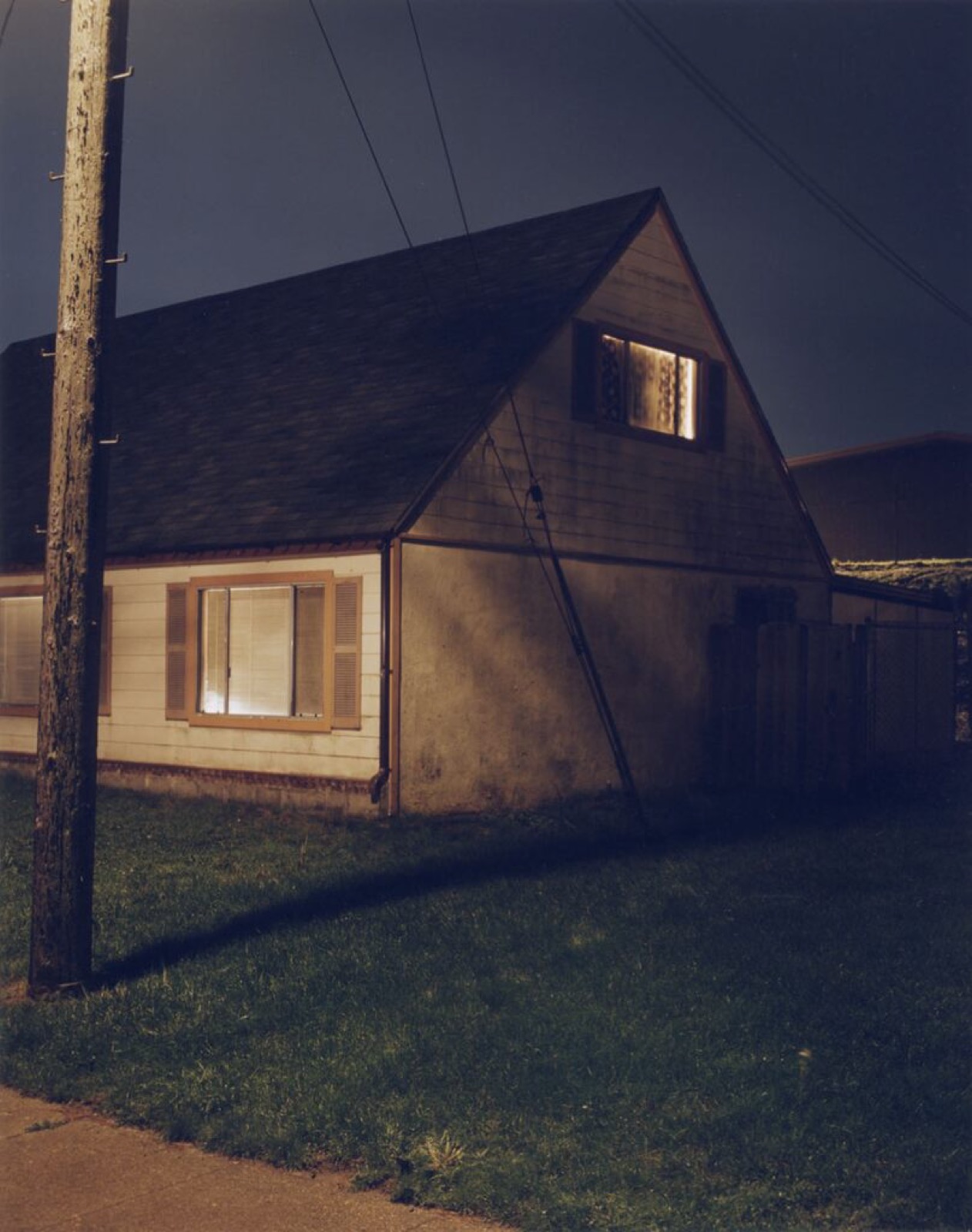
Under the peak of the roof, one window is awake, and in it hangs a lace curtain. This is the detail I cannot get past. The house presents itself as pure geometry, an enormous dark triangle bearing down on streaked stucco, and the night as pure circuitry, pole, cables, a brace running diagonally to the ground. Then the lace: patterned, grandmotherly, lit from within like a paper lantern. One soft thing, and the only one. It converts the whole severe structure into a shell around a life.
I do not know who chose that curtain, but I know the choosing: the wish to be veiled and luminous at once, to let the street see only that one is home. Below, a window flanked by shutters returns the light coldly, glass without confession. The lawn keeps the long shadow of the utility pole the way skin keeps the print of a watchband. Everything else is a silence of the deepest blue; the sky has the density of velvet, and against it the house insists, absurdly, tenderly, on being someone’s.
Hido’s night houses, numbered rather than named, hang now in SFMOMA, the Whitney, the Getty; institutions collect them, I suspect, for the very reason I linger here: they are portraits from which the sitter has been withheld. The archival pigment print gives the blue its full nocturnal weight and lets the little flame of the window stay warm inside it. Lace, shadow, velvet dark: a house like a body asleep, one eye still lit.