What is a school-crossing sign doing in a photograph where nobody will ever cross? Its yellow pentagon carries the silhouettes of two hurrying children, an image within the image, the only human figures this night allows. They walk forever inside their sign while the intersection beneath them lies empty, its double yellow lines converging on nothing, its asphalt cracked like old varnish. The house behind offers no help: curtains drawn, one window backlit to the pallor of a lampshade.
Everything in this scene was made from a template: the regulation sign, the painted lines, the tract house with its shingled roof, even the flagstone wall assembled from a catalogue. Hido photographs suburbia as a system of reproducible parts, then submits his own reproduction, and the difference is the light. A violet haze hangs overhead as though the air held a residue of every porch lamp and television, dry grass goes to gold at the curb, and a pile of scrap lumber waits by the fence like the kit for one more house.
The archival pigment print is itself a fabricated object, ink settled into paper with industrial precision, and it repays attention to its surface: the sky’s long violet gradation without a seam, the sign’s yellow held at full pitch. Prints from this series now sit in the collections of the Getty, the Whitney and SFMOMA, which is one kind of circulation; the other is the way this image lodges in whoever has ever walked a silent intersection at night and felt watched by the houses. Two children keep crossing. No one arrives.
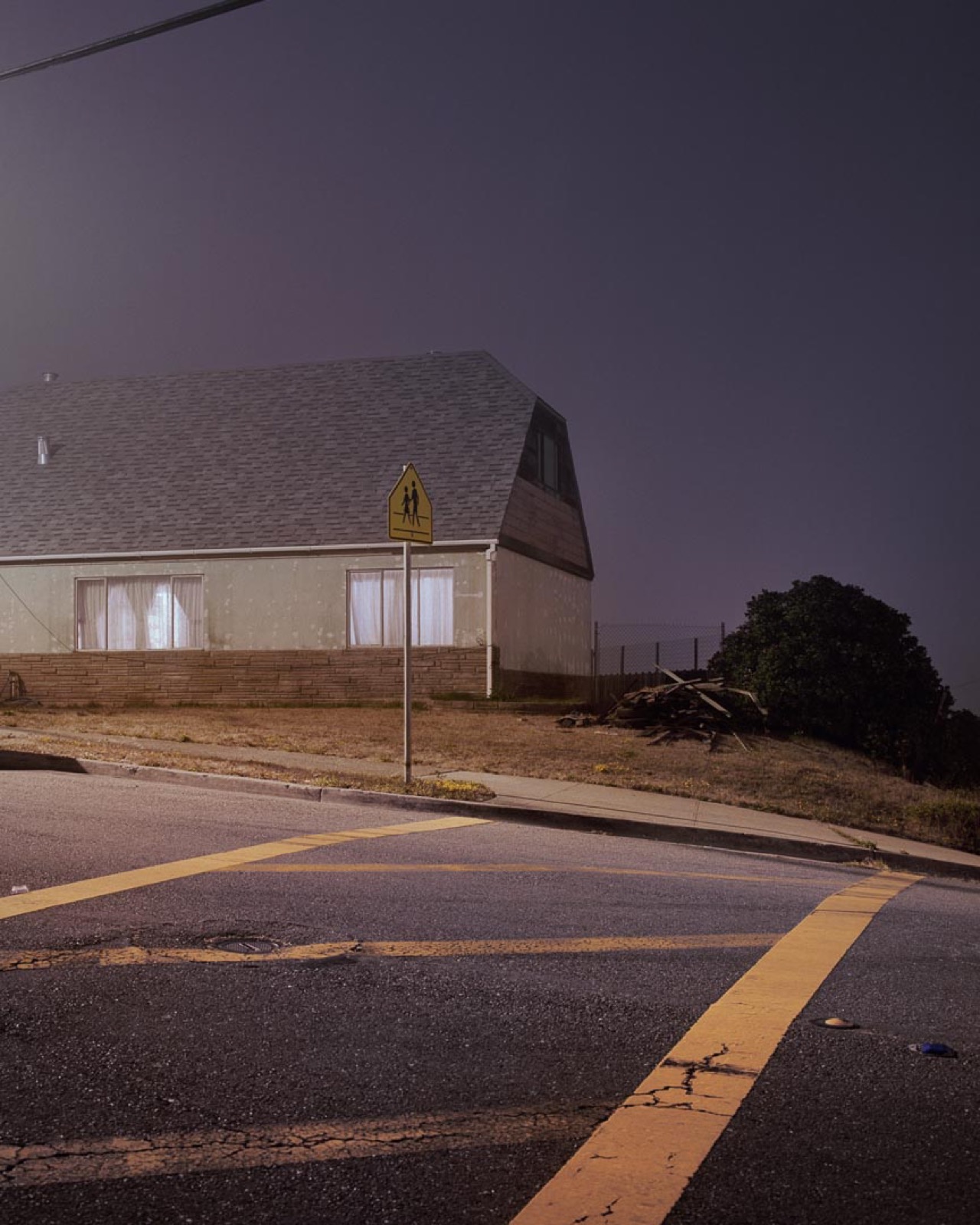

What is a school-crossing sign doing in a photograph where nobody will ever cross? Its yellow pentagon carries the silhouettes of two hurrying children, an image within the image, the only human figures this night allows. They walk forever inside their sign while the intersection beneath them lies empty, its double yellow lines converging on nothing, its asphalt cracked like old varnish. The house behind offers no help: curtains drawn, one window backlit to the pallor of a lampshade.
Everything in this scene was made from a template: the regulation sign, the painted lines, the tract house with its shingled roof, even the flagstone wall assembled from a catalogue. Hido photographs suburbia as a system of reproducible parts, then submits his own reproduction, and the difference is the light. A violet haze hangs overhead as though the air held a residue of every porch lamp and television, dry grass goes to gold at the curb, and a pile of scrap lumber waits by the fence like the kit for one more house.
The archival pigment print is itself a fabricated object, ink settled into paper with industrial precision, and it repays attention to its surface: the sky’s long violet gradation without a seam, the sign’s yellow held at full pitch. Prints from this series now sit in the collections of the Getty, the Whitney and SFMOMA, which is one kind of circulation; the other is the way this image lodges in whoever has ever walked a silent intersection at night and felt watched by the houses. Two children keep crossing. No one arrives.