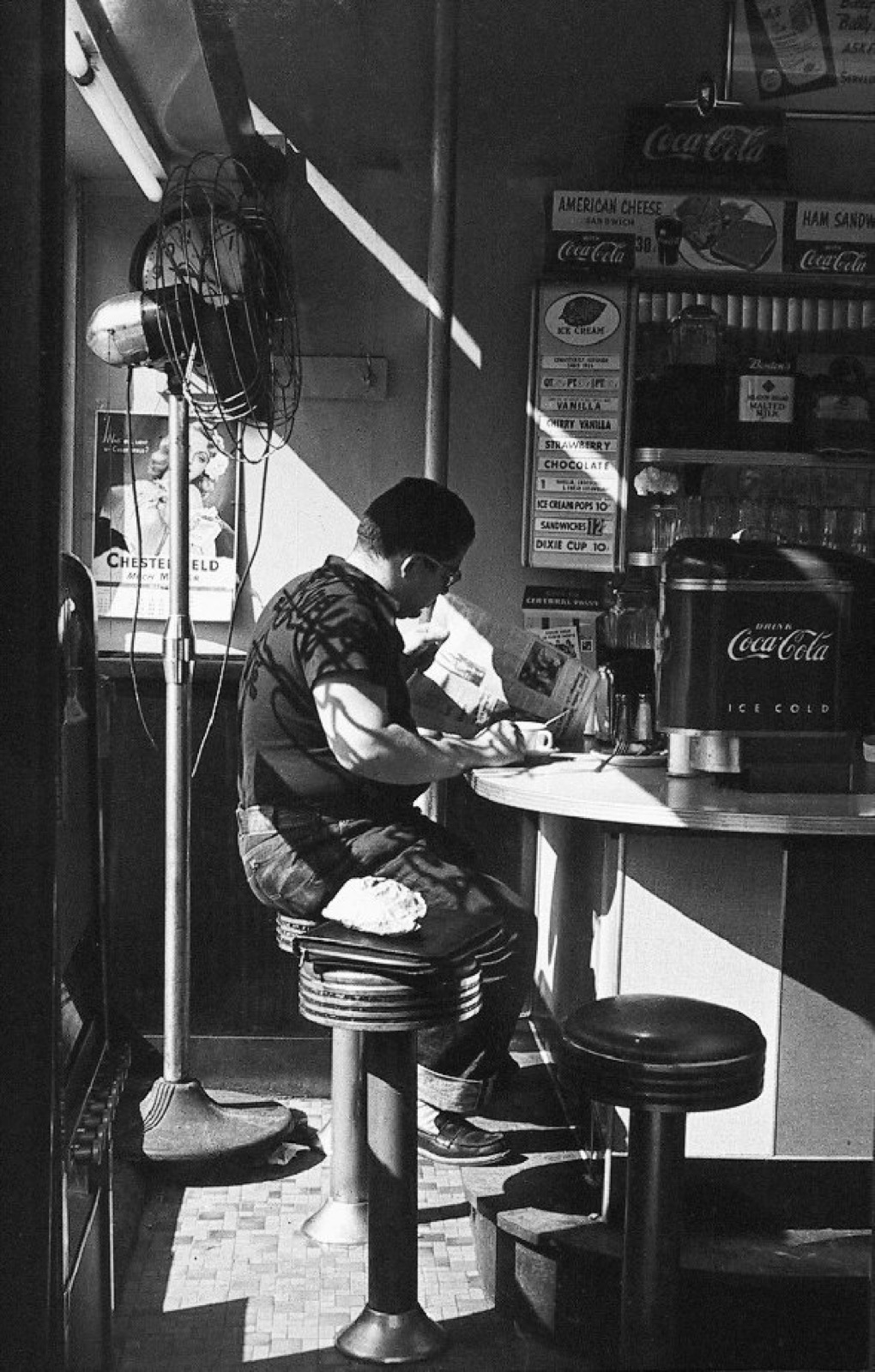
A man sits alone at the curved end of a counter, and the room bends toward him. He reads a newspaper spread beside a coffee cup, head lowered, cap pulled down, glasses catching nothing. The light arrives in a single diagonal wedge across the back wall and scatters over the tiled floor; everything else is held in cool interior dark. A chrome fan stands on its pole like a sentry, its nickel head a small captured sun, blades stilled.
The wall behind him is a litany of mid-century appetite: AMERICAN CHEESE, HAM SANDWICH, the price list for ice cream, and the great red script of Coca-Cola repeated like a refrain, ICE COLD on the cooler at his elbow. A Chesterfield ad glows faintly at left. These are the household gods of a particular New York, the working city of 1951, and the man among them is anonymous, absorbed, entirely himself. To read the paper at a lunch counter is to be alone in public, a privacy the metropolis grants and then quietly photographs.
What moves me is the empty second stool, its black cushion turned toward us, waiting. The picture is built on that geometry of presence and absence: one figure, one vacancy, the long bright floor between. A maker who crossed his whole life between this city and Paris knew that tenderness is a matter of where you stand and what you decline to interrupt. The vintage print holds the grain and silver of its making, the reason the Met and the Pompidou keep such things: not the diner, long gone, but the dignity of an ordinary man reading.
A man sits alone at the curved end of a counter, and the room bends toward him. He reads a newspaper spread beside a coffee cup, head lowered, cap pulled down, glasses catching nothing. The light arrives in a single diagonal wedge across the back wall and scatters over the tiled floor; everything else is held in cool interior dark. A chrome fan stands on its pole like a sentry, its nickel head a small captured sun, blades stilled.
The wall behind him is a litany of mid-century appetite: AMERICAN CHEESE, HAM SANDWICH, the price list for ice cream, and the great red script of Coca-Cola repeated like a refrain, ICE COLD on the cooler at his elbow. A Chesterfield ad glows faintly at left. These are the household gods of a particular New York, the working city of 1951, and the man among them is anonymous, absorbed, entirely himself. To read the paper at a lunch counter is to be alone in public, a privacy the metropolis grants and then quietly photographs.
What moves me is the empty second stool, its black cushion turned toward us, waiting. The picture is built on that geometry of presence and absence: one figure, one vacancy, the long bright floor between. A maker who crossed his whole life between this city and Paris knew that tenderness is a matter of where you stand and what you decline to interrupt. The vintage print holds the grain and silver of its making, the reason the Met and the Pompidou keep such things: not the diner, long gone, but the dignity of an ordinary man reading.