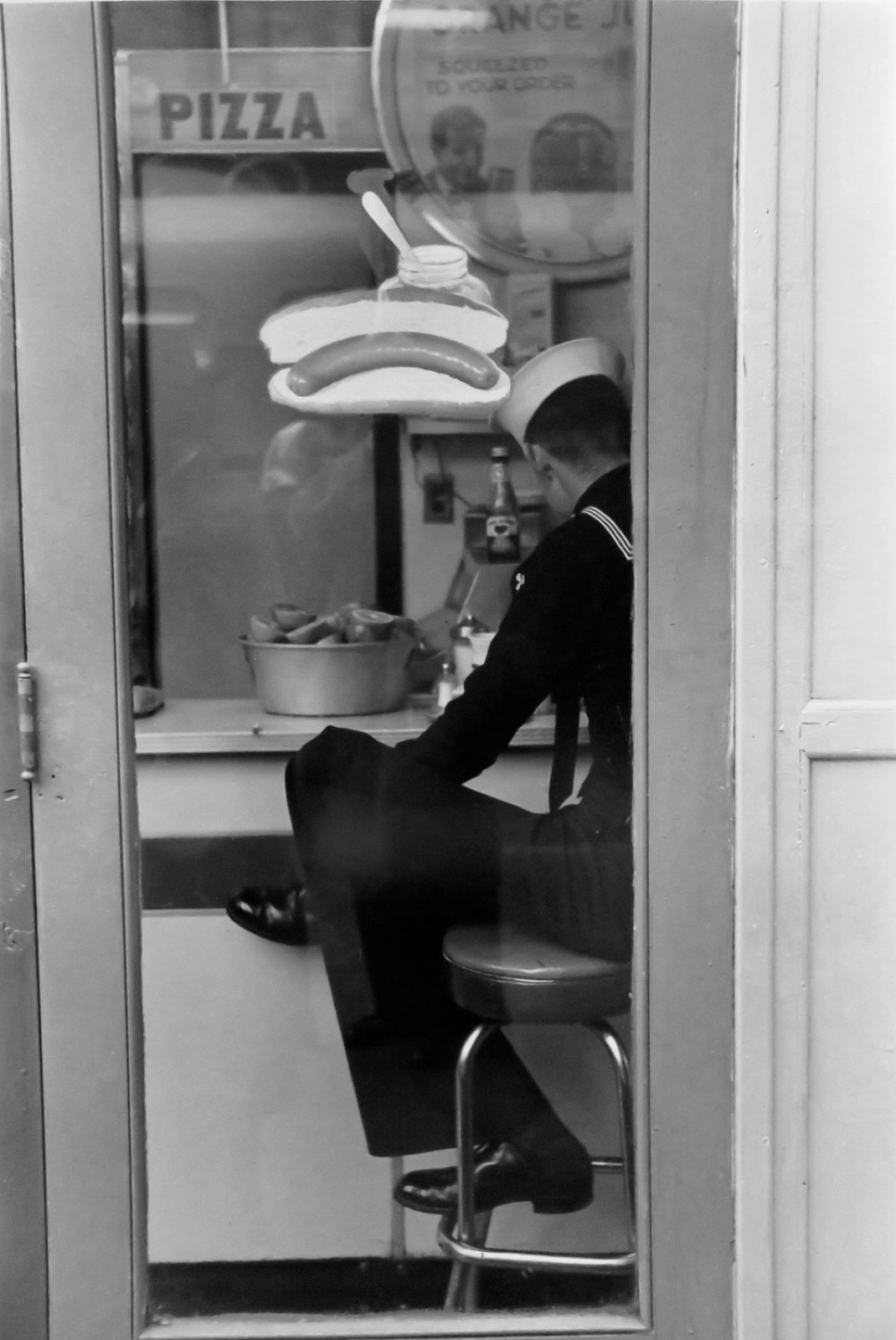
A young sailor in dress blues sits alone at a counter window, framed twice over: by the glass storefront and by the dark doorjambs that press in from either side, narrowing the world to this single lit cell. We read the studium easily — the lunch counter, PIZZA stencilled on the pane, the orange-juice dispenser promising it "squeezed to your order," the bowl of rolls, a bottle of ketchup. The codes of an era are all here, legible as a newspaper. He has turned away; we are given his white-capped head, the wide collar, the dark trouser leg crossed over the chrome stool.
And then the wound. Suspended above him, on a hand-painted advertisement, two enormous frankfurters in a split bun, a jar with its spoon. The cheap drawing floats exactly over his bowed head like a thought balloon, like a halo of meat — and that absurd, tender collision is the punctum, the detail that pierces and cannot be unseen. The image stops being about a serviceman eating and becomes about appetite, solitude, the pathos of being twenty and hungry and far from home. One does not choose the punctum; it rises and stings.
This is the humanist eye that worked New York and Paris for seven decades — patient, affectionate, never cruel. The reflections layered in the glass make the picture almost a meditation on photography itself: surface, depth, the seen and the half-glimpsed. Held now by the Met, the Centre Pompidou, SFMOMA, the work has entered the permanent record; a vintage print from these years carries the actual silver of that looking, the trace laid down close to the moment.
A young sailor in dress blues sits alone at a counter window, framed twice over: by the glass storefront and by the dark doorjambs that press in from either side, narrowing the world to this single lit cell. We read the studium easily — the lunch counter, PIZZA stencilled on the pane, the orange-juice dispenser promising it "squeezed to your order," the bowl of rolls, a bottle of ketchup. The codes of an era are all here, legible as a newspaper. He has turned away; we are given his white-capped head, the wide collar, the dark trouser leg crossed over the chrome stool.
And then the wound. Suspended above him, on a hand-painted advertisement, two enormous frankfurters in a split bun, a jar with its spoon. The cheap drawing floats exactly over his bowed head like a thought balloon, like a halo of meat — and that absurd, tender collision is the punctum, the detail that pierces and cannot be unseen. The image stops being about a serviceman eating and becomes about appetite, solitude, the pathos of being twenty and hungry and far from home. One does not choose the punctum; it rises and stings.
This is the humanist eye that worked New York and Paris for seven decades — patient, affectionate, never cruel. The reflections layered in the glass make the picture almost a meditation on photography itself: surface, depth, the seen and the half-glimpsed. Held now by the Met, the Centre Pompidou, SFMOMA, the work has entered the permanent record; a vintage print from these years carries the actual silver of that looking, the trace laid down close to the moment.