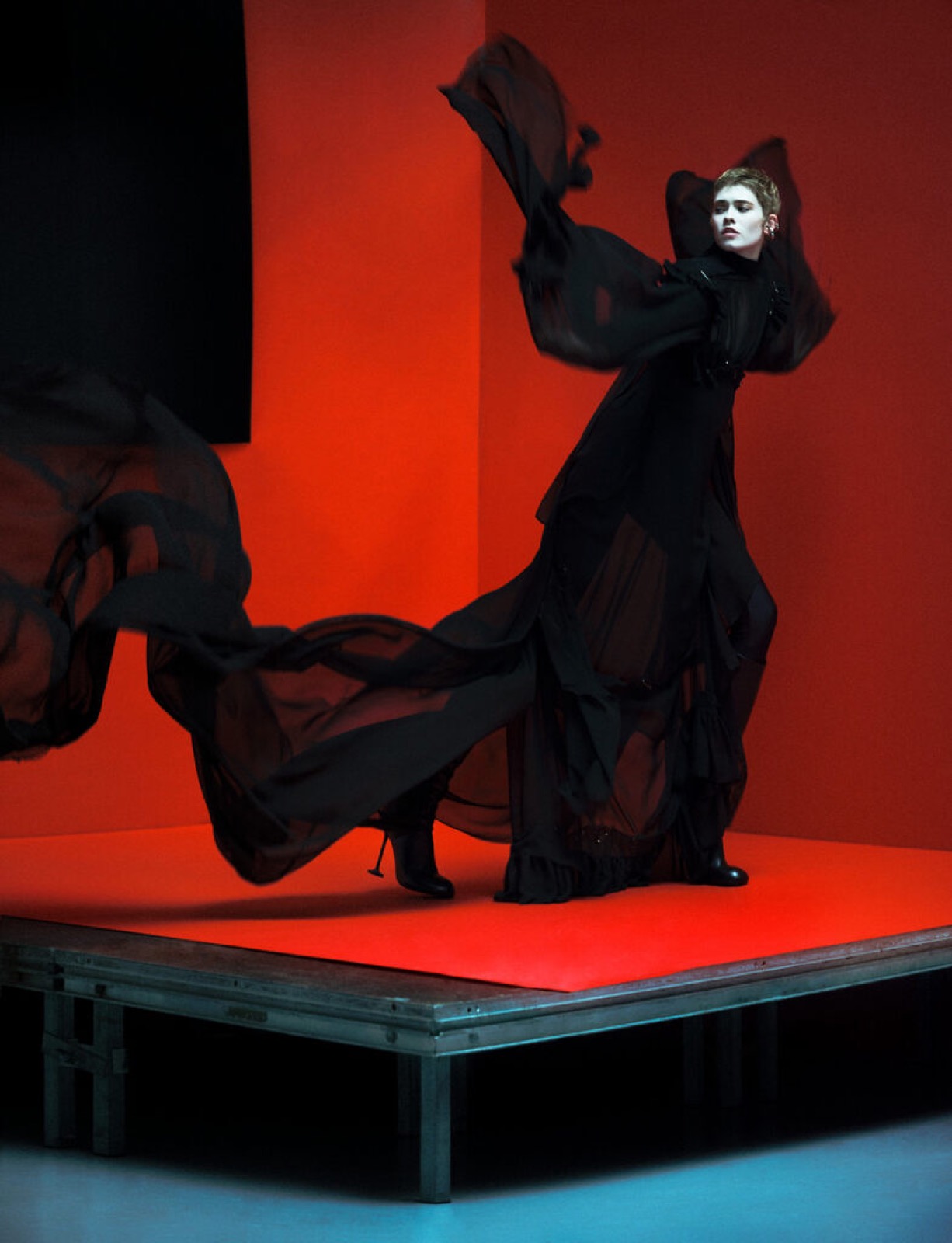
A black rectangle hangs on the red wall like a caption with its words scraped away, a hard slab of nothing set into all that heat. It behaves the way a sign should, commanding the corner, insisting on being read, yet it withholds its message and lets the fabric do the talking. Around it the chiffon opens into wings, sheer black panels blurred at the edges where the shutter caught them still moving, so that the picture carries two speeds at once: the stillness of the painted square and the rush of cloth.
The woman stands at the far edge of a plywood riser, cropped hair lit hard from the right, arms folded across a ruffled throat as if bracing against her own gown. Below her the stage is honest about itself, all bolts and battens and a strip of blue light seeping under the boards, the machinery a fashion image usually hides. A sheet of scarlet paper has been laid on top like a second floor, and the black heel that lifts off it turns the whole apparatus into choreography.
Yeste, among the first rank of Spanish fashion photographers, has spent his editorial years chasing the elements, and here the element is simply air made visible through cloth. What could be pure spectacle stays intelligent because he keeps the seams showing; the theatre is the subject as much as the dress. Rendered as an archival pigment print, the reds hold their saturation and the sheer blacks keep their gradations, so the fabric never collapses into a silhouette. It knows it is a performance and refuses to pretend otherwise.
A black rectangle hangs on the red wall like a caption with its words scraped away, a hard slab of nothing set into all that heat. It behaves the way a sign should, commanding the corner, insisting on being read, yet it withholds its message and lets the fabric do the talking. Around it the chiffon opens into wings, sheer black panels blurred at the edges where the shutter caught them still moving, so that the picture carries two speeds at once: the stillness of the painted square and the rush of cloth.
The woman stands at the far edge of a plywood riser, cropped hair lit hard from the right, arms folded across a ruffled throat as if bracing against her own gown. Below her the stage is honest about itself, all bolts and battens and a strip of blue light seeping under the boards, the machinery a fashion image usually hides. A sheet of scarlet paper has been laid on top like a second floor, and the black heel that lifts off it turns the whole apparatus into choreography.
Yeste, among the first rank of Spanish fashion photographers, has spent his editorial years chasing the elements, and here the element is simply air made visible through cloth. What could be pure spectacle stays intelligent because he keeps the seams showing; the theatre is the subject as much as the dress. Rendered as an archival pigment print, the reds hold their saturation and the sheer blacks keep their gradations, so the fabric never collapses into a silhouette. It knows it is a performance and refuses to pretend otherwise.