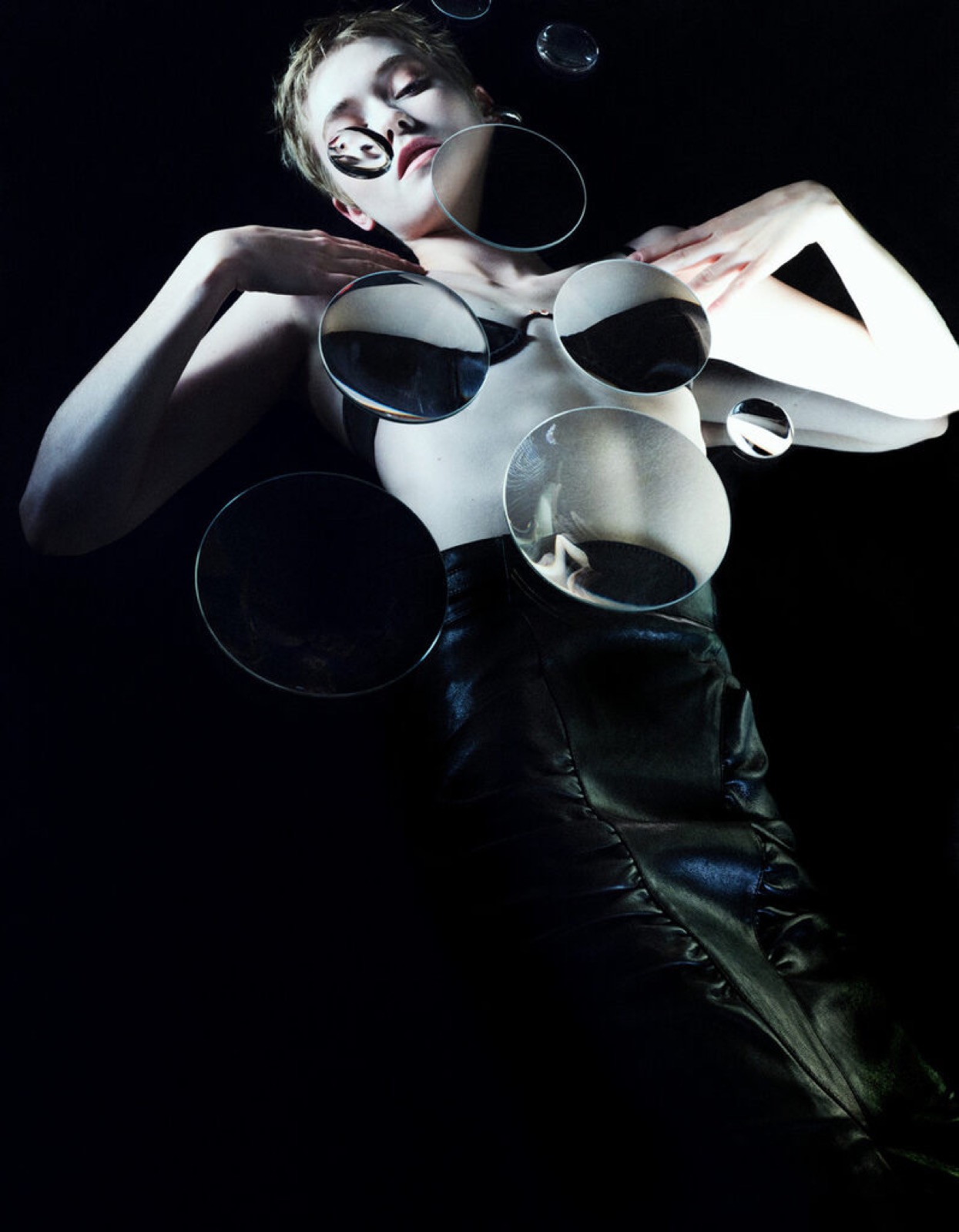
Against a black ground, a woman leans back with her arms raised, in a black leather skirt and little else. Suspended in front of her, between her body and the lens, are seven or eight circular glass discs of different diameters — plain lenses, unmounted, hanging without visible support. Each takes a piece of her: a section of the ribs, a shoulder, a breast, and, in the smallest disc beside her nose, a compressed reflection of her own face. What passes through the glass is displaced and dimmed; what falls outside it is lit hard and pale.
The device is a lens array used as a garment, and it converts the body into a set of partial views that do not add up. Some discs magnify slightly, some darken, one appears to return a curved reflection rather than a transmission, and the picture makes no attempt to keep them consistent. The result is a portrait in which the sitter is fully present and nowhere completely legible.
Optical apparatus turned into styling has a genealogy in fashion photography reaching back through the mirror and prism work of the mid-century studios, and Yeste's 2022 pictures of Maike sit knowingly inside it. What distinguishes this one is that the instruments are bare glass rather than mirror: the sitter is not multiplied but interrupted. The photographer has set a row of small lenses between his own lens and his subject and photographed the result — an image made through five or six optical systems at once, and candid about the fact that each of them took something out.
Against a black ground, a woman leans back with her arms raised, in a black leather skirt and little else. Suspended in front of her, between her body and the lens, are seven or eight circular glass discs of different diameters — plain lenses, unmounted, hanging without visible support. Each takes a piece of her: a section of the ribs, a shoulder, a breast, and, in the smallest disc beside her nose, a compressed reflection of her own face. What passes through the glass is displaced and dimmed; what falls outside it is lit hard and pale.
The device is a lens array used as a garment, and it converts the body into a set of partial views that do not add up. Some discs magnify slightly, some darken, one appears to return a curved reflection rather than a transmission, and the picture makes no attempt to keep them consistent. The result is a portrait in which the sitter is fully present and nowhere completely legible.
Optical apparatus turned into styling has a genealogy in fashion photography reaching back through the mirror and prism work of the mid-century studios, and Yeste's 2022 pictures of Maike sit knowingly inside it. What distinguishes this one is that the instruments are bare glass rather than mirror: the sitter is not multiplied but interrupted. The photographer has set a row of small lenses between his own lens and his subject and photographed the result — an image made through five or six optical systems at once, and candid about the fact that each of them took something out.