The crouched bather has a long lineage in Western picture-making, from the antique Aphrodite folding toward the water to the wet nudes of twentieth-century fashion, and this photograph knows it. The woman is bent almost to the sand, dark swimsuit cut open across the back, arms reaching down as if to touch her own shadow; the pose is classical, the light modern and merciless. I feel the citation, and I feel it dissolve, because what fixes me is not the borrowed grandeur but a single wet strand of hair blown loose across her cheek.
Everything around her has been burned nearly white: the sea, the pale sky, the translucent plastic crinkling over her hips catch the same glare, so that she seems to kneel inside light rather than on a beach. The composure of the whole is stately, almost sculptural. But my eye keeps returning to what refuses that stateliness, the soaked black hair pasted to her forehead, the eyes closed not in serenity but in effort, a body caught mid-fold and slightly ungainly. It is the ungainliness that persuades me. The picture would be colder without it.
Yeste has built his reputation on this elemental register, sand and salt water and wind-blown fabric pressed into the language of high fashion for Numéro and Harper’s Bazaar. Here the beach is not a backdrop but a co-author, its brightness eating the horizon until only a low dark headland survives at the left edge. Printed as an archival pigment print, the grain stays alive in the whites and the wet skin keeps its gleam.
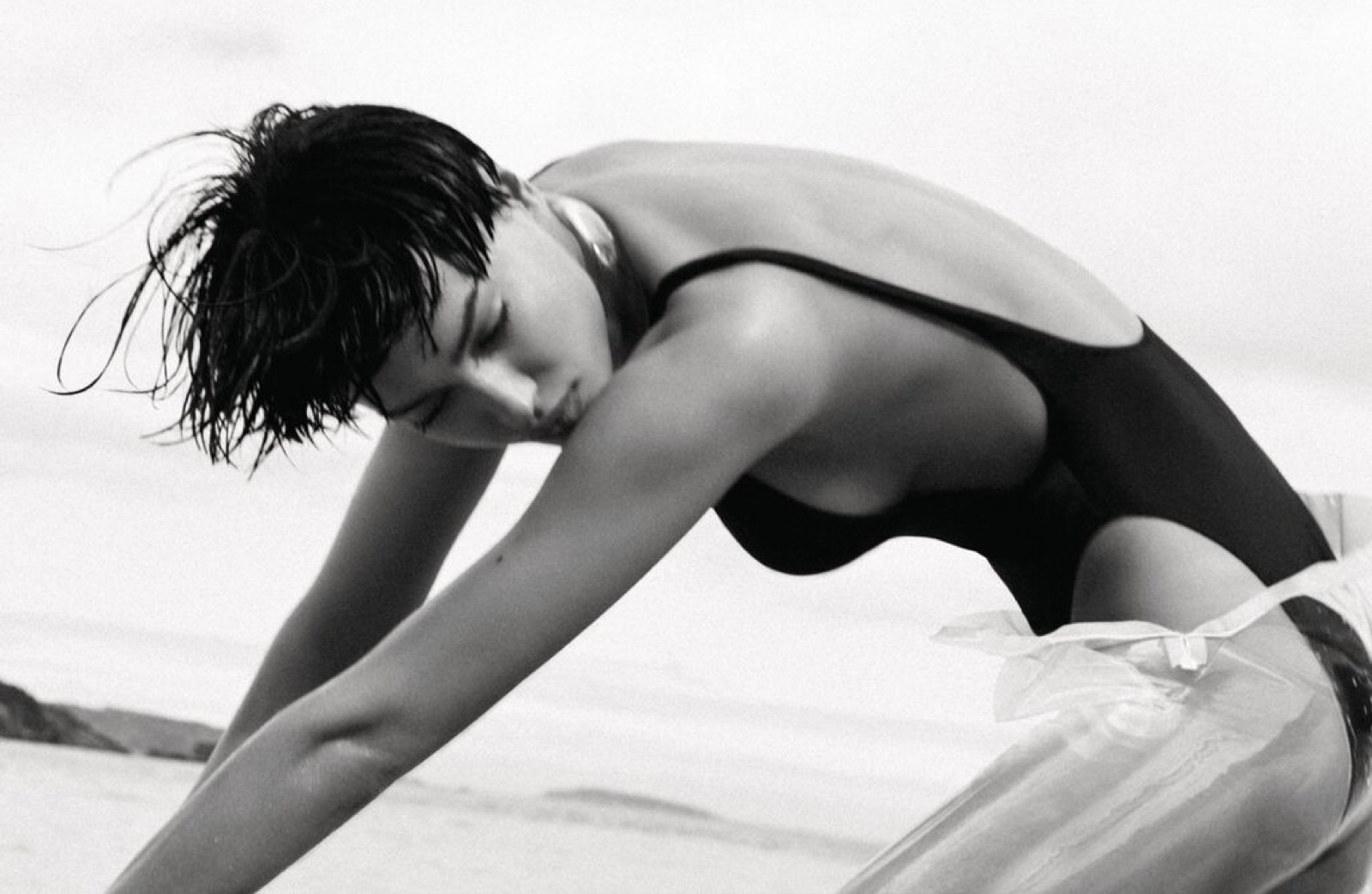

The crouched bather has a long lineage in Western picture-making, from the antique Aphrodite folding toward the water to the wet nudes of twentieth-century fashion, and this photograph knows it. The woman is bent almost to the sand, dark swimsuit cut open across the back, arms reaching down as if to touch her own shadow; the pose is classical, the light modern and merciless. I feel the citation, and I feel it dissolve, because what fixes me is not the borrowed grandeur but a single wet strand of hair blown loose across her cheek.
Everything around her has been burned nearly white: the sea, the pale sky, the translucent plastic crinkling over her hips catch the same glare, so that she seems to kneel inside light rather than on a beach. The composure of the whole is stately, almost sculptural. But my eye keeps returning to what refuses that stateliness, the soaked black hair pasted to her forehead, the eyes closed not in serenity but in effort, a body caught mid-fold and slightly ungainly. It is the ungainliness that persuades me. The picture would be colder without it.
Yeste has built his reputation on this elemental register, sand and salt water and wind-blown fabric pressed into the language of high fashion for Numéro and Harper’s Bazaar. Here the beach is not a backdrop but a co-author, its brightness eating the horizon until only a low dark headland survives at the left edge. Printed as an archival pigment print, the grain stays alive in the whites and the wet skin keeps its gleam.