A bedroom at night, the walls a cold institutional blue. A woman kneels astride a man on the bed, her white shirt open and slipping off one shoulder; he holds her waist and has his mouth at her breast; her head is thrown back and her eyes are on the ceiling. To the left, a wooden nightstand with a lamp whose yellow shade throws a splayed fan of warm light up the wall, a bunch of pink and purple flowers half fallen across it, and a red telephone lying on its side.
Two light sources and two temperatures: the lamp is warm and low and touches almost nothing, while the blue filling the rest of the room comes from nowhere identifiable and is the colour films use for night. The bed is neatly made beneath them. The room is furnished but not lived in — no clothes over a chair, no glass of water, nothing on the walls — and it has the particular emptiness of a set rather than a place.
What stays with me is the telephone. It has been knocked over, or laid down off the hook, and it is the one object in the frame that implies a before: somebody called, or somebody made sure nobody could. Everything else here is doing the work of a scene — the light, the flowers, the pose that quotes a hundred film stills. The phone is doing something narrower and better. It suggests that this room is connected to a world outside it, and that the connection has, for the moment, been deliberately interrupted.
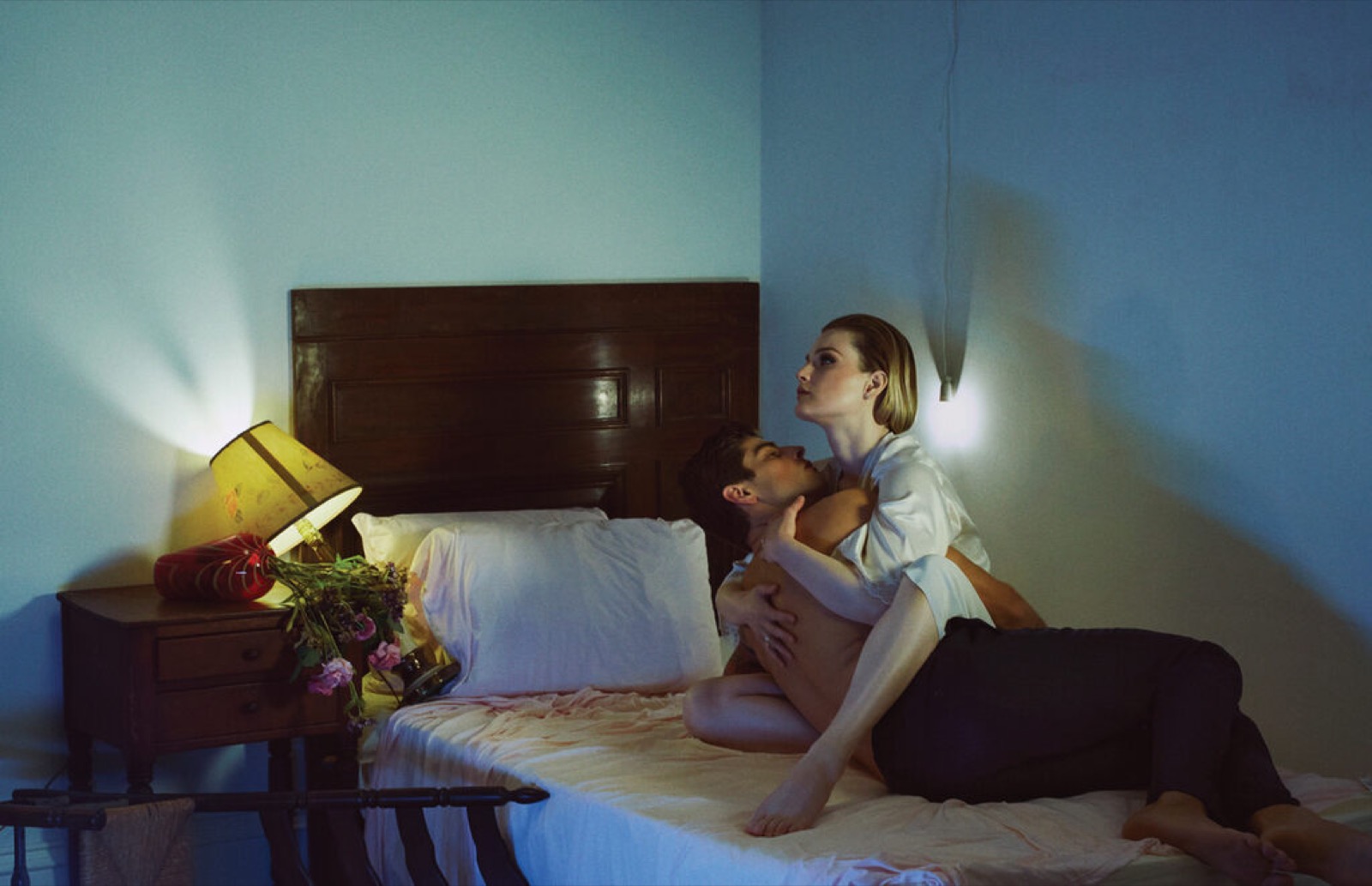

A bedroom at night, the walls a cold institutional blue. A woman kneels astride a man on the bed, her white shirt open and slipping off one shoulder; he holds her waist and has his mouth at her breast; her head is thrown back and her eyes are on the ceiling. To the left, a wooden nightstand with a lamp whose yellow shade throws a splayed fan of warm light up the wall, a bunch of pink and purple flowers half fallen across it, and a red telephone lying on its side.
Two light sources and two temperatures: the lamp is warm and low and touches almost nothing, while the blue filling the rest of the room comes from nowhere identifiable and is the colour films use for night. The bed is neatly made beneath them. The room is furnished but not lived in — no clothes over a chair, no glass of water, nothing on the walls — and it has the particular emptiness of a set rather than a place.
What stays with me is the telephone. It has been knocked over, or laid down off the hook, and it is the one object in the frame that implies a before: somebody called, or somebody made sure nobody could. Everything else here is doing the work of a scene — the light, the flowers, the pose that quotes a hundred film stills. The phone is doing something narrower and better. It suggests that this room is connected to a world outside it, and that the connection has, for the moment, been deliberately interrupted.