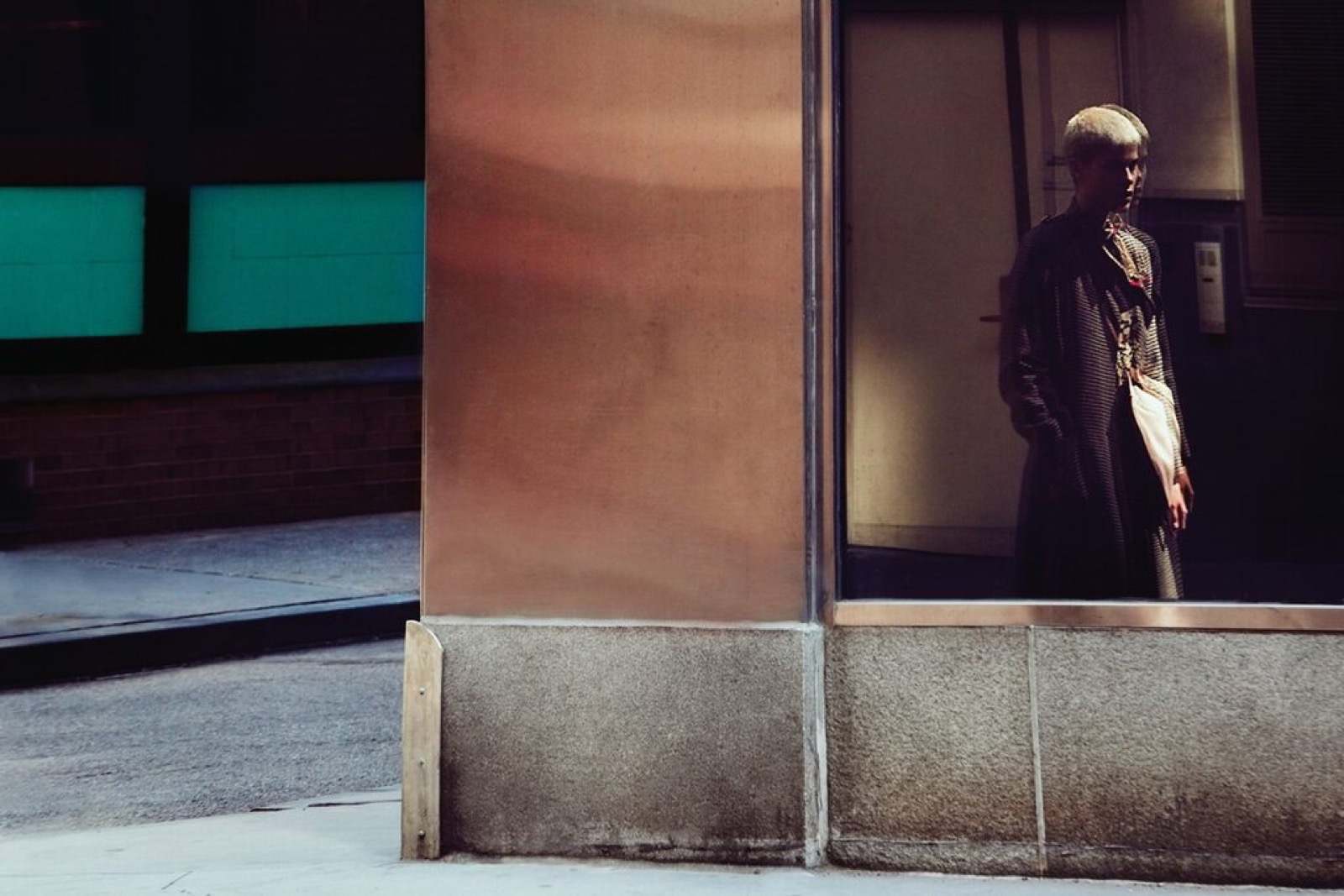
She has drifted to a halt behind a wall of plate glass, one hand curling around a pale clutch as if she has forgotten where she meant to take it. Nothing else in the frame moves, which makes that small stalled gesture the entire event. Yeste has parked her at the far right, a slim dark figure with cropped platinum hair, and handed the rest of the space to architecture: a coppery, salmon-pink column, a granite base, a sidewalk empty enough to feel faintly ominous.
The color is the sly part. Across the street a run of frosted panels glows a submarine teal, while the corner beside her blushes an unlikely coppery pink, as though the building had caught the last of a sunset it kept to itself. Between them the model is nearly swallowed by shadow, her long coat dissolving into the dim interior behind the glass. It is fashion photography behaving like a still from a film nobody quite made, a thriller in which the clothes are the only clue and the plot has wandered off down the block.
What I like is how little Yeste asks the figure to perform; the mood is carried by masonry, reflection and that peculiar light. It is the more restrained end of a photographer better known for fire and wind-blown cloth, the elemental drama that fills his pages in Numéro and Harper’s Bazaar. As an archival pigment print the muted palette is exactly where the pleasure lives, the teal and the copper and the greys holding their tension without raising their voice.
She has drifted to a halt behind a wall of plate glass, one hand curling around a pale clutch as if she has forgotten where she meant to take it. Nothing else in the frame moves, which makes that small stalled gesture the entire event. Yeste has parked her at the far right, a slim dark figure with cropped platinum hair, and handed the rest of the space to architecture: a coppery, salmon-pink column, a granite base, a sidewalk empty enough to feel faintly ominous.
The color is the sly part. Across the street a run of frosted panels glows a submarine teal, while the corner beside her blushes an unlikely coppery pink, as though the building had caught the last of a sunset it kept to itself. Between them the model is nearly swallowed by shadow, her long coat dissolving into the dim interior behind the glass. It is fashion photography behaving like a still from a film nobody quite made, a thriller in which the clothes are the only clue and the plot has wandered off down the block.
What I like is how little Yeste asks the figure to perform; the mood is carried by masonry, reflection and that peculiar light. It is the more restrained end of a photographer better known for fire and wind-blown cloth, the elemental drama that fills his pages in Numéro and Harper’s Bazaar. As an archival pigment print the muted palette is exactly where the pleasure lives, the teal and the copper and the greys holding their tension without raising their voice.