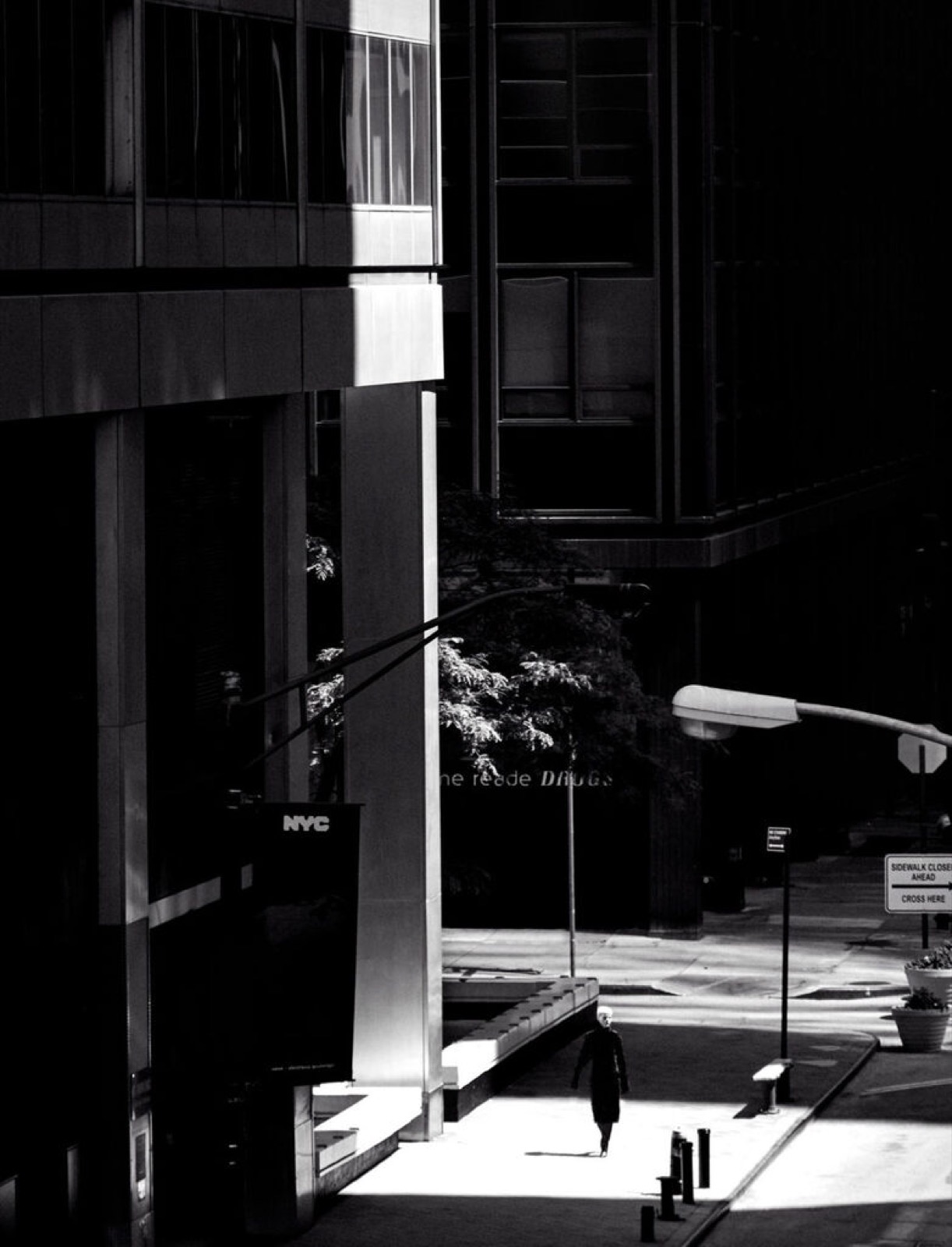
Lower Manhattan late in the day, in black and white: a slab of dark curtain wall on the left, another tower folding away behind it, and between them a wedge of raking sunlight that has reached street level and lit exactly one thing — a woman in a dark dress walking through it, so far off she stands barely a few millimetres tall. A streetlamp arcs in from the right. A sign reads SIDEWALK CLOSED AHEAD, CROSS HERE. A banner on the wall says NYC. A small tree burns white where the same light catches it.
Almost the entire picture is in shadow, and the shadows have been let go black — no rescue in the printing, no attempt to open up the windows or the granite. What remains is a diagram of light: the bright wedge on the pavement, the lit leaves, a strip of reflection down a mullion, the white sign. The figure is not a portrait and not a subject; she is the scale, the thing that tells you the wedge of light is the size of a room.
What surprises is the address. Yeste made his name in the studio and in the extravagant outdoor productions the European magazines commissioned through the 2010s, and this is neither — it is street photography of the most classical kind, a New York picture in the line that runs through the mid-century magazines and never entirely left them. It is the sort of frame that used to open a portfolio, the establishing shot before the clothes arrive, and it is the one here that most plainly enjoys the city rather than using it.
Lower Manhattan late in the day, in black and white: a slab of dark curtain wall on the left, another tower folding away behind it, and between them a wedge of raking sunlight that has reached street level and lit exactly one thing — a woman in a dark dress walking through it, so far off she stands barely a few millimetres tall. A streetlamp arcs in from the right. A sign reads SIDEWALK CLOSED AHEAD, CROSS HERE. A banner on the wall says NYC. A small tree burns white where the same light catches it.
Almost the entire picture is in shadow, and the shadows have been let go black — no rescue in the printing, no attempt to open up the windows or the granite. What remains is a diagram of light: the bright wedge on the pavement, the lit leaves, a strip of reflection down a mullion, the white sign. The figure is not a portrait and not a subject; she is the scale, the thing that tells you the wedge of light is the size of a room.
What surprises is the address. Yeste made his name in the studio and in the extravagant outdoor productions the European magazines commissioned through the 2010s, and this is neither — it is street photography of the most classical kind, a New York picture in the line that runs through the mid-century magazines and never entirely left them. It is the sort of frame that used to open a portfolio, the establishing shot before the clothes arrive, and it is the one here that most plainly enjoys the city rather than using it.