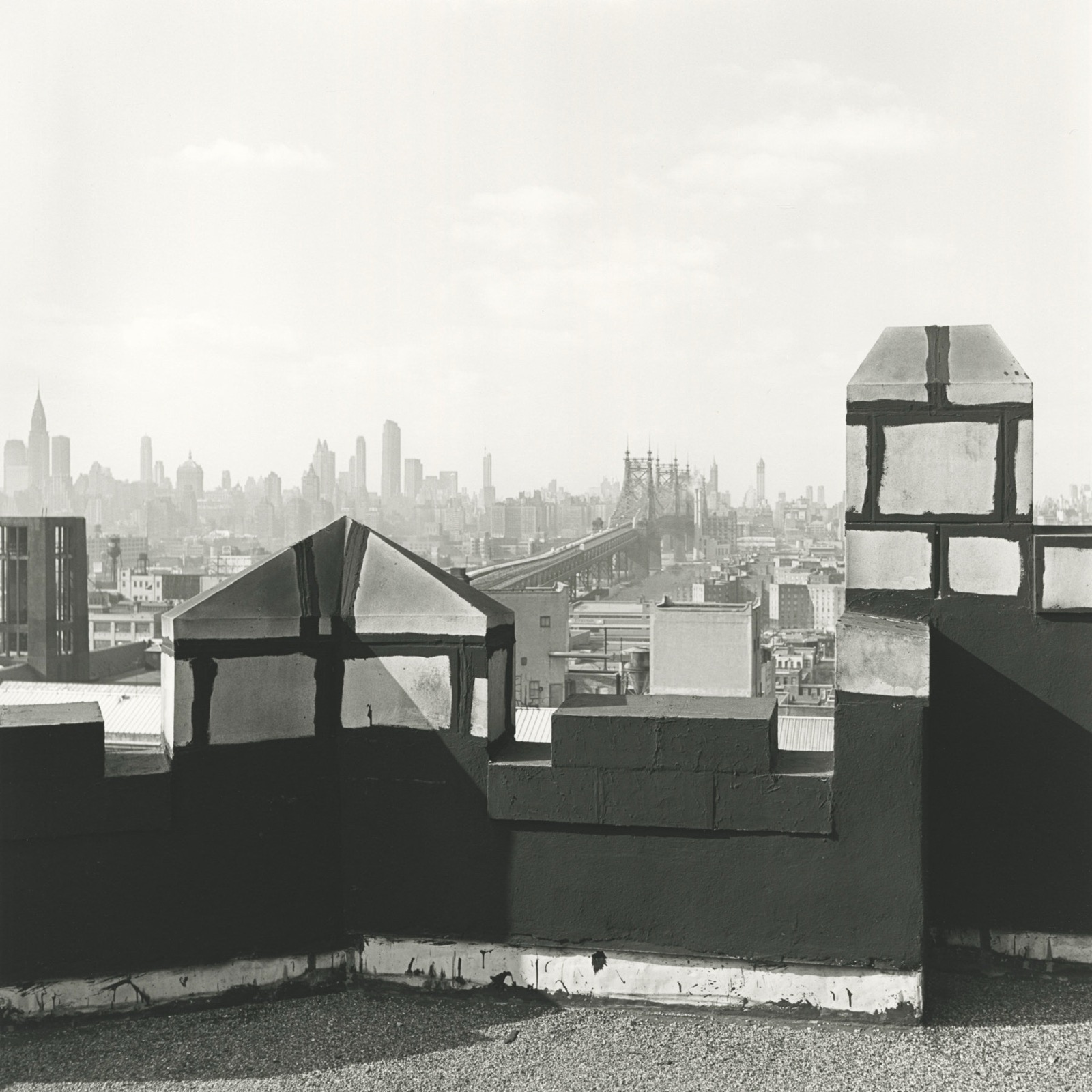
An hour from now this geometry will be gone: the low winter sun that cuts each bulkhead and coping into hard diagonals will have moved on, and the parapet will go back to being merely a wall. The negative is dated to a single day, February 9, 1953, and the picture has that kind of exactness throughout. Underfoot, gravel; at eye level, tar-sealed masonry whose joints are painted over in black so emphatically that the blocks seem drawn rather than built.
The composition proceeds in three registers, each a full step lighter than the last. Nearest, the near-black battlements of the roof itself, one peaked bulkhead rising like a small house. Beyond, the mid-gray industrial roofscape with its water towers. And on the horizon, the Queensboro Bridge striding toward a skyline dissolved in February haze, the crown of the Chrysler Building just legible at the far left. It is a lesson in atmospheric perspective conducted entirely in grays, and the square Rolleiflex frame holds the stacked planes in equilibrium: half sky, half city, hinged on the bright roadway of the bridge.
Maier was in her twenties then, photographing with no audience in mind and no expectation of one. When the archive surfaced in 2007, pictures like this one showed how early the eye was fully formed: she composes here with the calm of a Precisionist. Printed later in gelatin silver by her estate, the photograph keeps that tonal argument intact, from the dense matte black of the tar to the ghost gray of the towers. The view from this anonymous rooftop then went unseen for half a century.

An hour from now this geometry will be gone: the low winter sun that cuts each bulkhead and coping into hard diagonals will have moved on, and the parapet will go back to being merely a wall. The negative is dated to a single day, February 9, 1953, and the picture has that kind of exactness throughout. Underfoot, gravel; at eye level, tar-sealed masonry whose joints are painted over in black so emphatically that the blocks seem drawn rather than built.
The composition proceeds in three registers, each a full step lighter than the last. Nearest, the near-black battlements of the roof itself, one peaked bulkhead rising like a small house. Beyond, the mid-gray industrial roofscape with its water towers. And on the horizon, the Queensboro Bridge striding toward a skyline dissolved in February haze, the crown of the Chrysler Building just legible at the far left. It is a lesson in atmospheric perspective conducted entirely in grays, and the square Rolleiflex frame holds the stacked planes in equilibrium: half sky, half city, hinged on the bright roadway of the bridge.
Maier was in her twenties then, photographing with no audience in mind and no expectation of one. When the archive surfaced in 2007, pictures like this one showed how early the eye was fully formed: she composes here with the calm of a Precisionist. Printed later in gelatin silver by her estate, the photograph keeps that tonal argument intact, from the dense matte black of the tar to the ghost gray of the towers. The view from this anonymous rooftop then went unseen for half a century.