A flat, overcast light pours off the harbor and floods the deck, bleaching the sky to blank white and thinning the distant Manhattan skyline to a row of pale, dissolving towers. Under the ferry’s slatted wooden canopy a couple stands at the curved railing, their backs to us, his arm around her waist and hers around his, watching the city approach. The haze is the picture’s true subject, softening every hard edge but the dark silhouettes of the figures and the black band of the bulwark.
Maier organizes the tones with a printer’s care. The canopy overhead reads as deep shadow, the harbor light as luminous grey, and between them the couple is held in a graded scale from the man’s black shirt to the dotted pattern of the woman’s dress. Curving beams radiate above like the ribs of an umbrella; oval cutouts in the railing repeat down the deck; a cylindrical loudspeaker hangs at left. Every element is placed, yet nothing feels arranged, the geometry framing a moment of ordinary tenderness.
Maier made this on a Rolleiflex held at her waist, one of thousands of exposures she took across New York and later Chicago and showed to almost no one. The archive was discovered by chance and, after her death, secured her a place among the singular street photographers of the mid-century. This gelatin silver print, made later, honors her tonal range, the blown harbor sky, the velvet dark of the canopy, the couple poised between them, still watching a skyline that has long since changed.
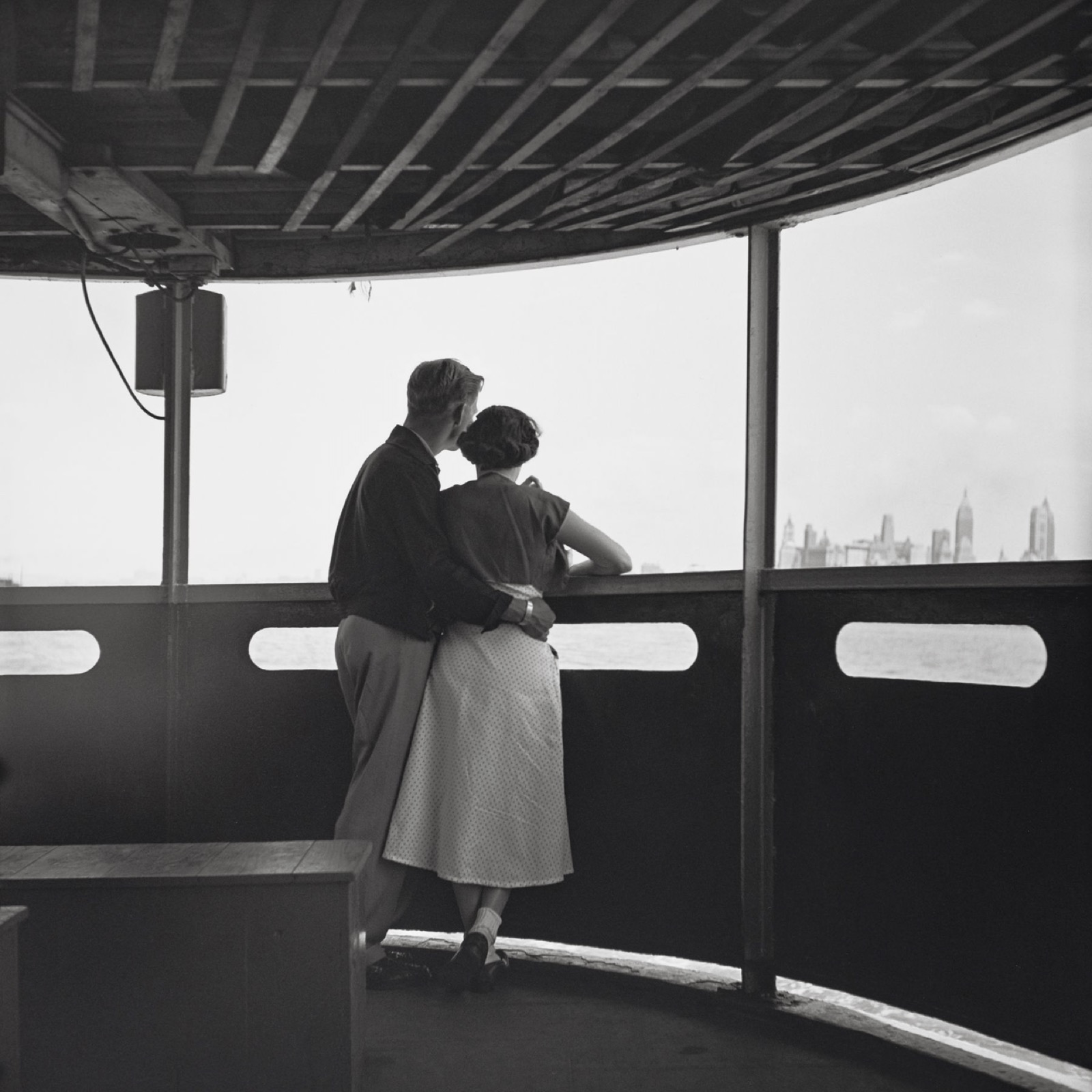

A flat, overcast light pours off the harbor and floods the deck, bleaching the sky to blank white and thinning the distant Manhattan skyline to a row of pale, dissolving towers. Under the ferry’s slatted wooden canopy a couple stands at the curved railing, their backs to us, his arm around her waist and hers around his, watching the city approach. The haze is the picture’s true subject, softening every hard edge but the dark silhouettes of the figures and the black band of the bulwark.
Maier organizes the tones with a printer’s care. The canopy overhead reads as deep shadow, the harbor light as luminous grey, and between them the couple is held in a graded scale from the man’s black shirt to the dotted pattern of the woman’s dress. Curving beams radiate above like the ribs of an umbrella; oval cutouts in the railing repeat down the deck; a cylindrical loudspeaker hangs at left. Every element is placed, yet nothing feels arranged, the geometry framing a moment of ordinary tenderness.
Maier made this on a Rolleiflex held at her waist, one of thousands of exposures she took across New York and later Chicago and showed to almost no one. The archive was discovered by chance and, after her death, secured her a place among the singular street photographers of the mid-century. This gelatin silver print, made later, honors her tonal range, the blown harbor sky, the velvet dark of the canopy, the couple poised between them, still watching a skyline that has long since changed.