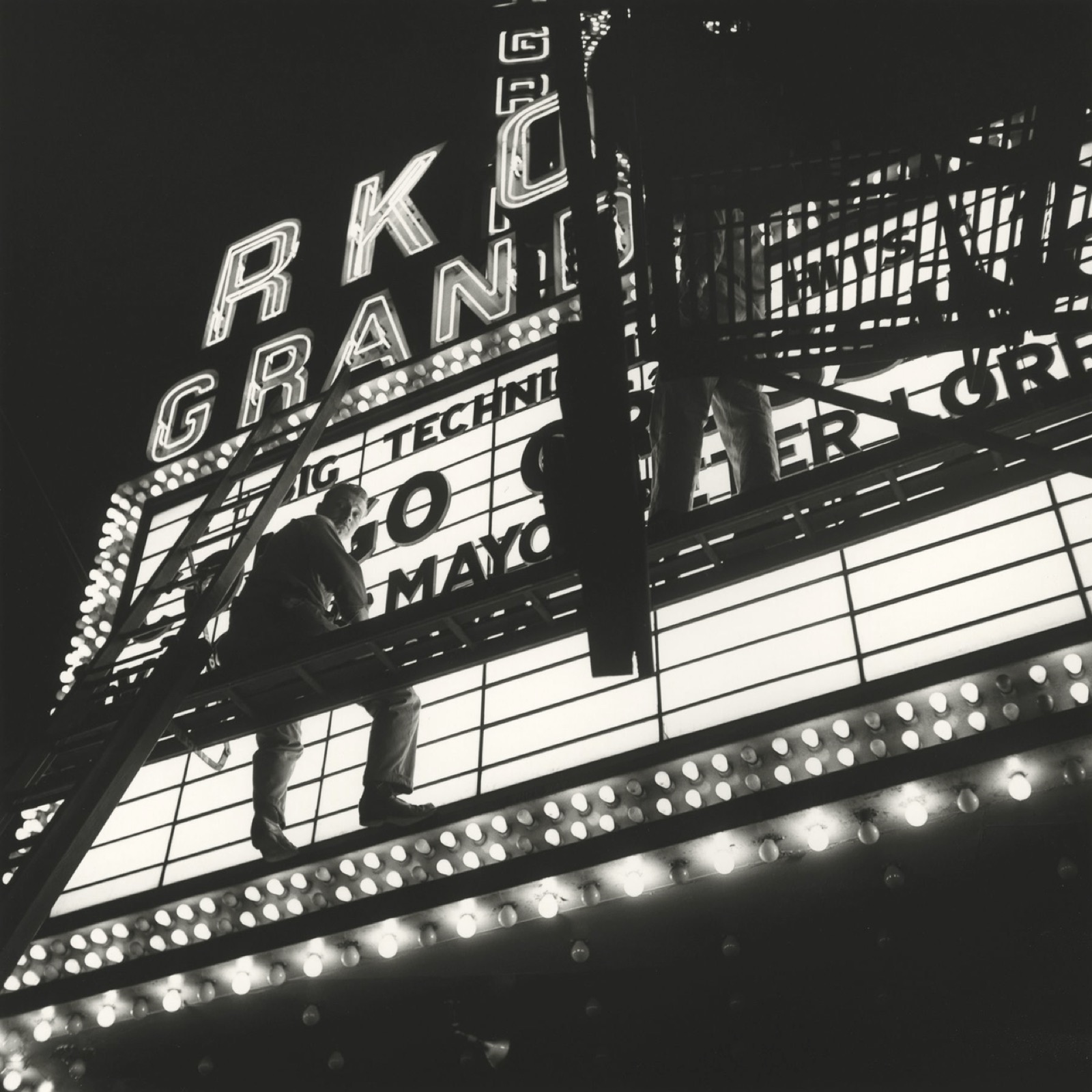
We are down on the pavement, necks tilted, looking up into the underside of the RKO Grand marquee, where the neon spells its name in hot cursive and a border of bare bulbs runs in bright dotted seams toward us. A man in a pale shirt has climbed a ladder onto the ledge, one boot braced on the letter tray, and he leans in to slot the evening’s program into place: TECHNICOLOR, MAYO, fragments still being assembled overhead. Maier catches him mid-errand, backlit to a clean silhouette against the glowing white panel.
The picture is all upward thrust and dazzle. Its marquee cuts the frame corner to corner, the light banked so densely that the bulbs bleed into little flares, and a second figure, higher in the scaffolding, dissolves almost into the wattage. Everything glamorous about mid-century movie-going is here, the Deco confidence of the signage, the promise of the screen, yet the star of the moment is a laborer in work clothes, ankle-deep in letters, arranging a spectacle he will never watch from a seat.
Maier worked a Rolleiflex at her waist, but here she tips her whole body back to find the angle, trading the camera’s usual downcast modesty for vertigo. The nanny who made these frames on her days off left them unseen; the archive surfaced only after her death, and the Chicago streets she prowled now read as a private cinema. This gelatin silver print, made later, keeps its blacks deep and its highlights just short of burning, a night of neon translated into permanent grain, the marquee lit long after the theater went dark.
We are down on the pavement, necks tilted, looking up into the underside of the RKO Grand marquee, where the neon spells its name in hot cursive and a border of bare bulbs runs in bright dotted seams toward us. A man in a pale shirt has climbed a ladder onto the ledge, one boot braced on the letter tray, and he leans in to slot the evening’s program into place: TECHNICOLOR, MAYO, fragments still being assembled overhead. Maier catches him mid-errand, backlit to a clean silhouette against the glowing white panel.
The picture is all upward thrust and dazzle. Its marquee cuts the frame corner to corner, the light banked so densely that the bulbs bleed into little flares, and a second figure, higher in the scaffolding, dissolves almost into the wattage. Everything glamorous about mid-century movie-going is here, the Deco confidence of the signage, the promise of the screen, yet the star of the moment is a laborer in work clothes, ankle-deep in letters, arranging a spectacle he will never watch from a seat.
Maier worked a Rolleiflex at her waist, but here she tips her whole body back to find the angle, trading the camera’s usual downcast modesty for vertigo. The nanny who made these frames on her days off left them unseen; the archive surfaced only after her death, and the Chicago streets she prowled now read as a private cinema. This gelatin silver print, made later, keeps its blacks deep and its highlights just short of burning, a night of neon translated into permanent grain, the marquee lit long after the theater went dark.