A picture is sometimes built on a coincidence that the photographer was quick enough to keep. Here the coincidence is a sign — CANADIAN PACIFIC STEAMSHIPS, big confident letters promising departure — set directly above an old nun in full black habit, propped upright on a wheeled stretcher and rolled across the dock toward the camera. The words say transit; the figure beneath them says something slower and more fragile. Maier did not arrange this. She saw that the two facts had landed in the same rectangle and pressed the shutter before they drifted apart.
What makes it hold together is the way the square describes its people. Working at waist level with the Rolleiflex, she gives each figure a frontal, level regard: the purser in white cap and bow tie striding out at us, the second officer steadying the gurney, the younger nun emerging from the dark doorway, the porter keeping his post at the far left with hands clasped. No one is caricatured and no one is hurried. The noon light is doing real work too — bleaching the men's shirts to paper, raking the concrete, and pressing the habits into a black so complete it looks cut from the print rather than printed on it.
That black is the picture's anchor, and the old nun's composed face, small and bright at the center, is its surprise. Maier (1926–2009) made tens of thousands of such negatives while working as a nanny in Chicago and showed them to no one; the work surfaced only after her death. Printed posthumously from her negative in an edition of fifteen, this is one of the few ways to hold a finished Maier in the hand.
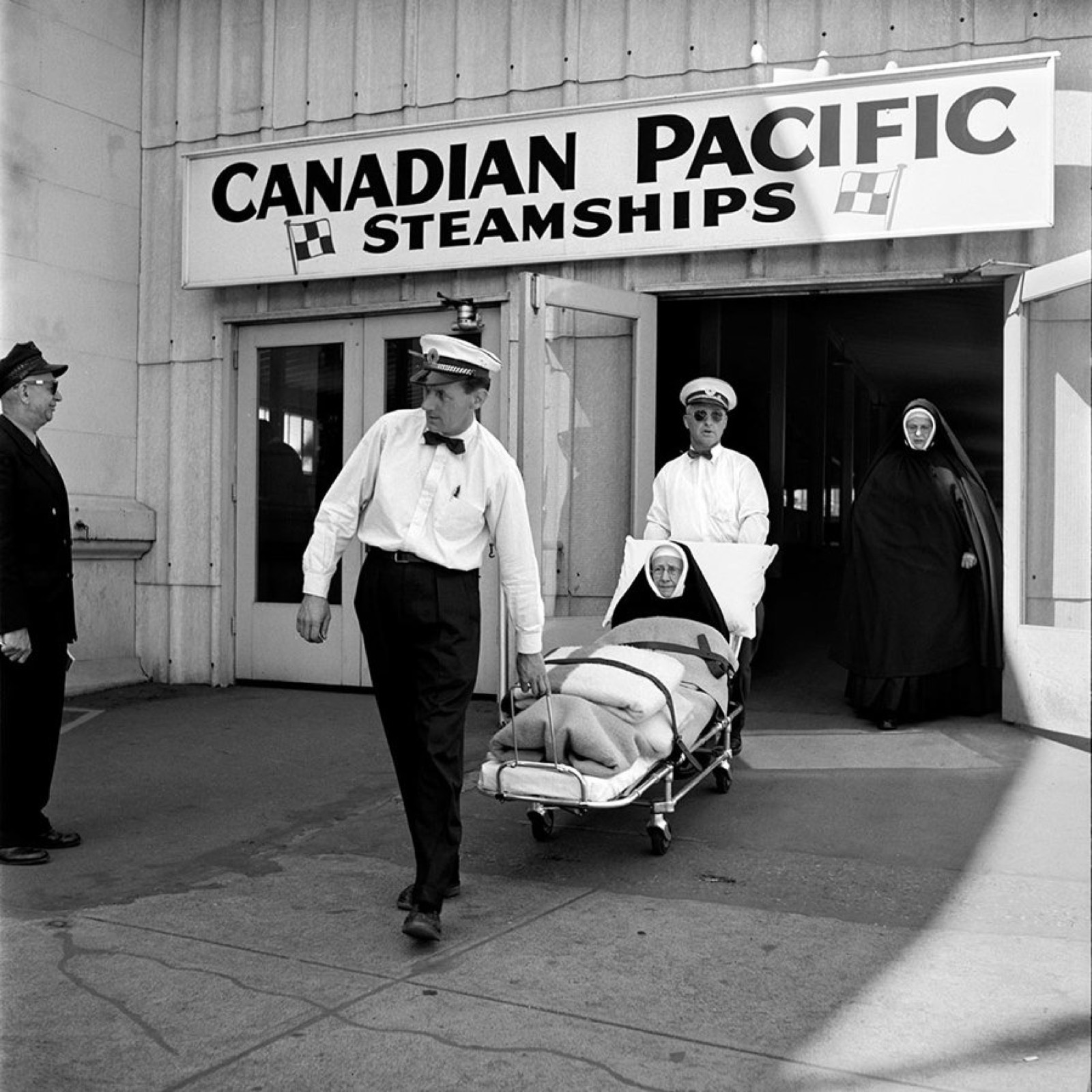

A picture is sometimes built on a coincidence that the photographer was quick enough to keep. Here the coincidence is a sign — CANADIAN PACIFIC STEAMSHIPS, big confident letters promising departure — set directly above an old nun in full black habit, propped upright on a wheeled stretcher and rolled across the dock toward the camera. The words say transit; the figure beneath them says something slower and more fragile. Maier did not arrange this. She saw that the two facts had landed in the same rectangle and pressed the shutter before they drifted apart.
What makes it hold together is the way the square describes its people. Working at waist level with the Rolleiflex, she gives each figure a frontal, level regard: the purser in white cap and bow tie striding out at us, the second officer steadying the gurney, the younger nun emerging from the dark doorway, the porter keeping his post at the far left with hands clasped. No one is caricatured and no one is hurried. The noon light is doing real work too — bleaching the men's shirts to paper, raking the concrete, and pressing the habits into a black so complete it looks cut from the print rather than printed on it.
That black is the picture's anchor, and the old nun's composed face, small and bright at the center, is its surprise. Maier (1926–2009) made tens of thousands of such negatives while working as a nanny in Chicago and showed them to no one; the work surfaced only after her death. Printed posthumously from her negative in an edition of fifteen, this is one of the few ways to hold a finished Maier in the hand.