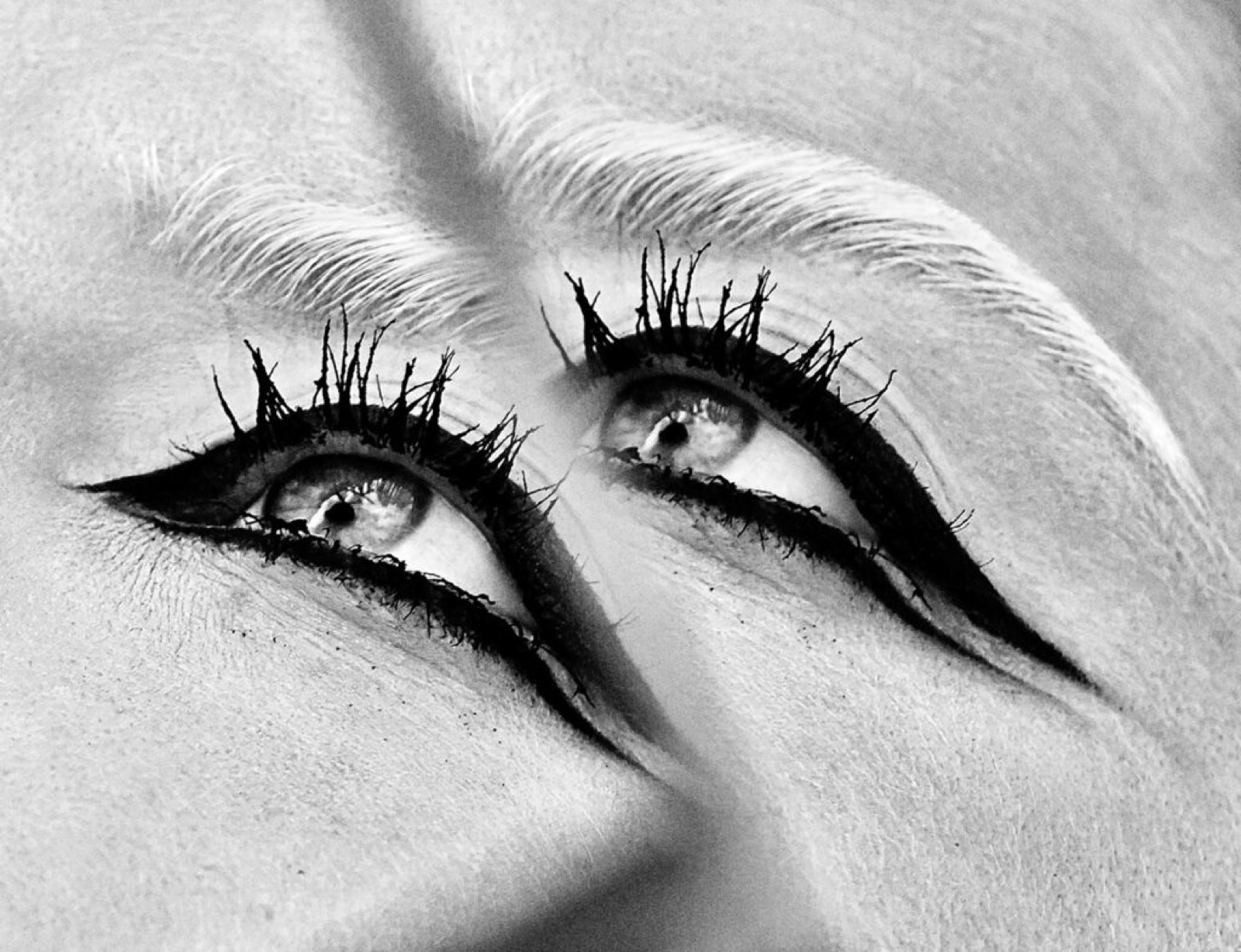
Almost all the work in this picture is done by light, and it is worth watching how. It arrives from just above and to one side, high and soft, so the skin becomes a pale luminous field with barely a shadow on it, and the only true blacks are the spiked lashes and the winged flick of liner. Inside each iris the source declares itself: a small bright window, gridded into panes, sits reflected there, telling you the exact shape of the lamp that made this whole face glow.
Photography has always been able to go closer than the eye politely would, and Yeste presses that privilege. Cropped to a band of brow, lash and cheekbone, the picture turns cosmetics into weather: the mascara clumps and forks like wet black grass after rain, each lash a separate stroke, while the pale bleached brows almost dissolve into the surrounding light. This is fashion’s oldest subject, the made-up eye, examined at a scale no mirror allows. The gaze slides down and away, refusing us and sharpening our attention on the craft laid over it.
What reads at first as pure beauty-page bravura is also a study in tonal control, the kind of high-key rendering that can collapse into chalk if the exposure is wrong. Yeste, a fixture of Numéro and Harper’s Bazaar and at the front of Spanish fashion photography, keeps every value in play, from the whitest cheek to the ink of the lashes. As an archival pigment print those extremes hold cleanly, the grain of the skin and the wet gleam of the reflected window both surviving intact.
Almost all the work in this picture is done by light, and it is worth watching how. It arrives from just above and to one side, high and soft, so the skin becomes a pale luminous field with barely a shadow on it, and the only true blacks are the spiked lashes and the winged flick of liner. Inside each iris the source declares itself: a small bright window, gridded into panes, sits reflected there, telling you the exact shape of the lamp that made this whole face glow.
Photography has always been able to go closer than the eye politely would, and Yeste presses that privilege. Cropped to a band of brow, lash and cheekbone, the picture turns cosmetics into weather: the mascara clumps and forks like wet black grass after rain, each lash a separate stroke, while the pale bleached brows almost dissolve into the surrounding light. This is fashion’s oldest subject, the made-up eye, examined at a scale no mirror allows. The gaze slides down and away, refusing us and sharpening our attention on the craft laid over it.
What reads at first as pure beauty-page bravura is also a study in tonal control, the kind of high-key rendering that can collapse into chalk if the exposure is wrong. Yeste, a fixture of Numéro and Harper’s Bazaar and at the front of Spanish fashion photography, keeps every value in play, from the whitest cheek to the ink of the lashes. As an archival pigment print those extremes hold cleanly, the grain of the skin and the wet gleam of the reflected window both surviving intact.