Everything is dipped in the same late-gold light, the honeyed low sun that New York keeps for the hour before dusk, and it falls without discrimination on the model and on the strangers who happen to share her platform. The blue-grey flank of the train, the yellow warning stripe at the platform edge, the burgundy of a floral dress, the amber letters spelling JAMAICA CENTER above a lit J: all of it glows with the same flattering, indiscriminate warmth. This is the seduction the photograph both performs and half confesses.
She stands in the open subway doorway in severe black, laced sleeves and wide trousers, a black acoustic guitar slung across her back like a weapon she will not use. Around her the ordinary city keeps moving: a woman consults her phone, a passenger dozes behind glass, commuters cross toward the sign for Marcy Avenue and Broadway. The fashion image feeds on this contrast, borrowing authenticity from people who did not agree to lend it. Yeste knows the trade he is making, and stages it so cleanly that we admire the theft even as we notice it.
What keeps the picture honest is its refusal to soften the setting into backdrop. The elevated station is specific, sunstruck, and fully itself, and the model is a visitor passing through it rather than its queen. Yeste, at the front of Spanish fashion photography and a regular in Vogue and Harper’s Bazaar, here trades his studio elements for street light. As an archival pigment print the low sun holds its exact temperature, the shadows long and clean across the platform’s yellow edge.
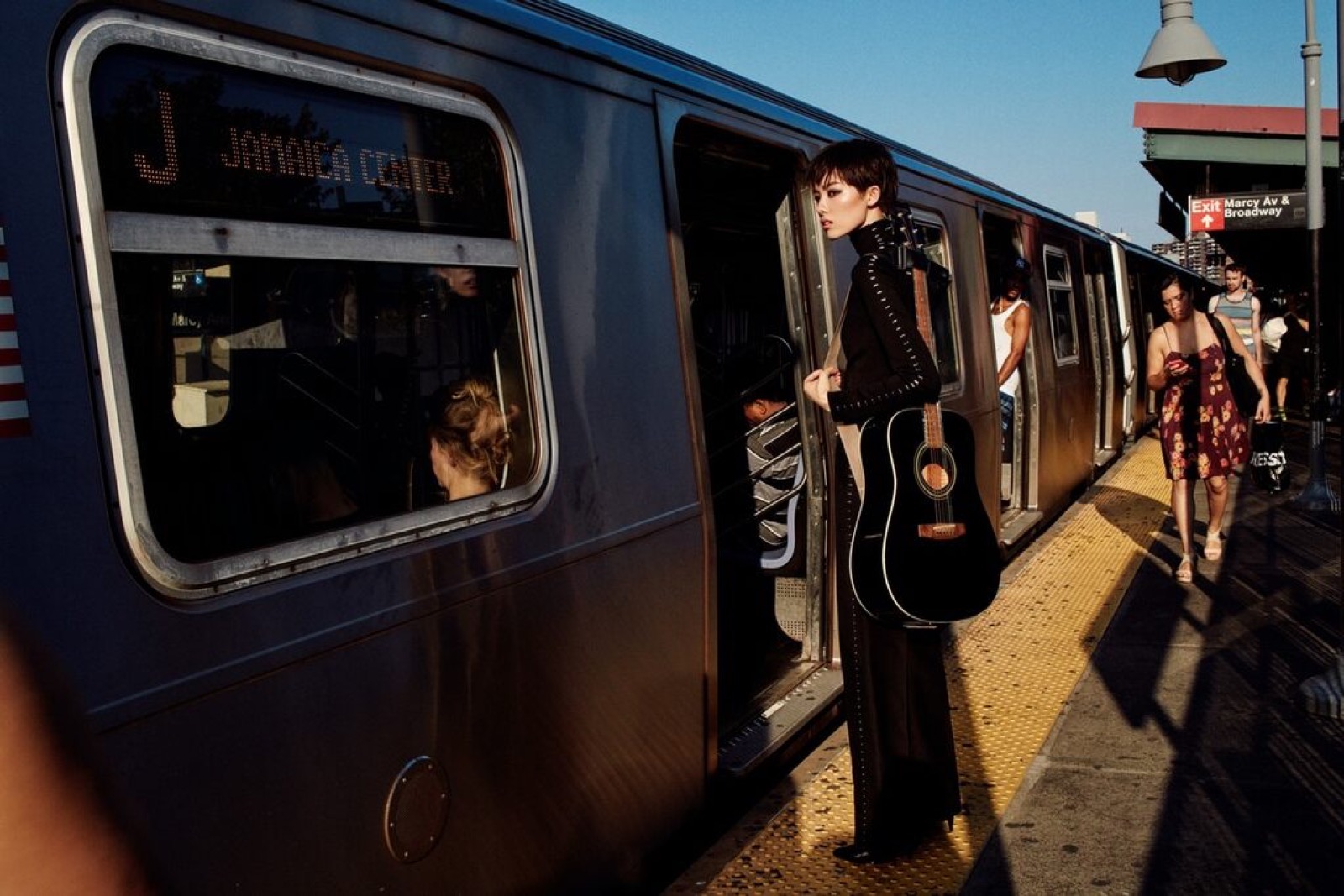

Everything is dipped in the same late-gold light, the honeyed low sun that New York keeps for the hour before dusk, and it falls without discrimination on the model and on the strangers who happen to share her platform. The blue-grey flank of the train, the yellow warning stripe at the platform edge, the burgundy of a floral dress, the amber letters spelling JAMAICA CENTER above a lit J: all of it glows with the same flattering, indiscriminate warmth. This is the seduction the photograph both performs and half confesses.
She stands in the open subway doorway in severe black, laced sleeves and wide trousers, a black acoustic guitar slung across her back like a weapon she will not use. Around her the ordinary city keeps moving: a woman consults her phone, a passenger dozes behind glass, commuters cross toward the sign for Marcy Avenue and Broadway. The fashion image feeds on this contrast, borrowing authenticity from people who did not agree to lend it. Yeste knows the trade he is making, and stages it so cleanly that we admire the theft even as we notice it.
What keeps the picture honest is its refusal to soften the setting into backdrop. The elevated station is specific, sunstruck, and fully itself, and the model is a visitor passing through it rather than its queen. Yeste, at the front of Spanish fashion photography and a regular in Vogue and Harper’s Bazaar, here trades his studio elements for street light. As an archival pigment print the low sun holds its exact temperature, the shadows long and clean across the platform’s yellow edge.