A mouth, enlarged until the frame holds almost nothing else: the upper lip lifted off the teeth, four upper teeth and a row of lower ones catching hard specular light, a dark liner smudged out past the corner on the left and again below the lower lip on the right. The lips are lacquered and heavily creased; the skin around them is open-pored and unretouched. Black and white, printed so that the teeth are the brightest object in the picture.
Scale is the whole operation. At life size this is a detail; at the size such prints are made it becomes architecture, and the transformation is one photography performs more convincingly than any other medium — the shift from feature to landscape occurs purely as a function of enlargement. It is also, historically, an advertising move: the cosmetic close-up that isolates a mouth in order to sell what is on it. Here nothing is being sold, and the isolation reads instead as an appetite for surface.
Which leaves the image unusually mobile. Detached from a face, a name and a season, it would sit as comfortably in a cosmetics campaign as on a gallery wall, and the picture seems to know it: the smudged liner is exactly the sort of imperfection a campaign would remove and a print keeps. That deliberate roughness is the hinge. It is what allows a photograph made in the language of commerce to be read, at a different scale and in a different room, as a study of what a mouth is actually like.
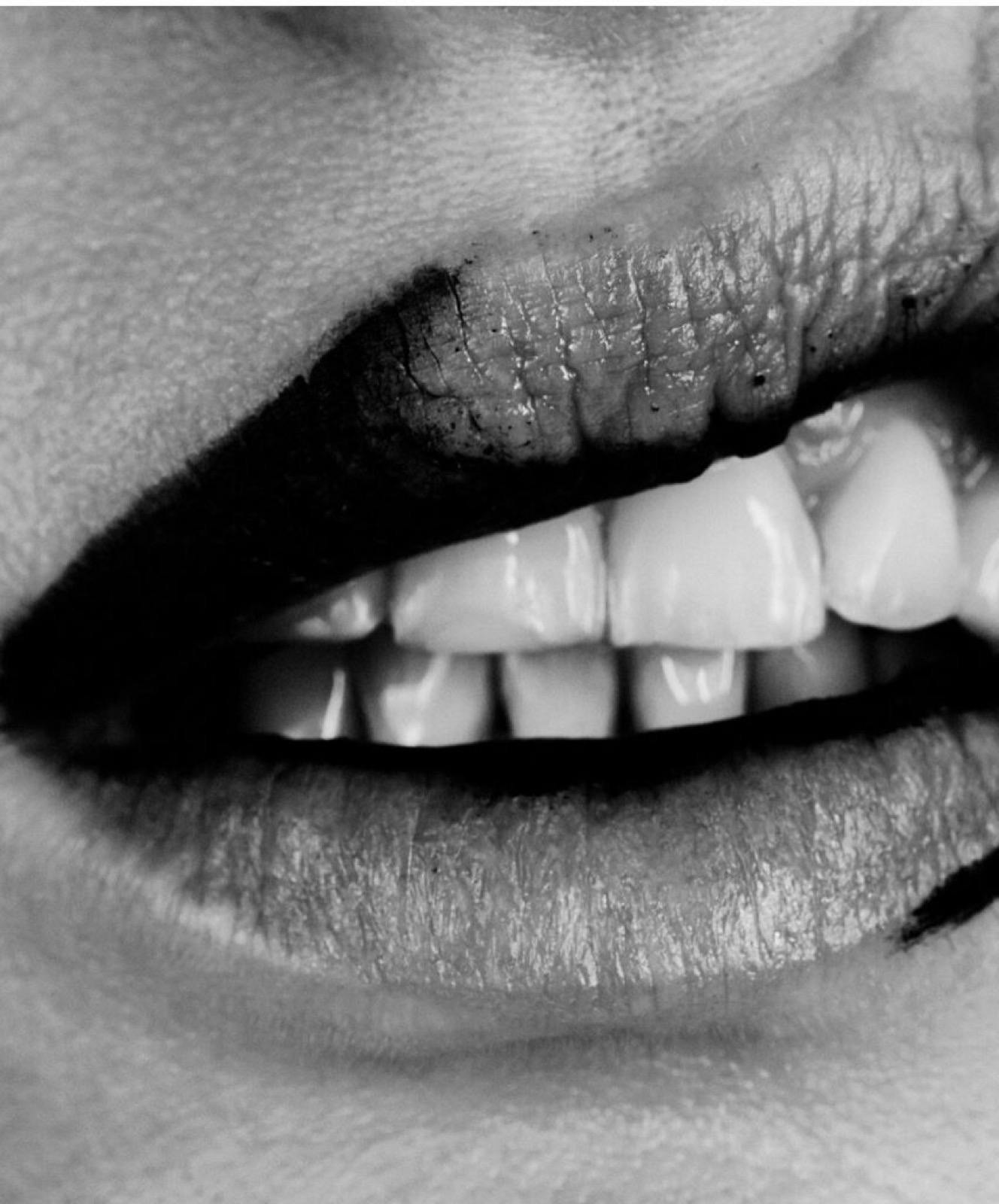

A mouth, enlarged until the frame holds almost nothing else: the upper lip lifted off the teeth, four upper teeth and a row of lower ones catching hard specular light, a dark liner smudged out past the corner on the left and again below the lower lip on the right. The lips are lacquered and heavily creased; the skin around them is open-pored and unretouched. Black and white, printed so that the teeth are the brightest object in the picture.
Scale is the whole operation. At life size this is a detail; at the size such prints are made it becomes architecture, and the transformation is one photography performs more convincingly than any other medium — the shift from feature to landscape occurs purely as a function of enlargement. It is also, historically, an advertising move: the cosmetic close-up that isolates a mouth in order to sell what is on it. Here nothing is being sold, and the isolation reads instead as an appetite for surface.
Which leaves the image unusually mobile. Detached from a face, a name and a season, it would sit as comfortably in a cosmetics campaign as on a gallery wall, and the picture seems to know it: the smudged liner is exactly the sort of imperfection a campaign would remove and a print keeps. That deliberate roughness is the hinge. It is what allows a photograph made in the language of commerce to be read, at a different scale and in a different room, as a study of what a mouth is actually like.