An open mouth filling the frame: two rows of teeth, the upper lip finely lined and dark, the lower one broad and matte, and at each corner a hard white flare where the light has caught something wet. Black and white, enlarged until the lip's surface reads as terrain — creases, a dry patch at the right edge, the faint grain of pores above. The mouth is open but not speaking and not smiling. It is simply open.
Pictures like this used to arrive as a full-bleed spread, the last page of a beauty story, and they were always the page you remembered. Cropping to a single feature is the oldest trick in the beauty book and it still works, because it converts an advertisement into an abstraction: strip away the face and the mouth stops belonging to a person and starts belonging to the layout. What is unusual here is how little flattery is involved. The lips are dry. The teeth are not perfect. Nobody has been made porcelain.
That refusal places it. Through the 2010s the European magazines — the Italian and Spanish titles above all — ran beauty pages far tougher than the American ones, printing skin as skin and treating the close-up as a licence for strangeness rather than perfection. Yeste built a career inside exactly that permission, and this 2015 frame is a pure specimen of it: a beauty picture with no product in sight, no smile on offer, and nothing to sell but the astonishing fact of a mouth.
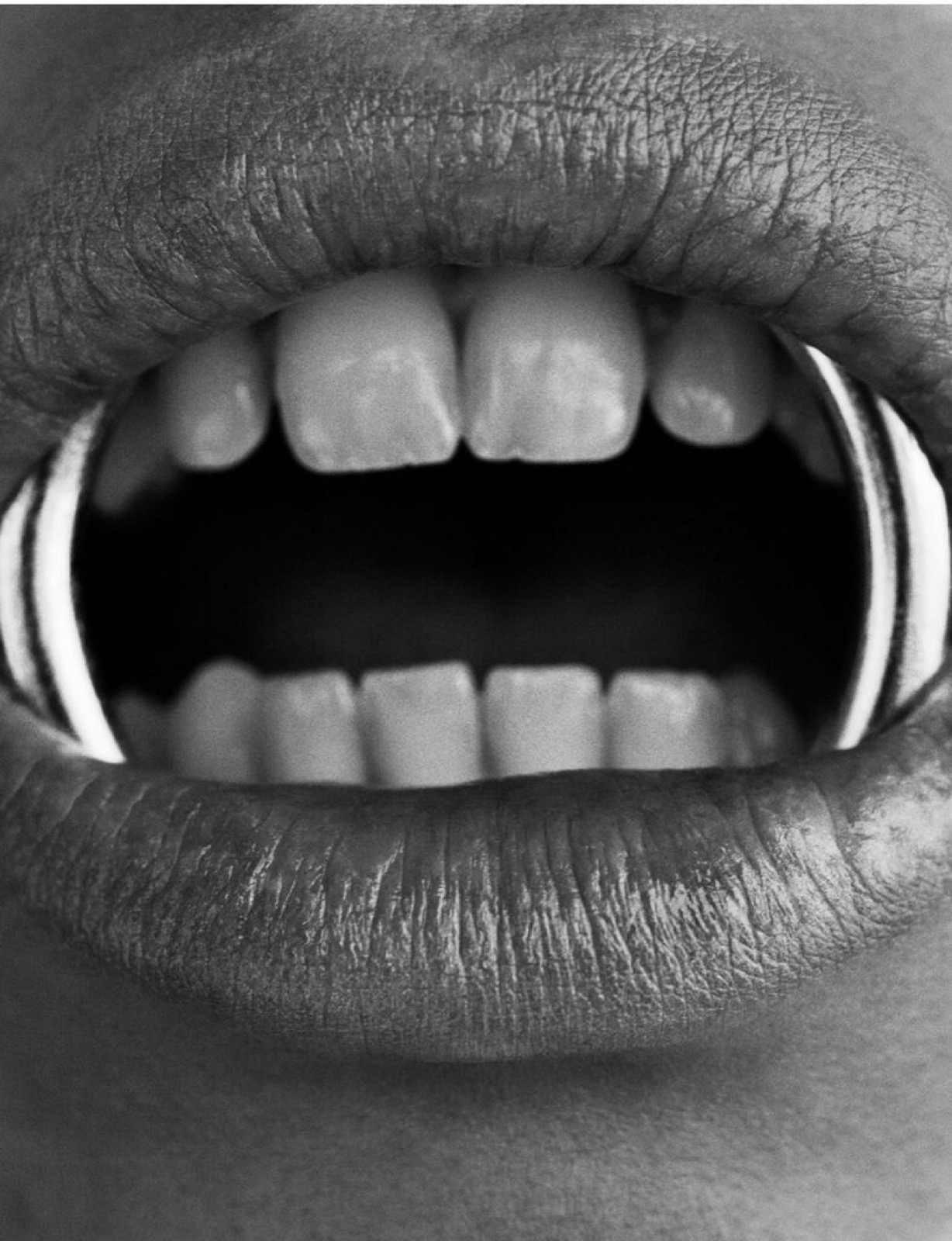
An open mouth filling the frame: two rows of teeth, the upper lip finely lined and dark, the lower one broad and matte, and at each corner a hard white flare where the light has caught something wet. Black and white, enlarged until the lip's surface reads as terrain — creases, a dry patch at the right edge, the faint grain of pores above. The mouth is open but not speaking and not smiling. It is simply open.
Pictures like this used to arrive as a full-bleed spread, the last page of a beauty story, and they were always the page you remembered. Cropping to a single feature is the oldest trick in the beauty book and it still works, because it converts an advertisement into an abstraction: strip away the face and the mouth stops belonging to a person and starts belonging to the layout. What is unusual here is how little flattery is involved. The lips are dry. The teeth are not perfect. Nobody has been made porcelain.
That refusal places it. Through the 2010s the European magazines — the Italian and Spanish titles above all — ran beauty pages far tougher than the American ones, printing skin as skin and treating the close-up as a licence for strangeness rather than perfection. Yeste built a career inside exactly that permission, and this 2015 frame is a pure specimen of it: a beauty picture with no product in sight, no smile on offer, and nothing to sell but the astonishing fact of a mouth.