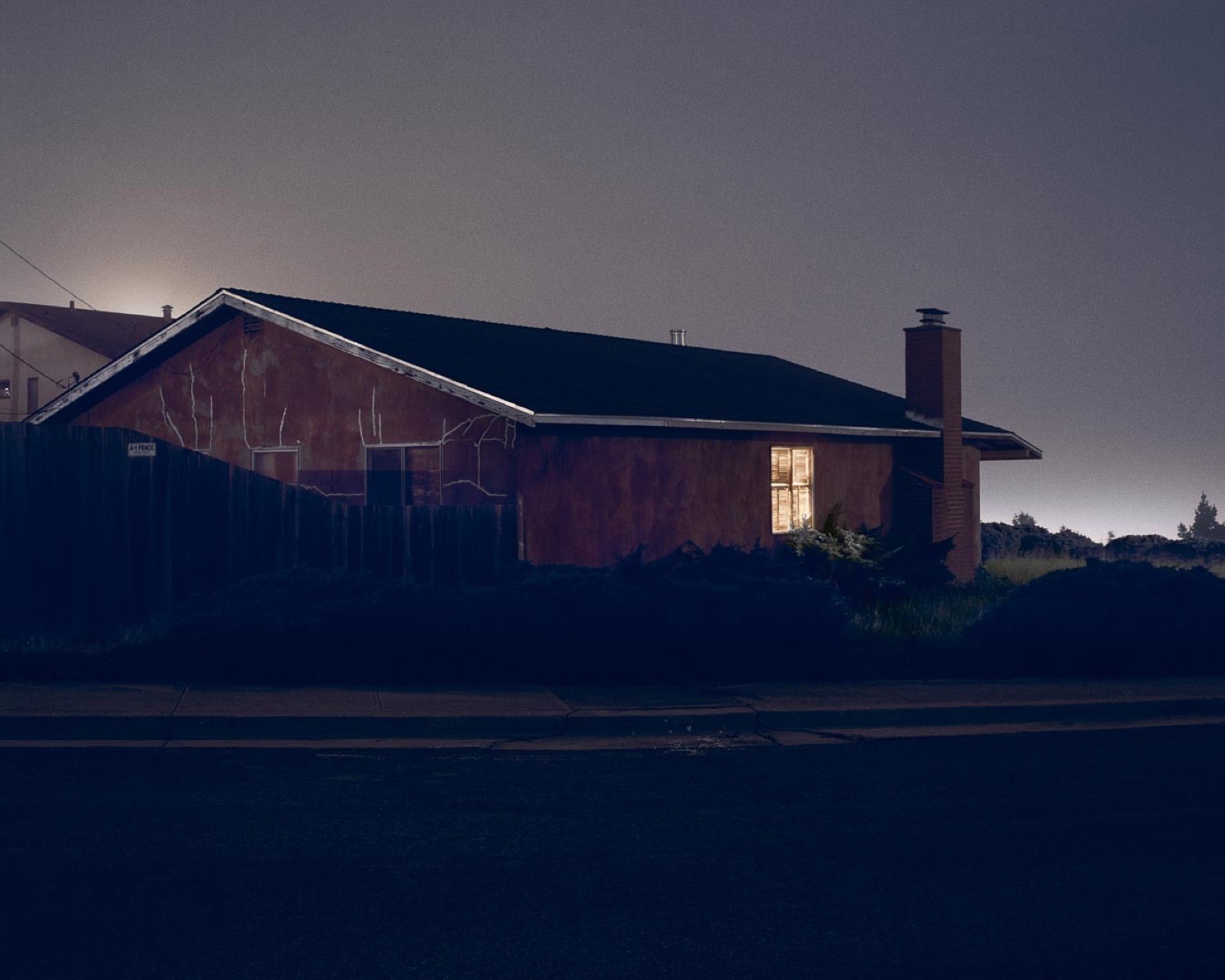
Bolted to the dark fence at the left, a small placard reads A-1 FENCE, the kind of hand-lettered trade sign that outlives the company that made it. Todd Hido photographs the tract house behind it at the hour when a suburb resolves into a few facts: a sloping roofline, stucco walls hairlined with cracks, a brick chimney, and one window burning amber behind slatted blinds. The archival pigment print, mounted on aluminium Dibond, gives the scene a smooth, almost lacquered skin, so that the dwelling reads less as architecture than as a specimen pressed under glass.
Houses like this one, from the Outskirts pictures, were built by the thousand from the same few plans, and the camera treats the type with the patience of an inventory. What individuates it is the light in the single window, the domestic signal that says someone is home without disclosing who. The overgrown shrubs, the neighbour's glow leaking over the fence, the empty road across the foreground: these are the ordinary furnishings of the American night, catalogued rather than dramatised.
Hido has long worked in the grammar of the vernacular snapshot, the drive-by, the surveillance frame, and here that lineage shows. The picture behaves like found evidence, something made while waiting in a parked car. Its melancholy is the melancholy of real estate: a structure meant to promise permanence, rendered as something already half-remembered, its one warm window the last thing left to go dark.

Bolted to the dark fence at the left, a small placard reads A-1 FENCE, the kind of hand-lettered trade sign that outlives the company that made it. Todd Hido photographs the tract house behind it at the hour when a suburb resolves into a few facts: a sloping roofline, stucco walls hairlined with cracks, a brick chimney, and one window burning amber behind slatted blinds. The archival pigment print, mounted on aluminium Dibond, gives the scene a smooth, almost lacquered skin, so that the dwelling reads less as architecture than as a specimen pressed under glass.
Houses like this one, from the Outskirts pictures, were built by the thousand from the same few plans, and the camera treats the type with the patience of an inventory. What individuates it is the light in the single window, the domestic signal that says someone is home without disclosing who. The overgrown shrubs, the neighbour's glow leaking over the fence, the empty road across the foreground: these are the ordinary furnishings of the American night, catalogued rather than dramatised.
Hido has long worked in the grammar of the vernacular snapshot, the drive-by, the surveillance frame, and here that lineage shows. The picture behaves like found evidence, something made while waiting in a parked car. Its melancholy is the melancholy of real estate: a structure meant to promise permanence, rendered as something already half-remembered, its one warm window the last thing left to go dark.