No one is in this picture, and it is careful to keep things that way. Whoever slept in the bed has gone; the pillow still leans where a head arranged it. The window that supplies the light is refused us too; it works from somewhere off to the left. High on the wall, a bent wire marks the spot where a picture once hung. The photograph withholds the sleeper, the window and that other picture, and draws its power from all three absences.
What remains is organized with unusual economy. Two-thirds of the frame goes to the wall, an ochre that deepens to umber in the corner and warms nearly to rose where the light reaches it; the lower third belongs to the sheets, whose creases take the light like a range of low hills. The boundary between them, the mattress edge, runs as level as a horizon. It is a landscape of a domestic kind: weather in the wall’s gradations, terrain in the linen. The color does not describe the room so much as its temperature, which is that of late afternoon, or of a fever breaking.
Todd Hido, born in Kent, Ohio, spent years photographing American houses from the street at night; an interior like this is what those lit windows concealed. SFMOMA, the Getty and the Whitney hold his prints. In this archival pigment print the wall’s warmth stays inside its register, nothing pushed, nothing prettified, the pinks of the linen kept separate from the clay of the wall. The bed is unmade because life is like that. The picture is orderly because art is.
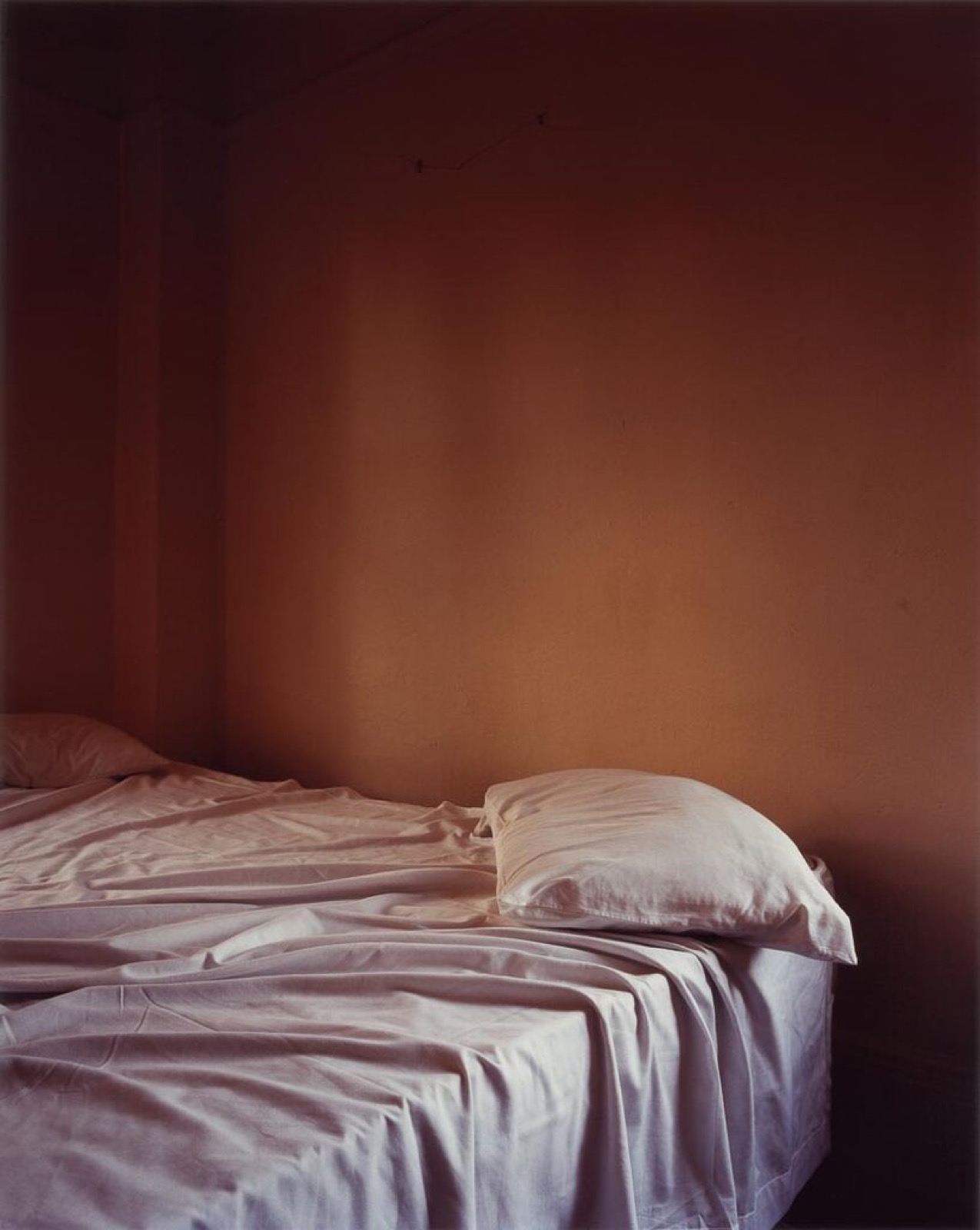

No one is in this picture, and it is careful to keep things that way. Whoever slept in the bed has gone; the pillow still leans where a head arranged it. The window that supplies the light is refused us too; it works from somewhere off to the left. High on the wall, a bent wire marks the spot where a picture once hung. The photograph withholds the sleeper, the window and that other picture, and draws its power from all three absences.
What remains is organized with unusual economy. Two-thirds of the frame goes to the wall, an ochre that deepens to umber in the corner and warms nearly to rose where the light reaches it; the lower third belongs to the sheets, whose creases take the light like a range of low hills. The boundary between them, the mattress edge, runs as level as a horizon. It is a landscape of a domestic kind: weather in the wall’s gradations, terrain in the linen. The color does not describe the room so much as its temperature, which is that of late afternoon, or of a fever breaking.
Todd Hido, born in Kent, Ohio, spent years photographing American houses from the street at night; an interior like this is what those lit windows concealed. SFMOMA, the Getty and the Whitney hold his prints. In this archival pigment print the wall’s warmth stays inside its register, nothing pushed, nothing prettified, the pinks of the linen kept separate from the clay of the wall. The bed is unmade because life is like that. The picture is orderly because art is.