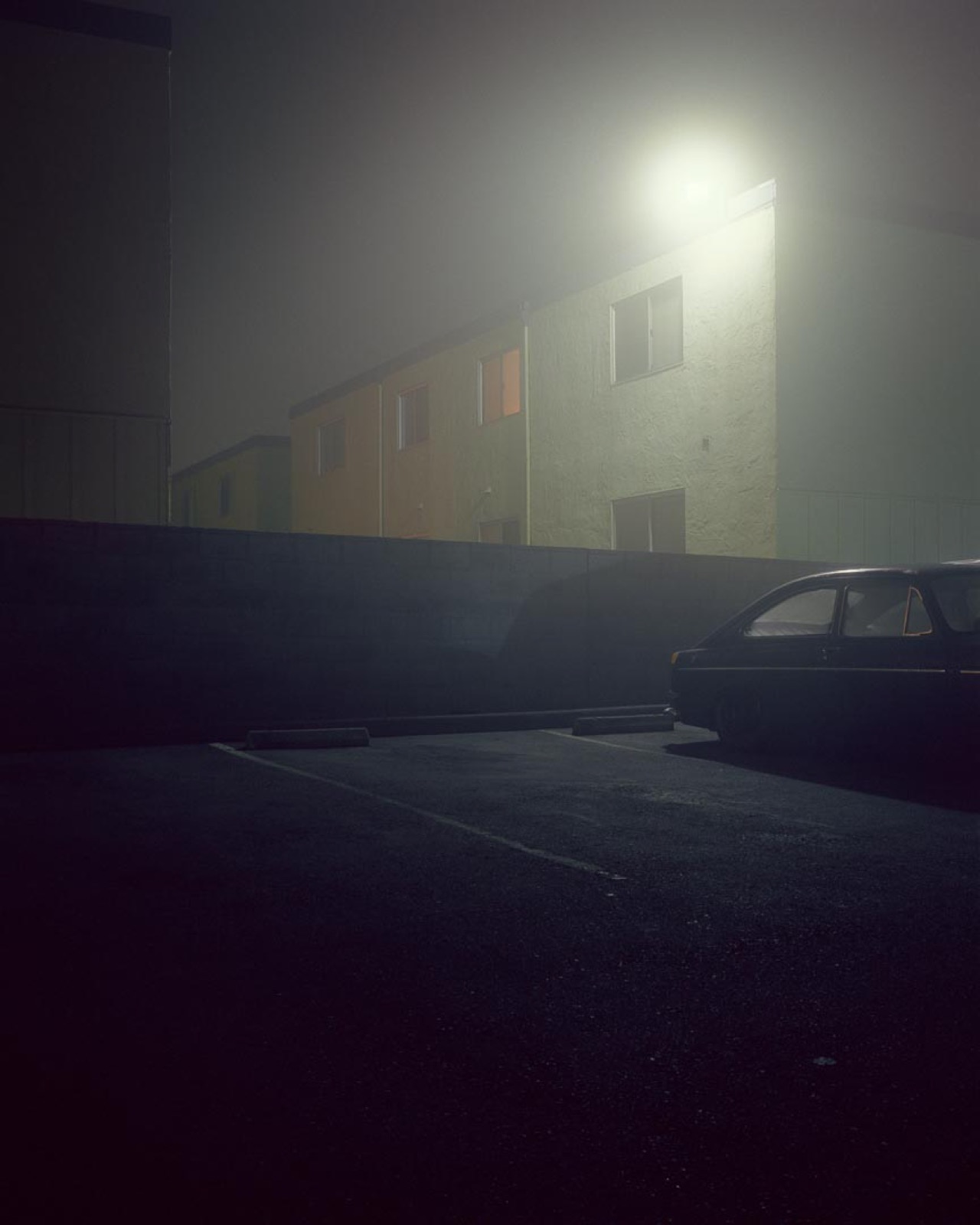
In a parking lot at night, a few paces from a cinderblock wall, we look across painted lines and concrete wheel stops toward an apartment block dissolving in fog. A floodlight at the roofline burns through the mist like a struck match behind tissue. One window, and only one, is lit from within, a rectangle of apricot in all that sea-green vapor. A dark car holds the right edge of the frame, patient as furniture.
The picture belongs to the long tradition of the nocturne, the mode Whistler painted and early photographers pursued through wet city streets, but its setting could not be less rhetorical: stucco, asphalt, block wall. What elevates it is tonal control. From the near-black of the foreground the values climb by measured steps, slate wall, celadon fog, the chalky yellow of the facade, up to the white bloom of the lamp, a full scale held in balance the way a fine print holds it. Fog is the great unifier of tone, and Hido uses it as nineteenth-century photographers used twilight, to simplify the world into planes.
Todd Hido, raised in Kent, Ohio, and long settled in the San Francisco Bay Area, has made the American night his archive, numbering each picture and letting place remain anonymous. His photographs are held by SFMOMA, the J. Paul Getty Museum and the Whitney Museum of American Art. As an archival pigment print, this one preserves what matters most here, the smoothness of those transitions, fog graded as finely as breath on glass, and the single warm window that keeps the scene from surrendering entirely to sleep.

In a parking lot at night, a few paces from a cinderblock wall, we look across painted lines and concrete wheel stops toward an apartment block dissolving in fog. A floodlight at the roofline burns through the mist like a struck match behind tissue. One window, and only one, is lit from within, a rectangle of apricot in all that sea-green vapor. A dark car holds the right edge of the frame, patient as furniture.
The picture belongs to the long tradition of the nocturne, the mode Whistler painted and early photographers pursued through wet city streets, but its setting could not be less rhetorical: stucco, asphalt, block wall. What elevates it is tonal control. From the near-black of the foreground the values climb by measured steps, slate wall, celadon fog, the chalky yellow of the facade, up to the white bloom of the lamp, a full scale held in balance the way a fine print holds it. Fog is the great unifier of tone, and Hido uses it as nineteenth-century photographers used twilight, to simplify the world into planes.
Todd Hido, raised in Kent, Ohio, and long settled in the San Francisco Bay Area, has made the American night his archive, numbering each picture and letting place remain anonymous. His photographs are held by SFMOMA, the J. Paul Getty Museum and the Whitney Museum of American Art. As an archival pigment print, this one preserves what matters most here, the smoothness of those transitions, fog graded as finely as breath on glass, and the single warm window that keeps the scene from surrendering entirely to sleep.