Before it is a scene, a photograph is a surface, and this one insists on the fact. Rain has smeared the car window into a second skin, so the wet road, the leaning pole with its barrel transformer, and the gray field beyond all reach us through a film of moisture that refuses to resolve. The picture is made of two surfaces at once, the glass Hido shot through and the paper it now lives on, and neither lets us forget it is there.
Notice how the wires organize the blur. From a single creosoted pole they fan out in every direction, taut black lines ruled across a sky the color of dishwater, while a receding file of smaller poles marches the road into the mist. The asphalt shines wet, a faint yellow centerline dissolving toward a horizon that has been rubbed away. Nothing is sharp, yet everything is legible, because the photograph records not the landscape but the condition of seeing it, weather and windshield and speed compressed into one exposure.
This is the vernacular gesture Hido has made his own: the drive-by frame, the snapshot logic of shooting from a moving car, raised to the pitch of a devotional object. The image circulates as an archival pigment print, its grays held in the paper with a density that a screen cannot fake, so the fog keeps its weight. His fogged roads and night houses belong to SFMOMA, the Getty and the Whitney, where they read less as places than as moods you drove through once and never quite left.
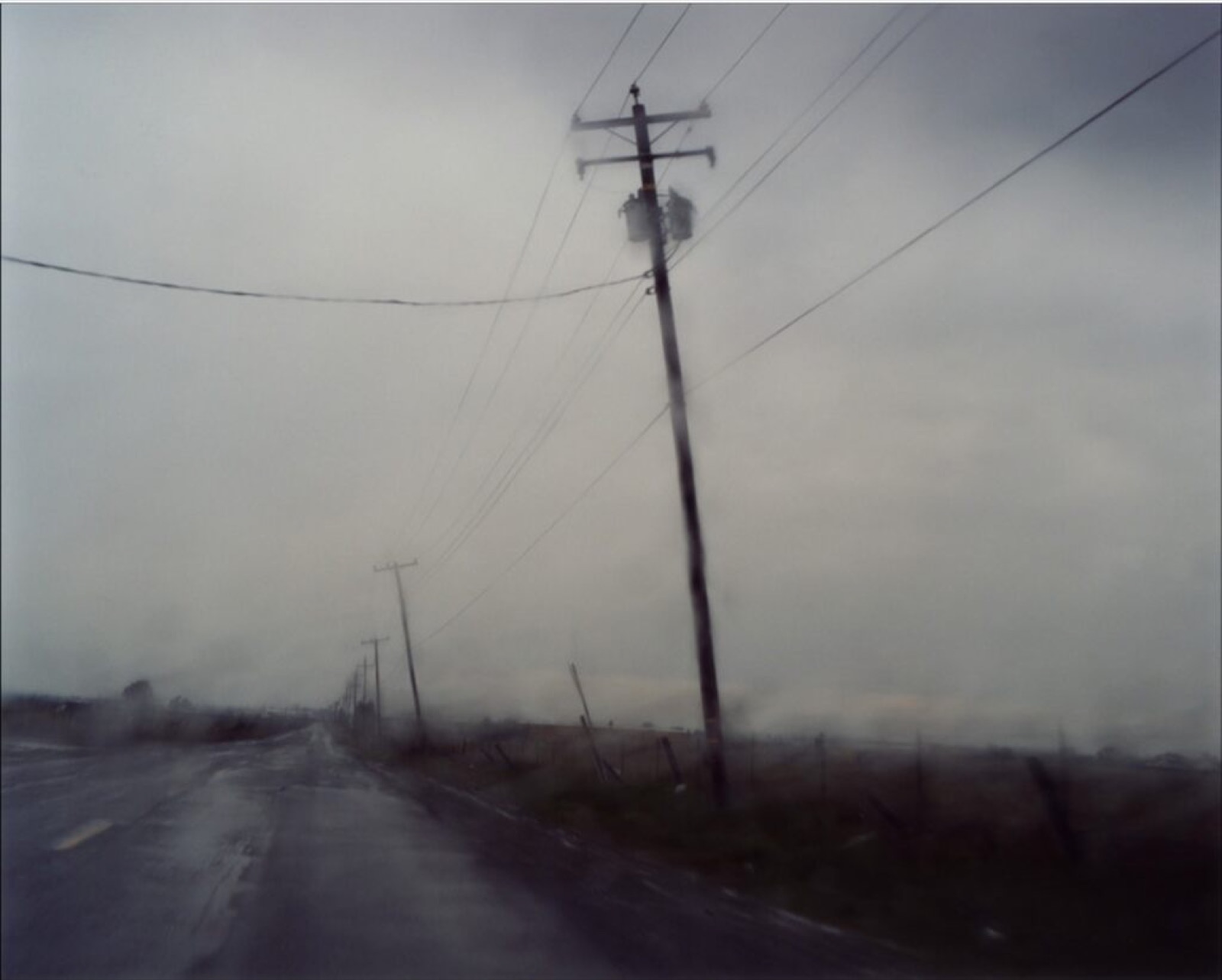

Before it is a scene, a photograph is a surface, and this one insists on the fact. Rain has smeared the car window into a second skin, so the wet road, the leaning pole with its barrel transformer, and the gray field beyond all reach us through a film of moisture that refuses to resolve. The picture is made of two surfaces at once, the glass Hido shot through and the paper it now lives on, and neither lets us forget it is there.
Notice how the wires organize the blur. From a single creosoted pole they fan out in every direction, taut black lines ruled across a sky the color of dishwater, while a receding file of smaller poles marches the road into the mist. The asphalt shines wet, a faint yellow centerline dissolving toward a horizon that has been rubbed away. Nothing is sharp, yet everything is legible, because the photograph records not the landscape but the condition of seeing it, weather and windshield and speed compressed into one exposure.
This is the vernacular gesture Hido has made his own: the drive-by frame, the snapshot logic of shooting from a moving car, raised to the pitch of a devotional object. The image circulates as an archival pigment print, its grays held in the paper with a density that a screen cannot fake, so the fog keeps its weight. His fogged roads and night houses belong to SFMOMA, the Getty and the Whitney, where they read less as places than as moods you drove through once and never quite left.